English
EN


Sri Lanka seemed to have regained its grip after the 30-year civil war. The island attracted tourists again and exported plenty of coffee, rubber and tea. Yet since 2019, the chaos has been complete again, as terrorist attacks, the corona crisis and high energy prices expose the country's vulnerability. The country is now in a deep crisis and the road out of this crisis promises to be difficult. What is going on in Sri Lanka and how did it come to this?
Background
The civil war was the result of a deep-rooted conflict between the Buddhist Sinhalese and the Hindu Tamils. The civil war was terrible for the country, but also for the economy. When the civil war was over in 2009, things seemed to be moving in the right direction again. The country earned a lot from tourists visiting the country. For example,12,6% of national income earned from tourism, compared to 6% in 2002. Also the money that Sri Lankans working abroad to Sri Lanka send was an important source of income.
The country made major investments in infrastructure and went deep into debt in the process. For example, a large port was built with Chinese money. China imposed very unfavourable conditions on the loans, and when Sri Lanka was unable to repay in 2016, the Chinese practically owner of the port. Sri Lanka, which hoped to obtain a status similar to that of Singapore, ended up in a so-called Debt trap and had to take on new debts to pay off old debts.
Although Sri Lanka exports a lot of coffee, rubber, and coconut, other important products must be imported, such as food, oil, and medicines. As a result, the country has been struggling with a trade deficit for years, which should have caused the value of the Rupee, Sri Lanka's currency, to fall. Instead, the exchange rate was kept stable by The Central Bank, which intervenes in that case by exchanging US dollars for rupees.
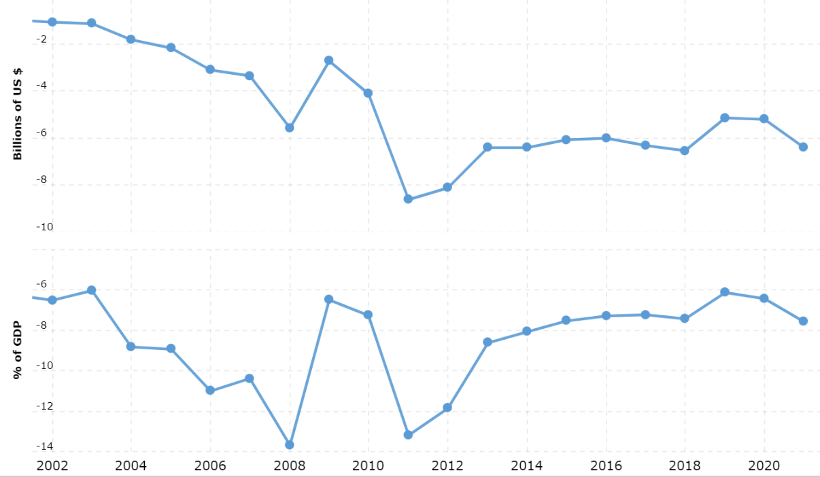
Sri Lanka has been struggling with a trade deficit for years (source; Macro trends)
The Problems
Since 2019, the situation has worsened. Tourism was decimated by terrorist attacks. Subsequently, the world was forced to a standstill in the corona crisis, causing a large part of tourism to disappear. This year, the war in Ukraine was added to the mix, causing energy prices to skyrocket. Vital goods are still bought from abroad, including expensive energy. When these products are purchased, rupees are exchanged for dollars over and over again. When there were almost no foreign currency reserves left in March 2022, the rupee plummeted and since then it has been chaos.
There is skyrocketing inflation and a shortage of all kinds of products that are normally imported. Schools were already unable to hold exams in May due to a shortage of paper, now people are queuing for days for petrol, medicines are difficult to obtain and power is regularly out. There is now even a shortage of rice, while in previous years there was always plenty of production in our own country. Since 2021, farmers have had toProduce completely organically, without the use of artificial fertilizer. This caused the harvest to partially fail, with disastrous consequences for the country.
In order to keep taxes low, the central bank has also printed extra money in recent years. With more money in the economy, but with a limited supply of goods and a falling rupee, inflation rates began to skyrocket in 2021. It was only when inflation rates reached 60% that considered quitting with printing money.
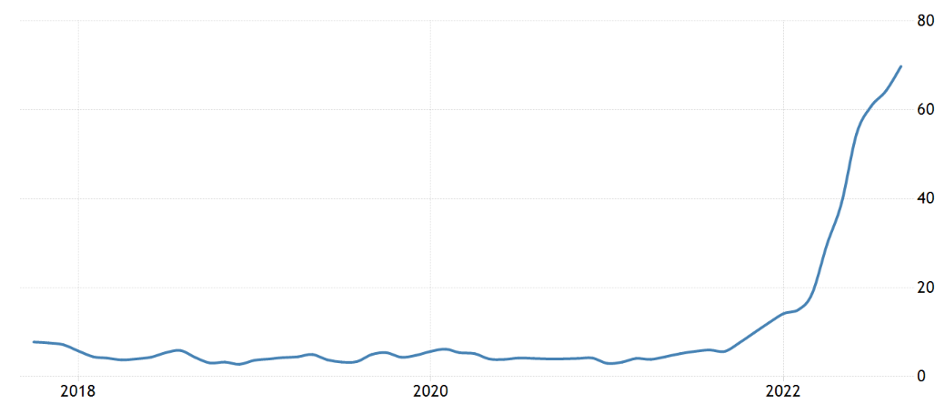
Sri Lanka's inflation rates since 2018 (source; tradingeconomics)
Sri Lanka was able to not paying the interest on the national debt. There are now talks with creditors about debt restructuring. Talks are also now underway with the IMF, but their Support package doesn't seem to be available until December. The World Bank was also considering financial support, but would only commit to it if prudent economic policies were pursued.
Elastic money system
These practices often make proponents of the gold standard long for a more entrenched currency. This could be in the form of a gold standard, but also based on silver, or raw materials.
Under a classical gold standard, the situation in Sri Lanka would have turned out very differently. In the event that a country structurally imports more than it exports, a corrective mechanism occurs under this gold standard. In that case, the central bank's main task is to make the money supply coincide with the amount of gold in the country. When gold flows out of the country, the central bank reduces the money supply. Gold is becoming scarcer, but because the price of gold is constant, this can only manifest itself in a decrease in the price level. Products from Sri Lanka will become cheaper for other countries, making export more attractive again.
In addition, a gold standard also inhibits the growth of credit, since one must always be able to exchange money for gold. Strong credit growth undermines this convertibility. Sri Lanka has now entered a so-called Debt trap which makes the situation even more desperate. The current elastic money system has made almost unlimited credit creation the order of the day. Money can easily be created, with the result that both private and public debt has increased sharply. A system with a currency anchor makes the system inelastic, resulting in more even growth.
In addition, money printing has also only worsened the situation and fueled massive inflation. In the case of a gold standard, the money supply depends on the amount of gold in a country and no money can be printed if it does not go hand in hand with a growth in the amount of gold.
The situation in Sri Lanka shows how people can bear the brunt of mismanagement. It is to be hoped that the thread can be picked up again now that the IMF is on board. The fact remains, however, that some of the problems have been made possible by making the monetary system so elastic. In addition to Sri Lanka ,Pakistan and Nepal are in similar trouble. It will be interesting to see if Sri Lanka is a stand-alone problem, or if it is just the first domino to fall.
 Have a look at us YouTube channel
On behalf of Holland Gold, Paul Buitink and Joris Beemsterboer interview various economists and experts in the field of macroeconomics. The aim of the podcast is to provide the viewer with a better picture and guidance in an increasingly rapidly changing macroeconomic and monetary landscape. Click here to subscribe.