9.3
8.887 reviews

English
EN


Venezuela has been selling gold again in the past month to support the economy. According to Bloomberg the central bank sold about 9 tons of gold to Iran, good for a market value of about $500 million. In exchange for the gold, Iran provided parts that Venezuela could use to repair oil refineries. Iran also sent technical personnel to install parts and scale up refinery production.
The two countries, both of which have been hit by U.S. sanctions, are trying to help each other during these difficult times. Gold has proven to be an extremely effective medium of exchange for this. Due to the economic crisis, Venezuela has already had to sell a lot of gold in recent years. This is proving to be no easy task, as the United States has imposed sanctions on transactions of dollars and gold. Yet there are still plenty of countries that did accept Venezuela's gold, such as Russia, Turkey and the United Arab Emirates. Iran is also willing to accept gold in exchange for goods.
Venezuela is grappling with a deep economic crisis due to poor economic policies and a sharp drop in the price of oil. In recent years, the domestic currency has become completely worthless, causing the country to use more and more euros and dollars in payment transactions. Due to the loss of oil revenues, the country is eating into its reserves. In addition to gold, Venezuela has also had to draw on its foreign exchange reserves. According to Bloomberg, the country has only $6.3 billion in reserves in strong currencies, which means that the country can import few goods.
To save as many reserves as possible, Venezuela wants to restore the production of oil refineries, so that the country can produce enough fuels itself. To this end, Maduro's government has called in the expertise of ally Iran. Both countries are weighed down by US sanctions and are therefore looking to each other for support. For Iran, this deal generates revenue, while Venezuela becomes less dependent on imported fuels.

Venezuela's foreign exchange reserves (Source: Bloomberg)
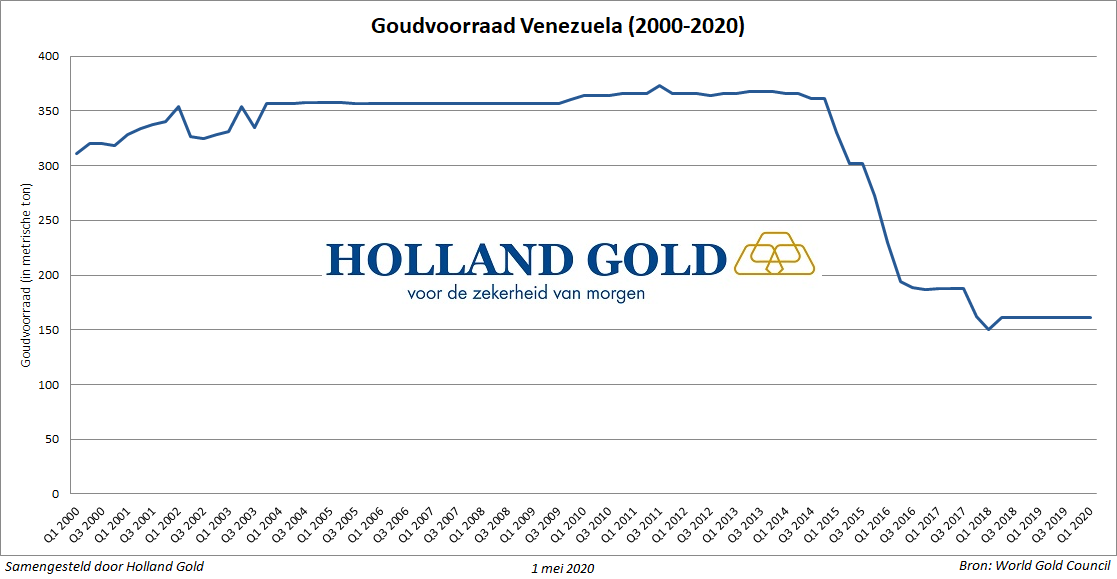
Venezuela has already sold a lot of gold
The Iranian airline Mahan Air already operated a number of flights last week to bring parts to Venezuela and to pick up gold. The precious metal turns out to be a valuable reserve, as it is not subject to economic sanctions. Unlike foreign exchange reserves, central banks can always dispose of their gold reserves, provided that it is stored domestically. That is why more and more central banks are returning (part of) their gold to their own country.
Venezuela knows from its own experience that it is risky to store gold in another country. At the end of 2018, the central bank tried to take some of its gold stock stored in London Retrievable, but that request was rejected by the Bank of England refused. Due to the US sanctions, the Bank of England did not want to release the gold. In doing so, she would be aiding Maduro's government and thus acting against the interests of the United States.
This week Tried Venezuela to release gold again at the Bank of England. The country wants to sell some of its stock and send the proceeds to the United Nations. It looks like a charm offensive to ease the sanctions and still release some of the blocked gold. Venezuela still has about $1.7 billion in gold in London.
Also Read:


