English
EN


The market of virtual currencies and so-called initial coin offerings (ICOs) is like a financial pyramid scheme that can collapse at any time. This was said by Deputy Governor of the Russian Central Bank Dmitry Skobelkin at a meeting for bankers in Sochi.
"China does not recognize virtual currencies as a means of payment and prohibits the issuance of new virtual coins. Our view on this is absolutely similar, because in our opinion it is a kind of financial pyramid scheme that can collapse at any time."
Various governments and central banks are struggling with the popularity of virtual currencies. In some countries, strict regulation is being pursued, while in others the authorities want to ban the use of this technology. In China, it has recently become forbidden to raise money with the issuance of new virtual currencies (ICOs), but in Russia people seem to be taking the path of legalization and regulation. The Russian Minister of Finance, Anton Siluanov, recently promised that there will be a bill on the regulation of virtual currencies later this year. Interest in virtual currencies has also increased sharply in Russia following the meeting between President Putin and the founder of Ethereum, the second most popular virtual currency after Bitcoin.
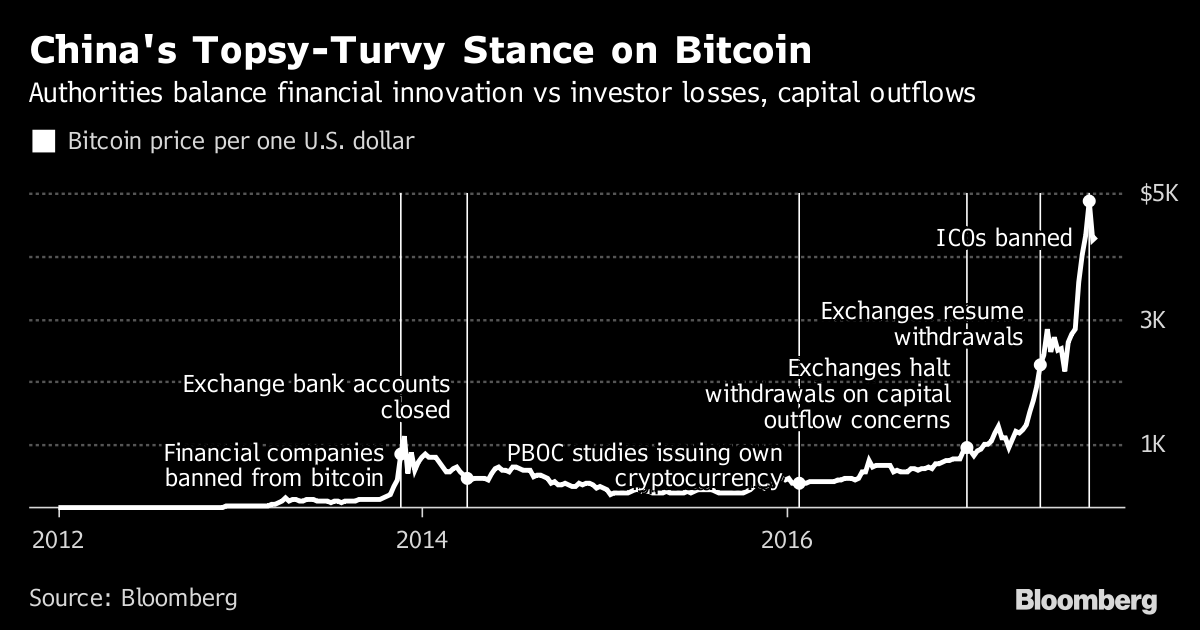
Bitcoin down after banning ICOs in China (Source: Bloomberg)
Since the beginning of this year, more than $1.25 billion has been raised worldwide through the issuance of new virtual currencies, the so-called initial coin offerings (ICOs). Regulators want to regulate this market, because in this way the virtual currencies are used as a kind of stock. Before a new stock can be put on the market, a company must meet several requirements, but in the world of virtual currencies there is no control whatsoever that participants' money is actually used for its intended purpose.