9.3
9.038 reviews

English
EN


In the first quarter of this year, total private households werelarger than the 2008 peak, just before the outbreak of the global credit crisis. Lending has risen sharply in recent years due to the combination of extremely low interest rates and improved consumer confidence.
Total private debt is therefore the same as nine years ago, but the composition of that debt has changed over the years. Student loans and car loans are particularly popular, while the demand for mortgages has only picked up a bit in the last three years. Whereas in 2008 73% of all private debt consisted of mortgages, now it is about 68%. The share of student loans, on the other hand, rose from 5% to 9% of the total during the same period, while car loans went from 6% to about 9%.
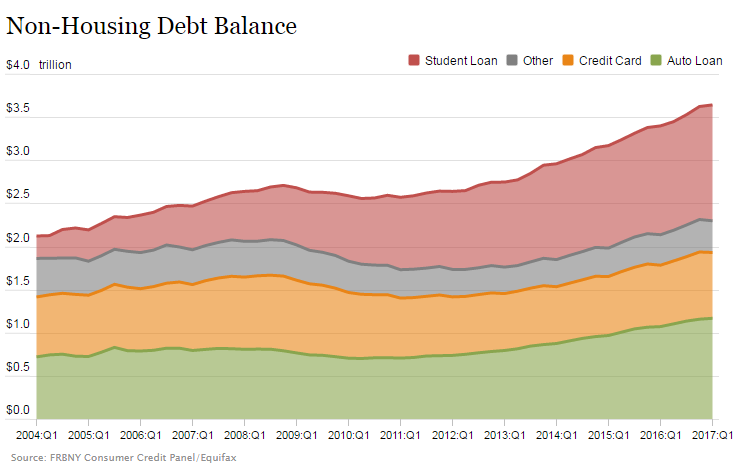
Sharp increase in student debt and car loans (Source: New York Fed)
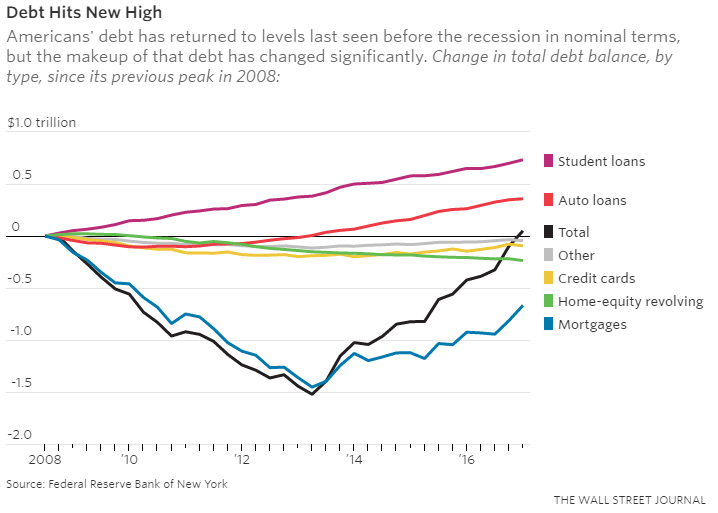
Private debt is higher than before the crisis (Graph via Wall Street Journal)
Total private debt has returned to pre-crisis levels at more than $12 trillion, but that does not yet include the effect of population growth and inflation. Adjusted for these factors, total private debt is currently still slightly lower than just before the credit crisis. According to economist Donghoon Lee of the New York Fed, there is no cause for concern.
Due to the increase in total debt, it seems as if the economy is doing well again. But while the official unemployment rate is falling, the Participation in the U.S. labor market is very low. As a result, unemployment in reality much higher than the government's figures would lead you to believe. Also striking is the Extremely low turnover rate of the money, which means that many Americans are still tightening their purse strings.
Another worrisome sign is the high student loan default rate, which has been above 11% for years. Americans may be accumulating cheap student debt to pay off relatively expensive credit card debt, because the percentage of non-payments on credit card debt is actually showing a downward trend.
Credit growth seems to be putting the US economy back on track, but let's not forget that much of this growth is not delivering any additional productivity. It seems only a matter of time before another crisis erupts. Especially if we return from an extremely low interest rate of almost zero percent to the historical average of 4 to 5 percent. The Federal Reserve will therefore be very cautious about raising interest rates.