English
EN


By: Wouter Wilmer
Norway, the country is known for its idyllic landscapes, tasty fish and high prices. From a political point of view, the country is also interesting, as it is not a member of the EU. As a result, the question is; how does monetary policy differ from that of the European Central Bank?
Norway has chosen not to become a member of the EU, just like Switzerland, for example. Unlike the Swiss, the Norwegians did choose to join the European Economic Area, the EEA. This means that Norway has access to the internal market and that there is also free movement of goods, services and people, but that there is no membership of the EU. Therefore, from a monetary point of view, Norway is not subject to the supervision of the ECB. Norway retained its own central bank, the Norges Bank, with its own currency, the Norwegian Krone. This can have certain advantages.
The Norwegian Krone is an interesting currency. Since Norway exports a lot of raw materials, there is a relatively high correlation between the exchange rate of the Krona and the price of certain commodities. For example, the price of the Krona often rises when the price of oil or gas rises, but the price falls when energy prices fall. As a result, the Norwegian Krone is not so much a safe haven, but it is a solid currency because of the strength of the Norwegian economy. However, it should be mentioned that the currency is also a risk in turbulent times. For example, the share price fell sharply at the start of the corona crisis, as investors started looking for safe investments.
Nevertheless, the prospects for the Norwegian krone remain good, especially now that Norway has given Europe the alternative to Russian gas offers what Europeans are so hastily looking for. The Norwegian economy has also been hit less hard by the corona crisis than other European countries, because it had introduced a less strict lockdown. Now that the economy is booming after the crisis and there is a threat of increasingly higher inflation due to the war in Ukraine, Norges Bank is raising interest rates continual. While interest rates were still at 0% in the summer of 2021, interest rates have been rising in steps since then and the Norwegian central bank already set interest rates at 1.75% in August 2022. Nevertheless, inflation is still high.
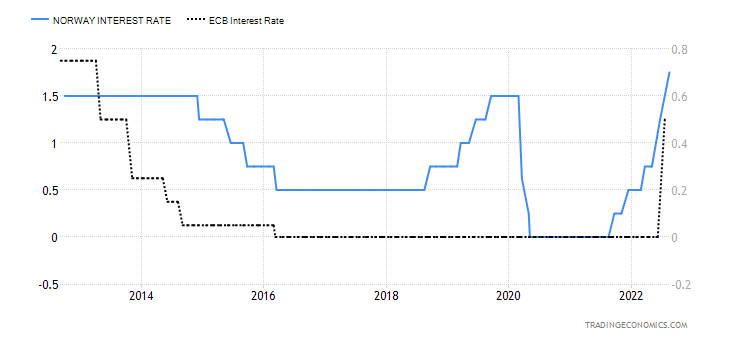
Policy rate Norges Bank vs European Central Bank (Source: Tradingview)
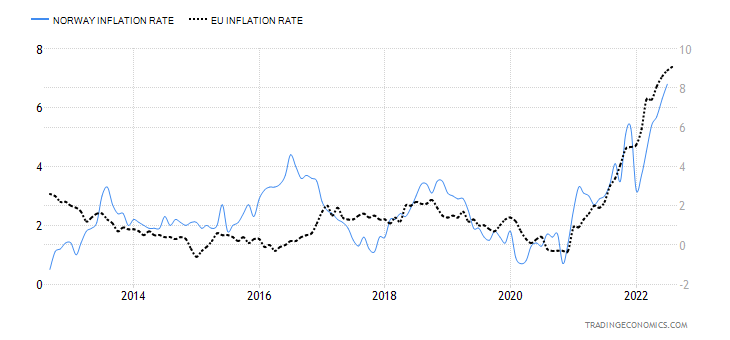
Inflation Norway vs Eurozone (Source: Tradingview)
In July 2022, inflation in Norway was 6.8% year-on-year, compared to 8.9% in the euro area. That is why, according to ING economist James Smith, the next interest rate hike could already be on the horizon, as he recently said in the Flemish daily De Tijd. ABN Amro is also convinced of new interest rate hikes, according to a New publication from FX Weekly. Norway therefore seems to be based on a different footing than the eurozone. Because of the excessive debt burden of southern Europe, the ECB still has a very difficult time implementing interest rate hikes and it seems that the ECB is the having to make a choice between a major recession or high inflation. The ECB has also been buying government bonds for years, while the Norwegians have never engaged in quantitative easing.
In addition to monetary policy, Norges Bank has another task. Since the discovery of oil in the North Sea in 1969, an enormous amount of oil has been exported. The income from these exports often went to a fund managed by the Norwegian central bank; the Oil Fund. Because of all the oil that has been sold since then, there is now just under 1200 billion euros in the fund. It would be enough to pay each resident an amount of more than 200,000 euros, if they all sold their investments. The money is now mainly in foreign companies. The Norwegians now have a stake in more than 9,300 companies, according to the read on the Norges Bank website.
Since I am studying at the Norwegian University in Kristiansand for a semester, I thought it would be interesting to ask one of my lecturers about the fund, such as Associate Professor Stina Torjesen, who teaches international political economy, among other things. She says that the sovereign wealth fund deliberately invests the money earned from oil exports abroad to prevent the fund from having a negative effect on the Norwegian economy: "The money is invested abroad, because we have seen in the Netherlands, for example, that an economy can be damaged if such amounts are invested in our own country."
"For a long time, the Netherlands invested the money generated by gas extraction in infrastructure and social security. The result of this policy is that the exchange rate of the domestic currency rises sharply and that other sectors that depend on exports suffer as a result of the price increase. It is called the Dutch disease. Each year, therefore, only a certain percentage of the proceeds may be used by the government.", Torjesen explains. "Only 3% of the return from the Norwegian sovereign wealth fund can be used by the government and politicians are very cautious about breaking that rule. If inflation really does skyrocket, the fund could possibly be used. For now, there is only compensation for the electricity bill and the government only supports the lower income classes."
Inflation is therefore worrying, but for the time being the bank is mainly using the policy rate to combat inflation. The inflation figures in Norway are not as dire as in the Netherlands, but there has not been such high inflation in Norway since 1988. That is why Norges Bank, like all other central banks, is closely following developments. It will be very interesting to see how inflation rates develop in Norway and how they will differ from other European countries.
Photo above article is taken from the Norges Bank and can be used royalty-free under the Creative Commons 2.0 license