English
EN


Sharp swings in equity markets are also affecting precious metals. What will it take for gold and silver prices to recover? And what can we learn from the uncertainty surrounding AI and technology stocks? Meanwhile, trading activity at Holland Gold has surged. Many long-term investors have bought the dip, while others have cut their losses. How can investors keep a cool head amid the volatility?
Nvidia, the world's largest chipmaker and the poster child of the AI boom, removed CEO Jensen Huang earlier this month following revelations about an affair with a subordinate and a relationship with an alleged Chinese spy. On Monday, the board unexpectedly reinstated him following intervention by President Trump.
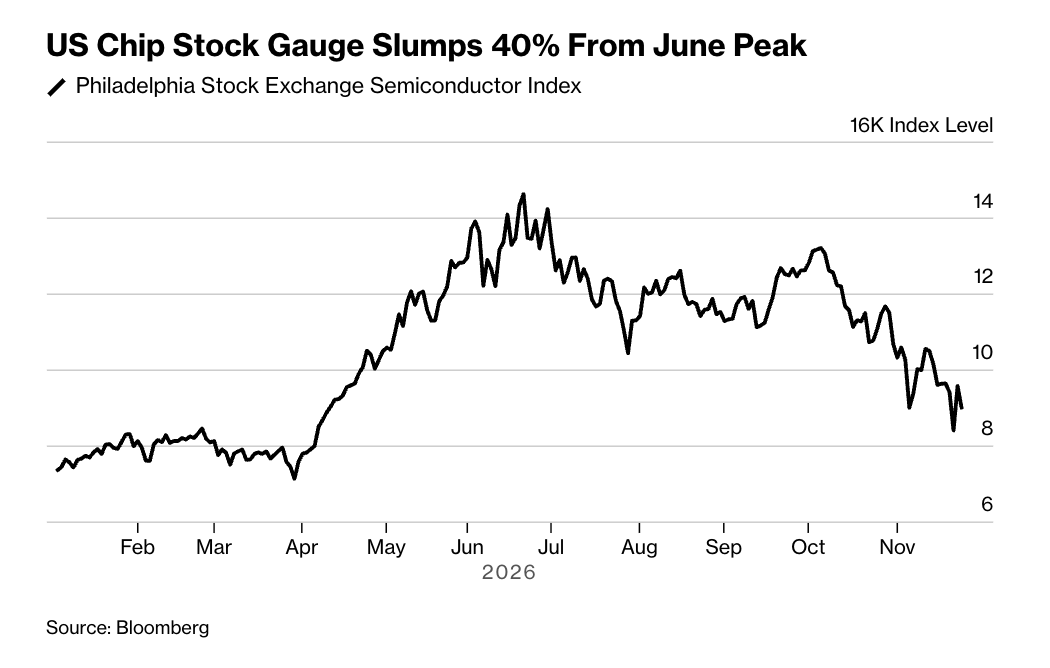 The US semiconductor index is around 40% below its June peak, reflecting deteriorating sentiment towards technology and AI stocks. Source: Bloomberg.
These are extraordinary price swings. Gold typically moves by around 1% a day, and even for silver, a 7% move is substantial. When silver rose by more than 7% in May, it marked its biggest daily gain in months.
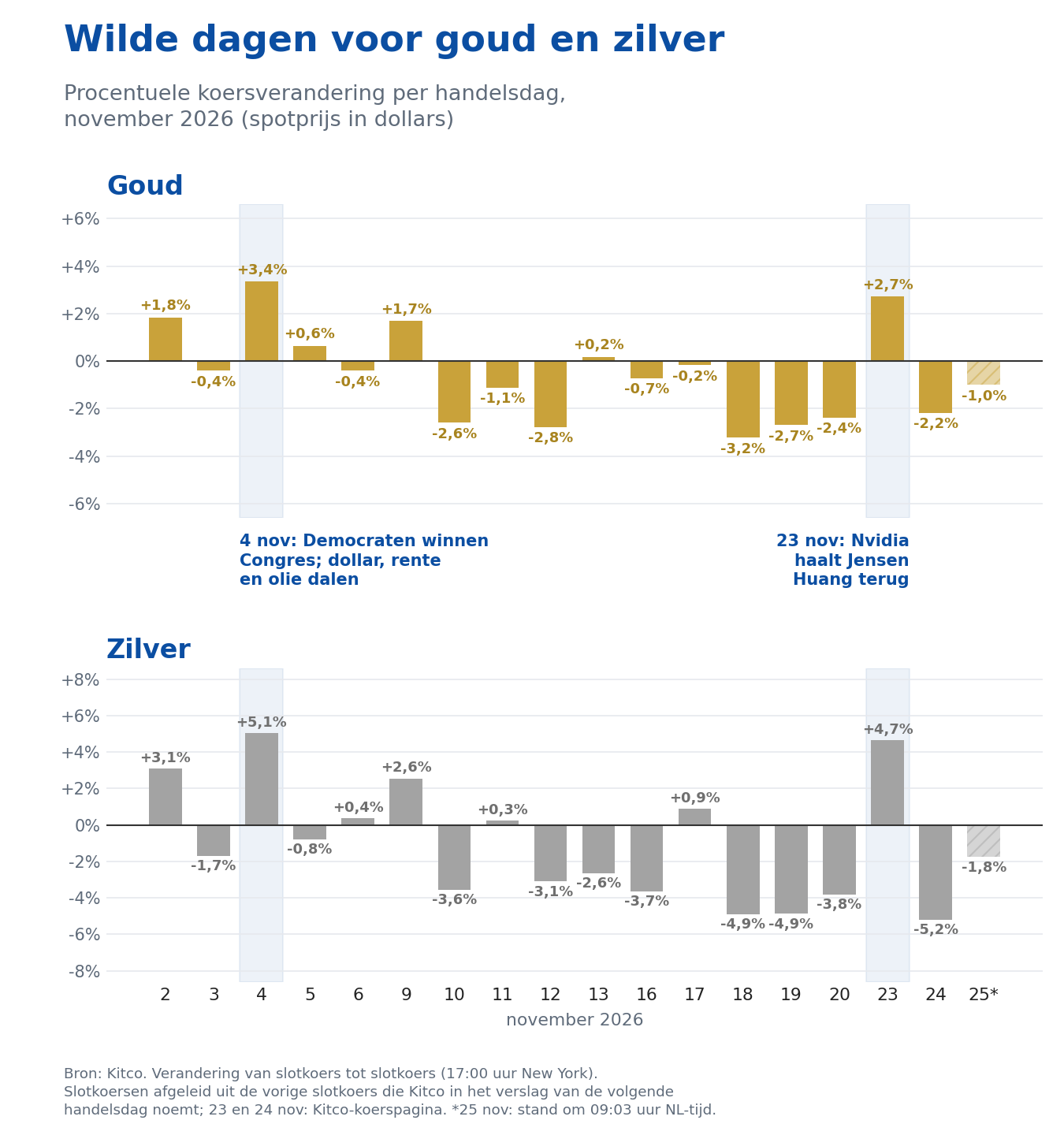 Daily percentage changes in gold and silver prices in November (in US dollars). Intraday gains on Monday were even larger, reaching 4.3% for gold and nearly 8% for silver. Source: Kitco.
Precious metals also tend to move independently of equities. So why are they falling together now? Investors who buy shares with borrowed money must provide additional collateral when prices fall. This is known as a margin call. When that happens, investors sell whatever they can most easily liquidate. On Friday, we referred to this as fast money. Bloomberg columnist John Stepek describes it as 'sell what you can'. In other words, investors do not necessarily sell what they want to sell, but what they can sell. Gold thus becomes a victim of its own liquidity. When that selling pressure eased on Monday, gold rebounded alongside equities.
November has demonstrated just how sensitive gold is to interest rates. On 4 November, gold rose 3.4% as the dollar, US Treasury yields and oil prices fell following the Democrats' election victory. The picture subsequently reversed. Higher-than-expected inflation, rising bond yields and hawkish Fed minutes triggered daily losses of between 2.5% and 3.5%, while turmoil in AI stocks added to the selling pressure.
The most important signal comes from the Federal Reserve, the US central bank. Traders are pricing in around a 95% probability of a rate hike on 9 December. This affects gold through real interest rates. These are interest rates adjusted for inflation, reflecting the return investors actually earn on bonds. The higher real rates rise, the less attractive gold becomes, as the metal pays no interest. The US 10-year real yield has risen from 1.8% to approximately 2.9% over the past year. Only when the Fed changes course could this headwind turn into a tailwind. JPMorgan expects the Fed to pause its rate hikes from early 2027 and partly for that reason forecasts gold at $4,500 by the end of 2027.
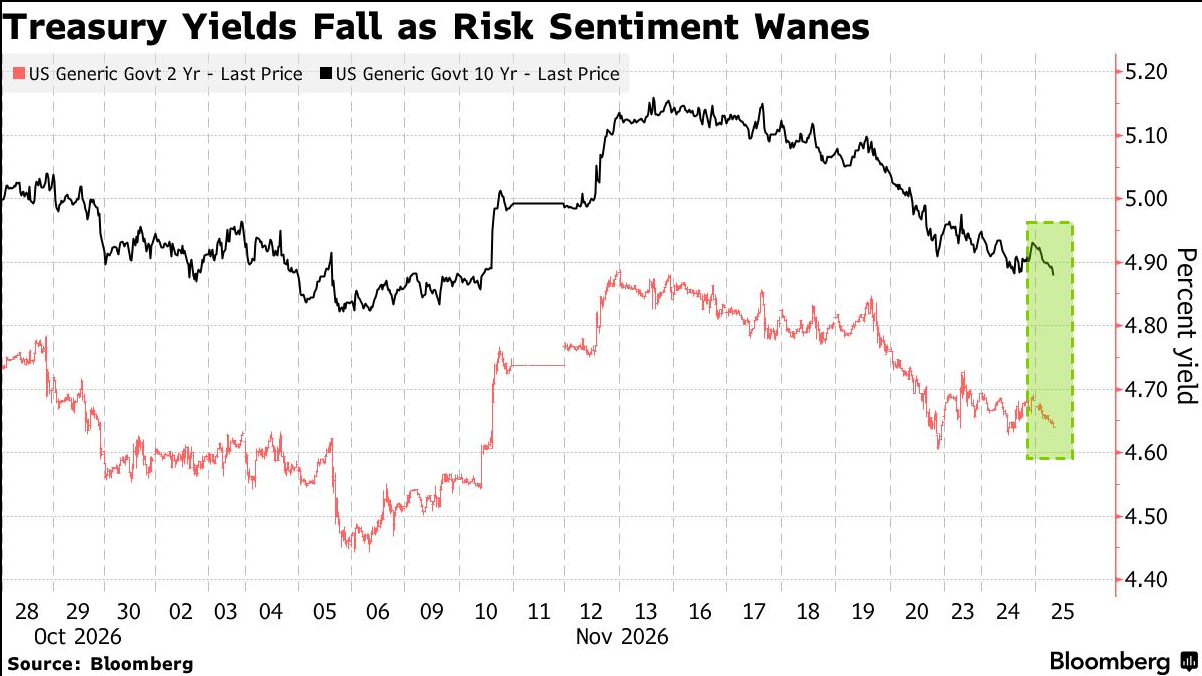 US Treasury yields are falling as investors seek safety in government bonds while technology stocks drag equity markets lower. This could also push real yields down, although the effect on gold is not yet apparent. Source: Bloomberg.
For that to happen, inflation needs to ease. So far, there is little sign of that. PCE inflation, the Federal Reserve's preferred inflation measure, came in at 3.8% year on year on Wednesday, in line with expectations. Core inflation, which excludes food and energy, rose to 3.3%, slightly above forecasts. Meanwhile, the US economy grew at an annualised rate of 4.3% in the third quarter. This reinforces expectations that the Fed will raise interest rates in December.
President Trump's new import tariffs could also keep inflation elevated. On Wednesday, the US announced new tariffs targeting China, the EU and twelve other economies. China faces a 20% tariff, which could double to 40% if trade negotiations fail. The proposed tariff on EU goods is 15%, potentially rising to 20%. The measures replace tariffs that the US Supreme Court ruled unconstitutional in February. A final decision could come as early as January. Inflation is also influenced by oil prices and remains sensitive to developments in the Strait of Hormuz, where, according to Iran, tankers have again struck naval mines.
Trading in paper gold and silver also plays a significant role in price movements. According to UBS, the selling was concentrated in the futures market. Gold contracts are traded there, often using borrowed funds, without any physical bullion changing hands. Margin calls can also occur in these markets, just as they do with equities. They can trigger forced selling and amplify price declines.
Gold price swings are becoming increasingly pronounced. The Cboe gold volatility index, which measures how much investors expect gold prices to fluctuate over the coming month, rose last week to its highest level in seven months.
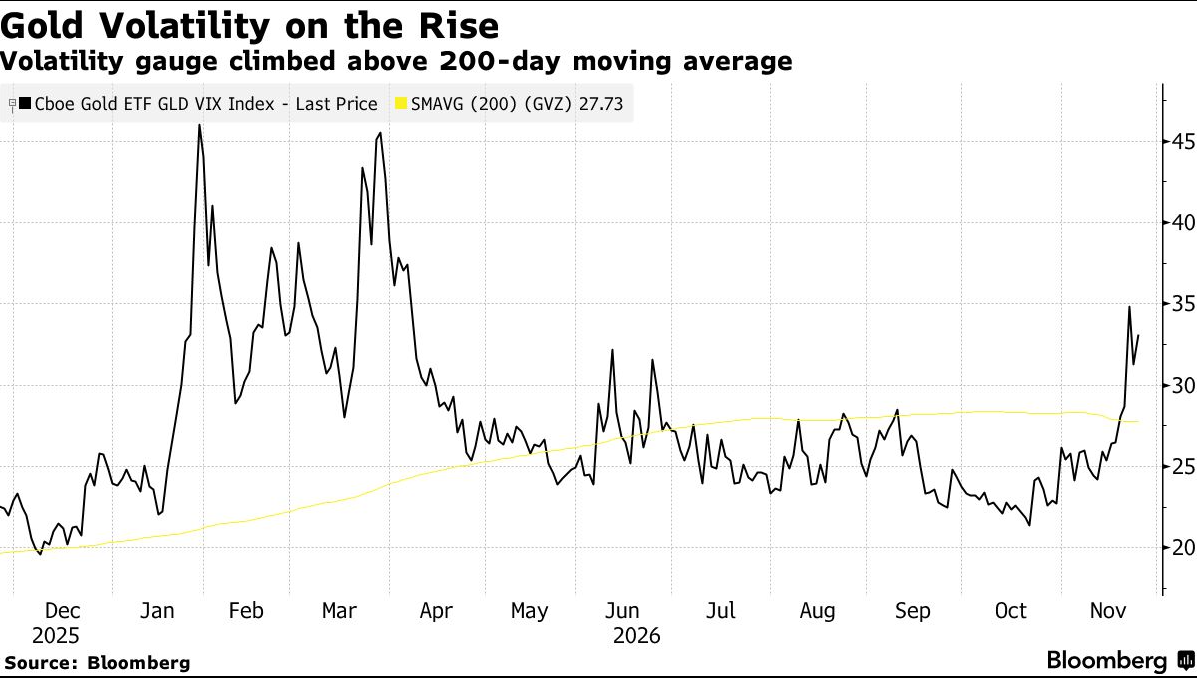 The gold volatility index reached its highest level in seven months last week. Source: Bloomberg.
Many Holland Gold customers bought the dip, while gold shops in China were packed. Central banks, meanwhile, tend to buy even more when prices fall. There is clearly plenty of dip-buying, although nobody can say exactly where the bottom lies.
Analysts are now focusing on $3,500 per troy ounce as a key support level for gold. Pepperstone describes it as a crucial level, while Britannia Bullion warns that a sustained move below it would be a warning sign. On Wednesday, gold fell below $3,500. For silver, $40 per troy ounce is the level being watched by CPM Group. Silver also fell below that threshold on Wednesday.
Some investors wait for gold or silver to fall below a particular price level before buying. Others prefer to wait until the decline has ended and prices begin to stabilise. They see this as a sign that a firmer bottom has formed. In the Holland Gold app or on our gold price page, you can easily set a price alert at a chosen level and receive a notification as soon as the price reaches it.
Investors who buy physical gold or silver often do so with a long-term perspective. Spreading purchases over time is consistent with that approach: investing a fixed amount in gold or silver every month. This strategy is known as dollar-cost averaging (DCA). When prices fall, the same amount of money buys more gold, reducing your dependence on a single entry point. Our colleague Victor Maesen explains this in Buying Gold in a Turbulent Market. At Holland Gold, you can put this approach into practice with a savings plan, investing a fixed amount at regular intervals.
Bitcoin, often described as 'digital gold', has fared even worse. US Bitcoin funds saw nearly $5 billion in outflows in November, their largest monthly outflow since launching in 2024. Bitcoin fell below $60,000 and was heading for its worst month since June 2022. According to Glassnode, investors are currently using every rebound as an opportunity to sell.
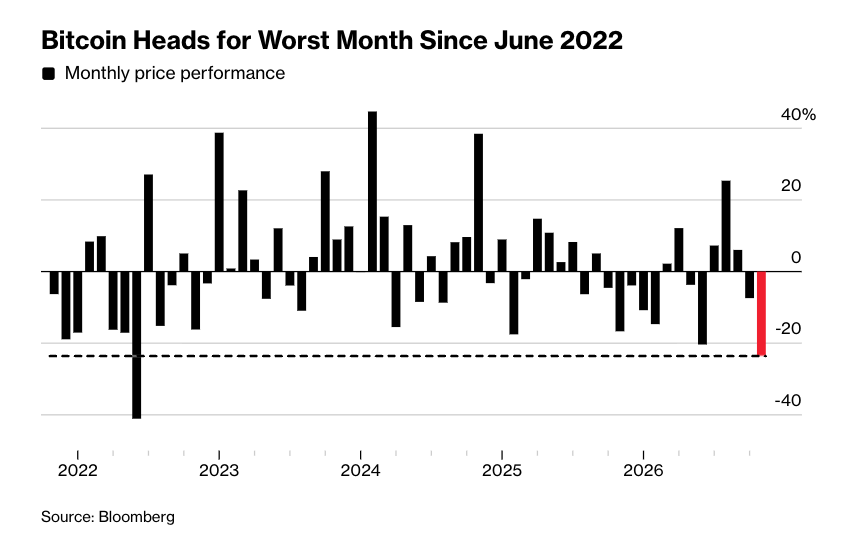 Bitcoin is heading for its worst month since June 2022 (monthly returns). Source: Bloomberg.
China has already imported $209 billion worth of gold this year, a record amount representing almost 8% of the country's total imports. Gold counts towards imports and therefore reduces the reported trade surplus, which is the difference between exports and imports. Without gold, China's trade surplus would have exceeded $1 trillion as early as September.
Chinese households are increasingly turning to gold as property proves disappointing as a store of wealth. Jewellery now accounts for less than a third of Chinese demand for the precious metal.
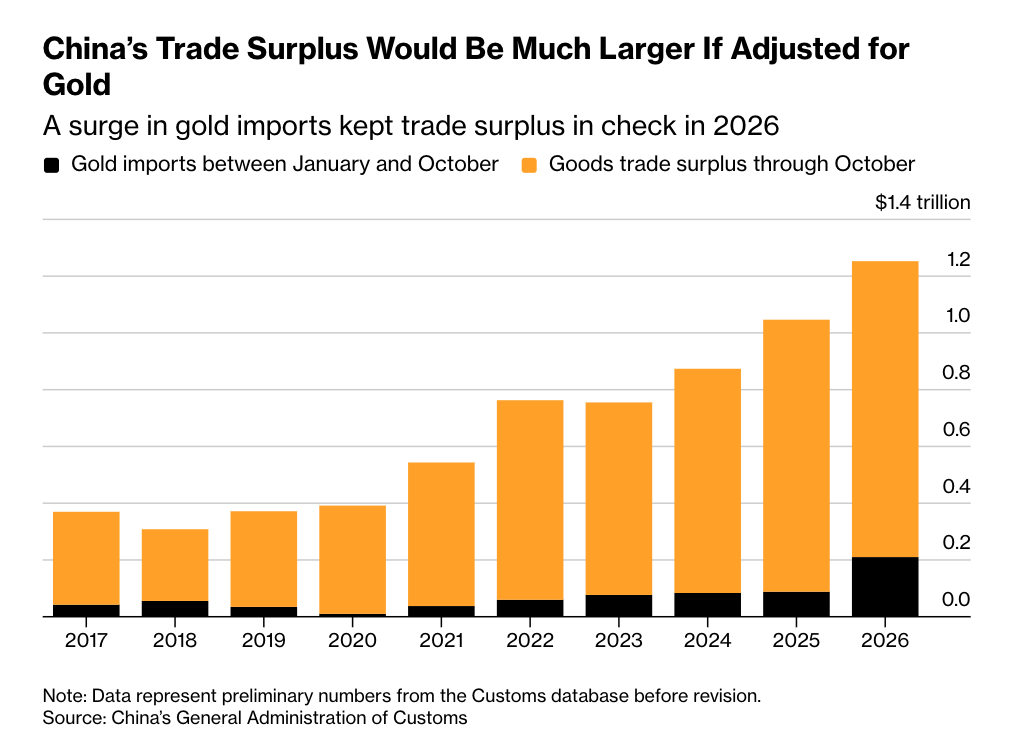 Without gold imports (shown in black), China's trade surplus would be considerably larger. Source: Bloomberg, based on Chinese customs data.
This week has highlighted two types of investor. One sells whenever equity markets suffer a sharp fall, including selling gold. The other buys more when prices decline, from Chinese households and central banks to many Holland Gold customers. They view physical gold as a way to diversify their investments and as an asset whose value does not depend on a technology company's profits or a boardroom decision.
Physical ownership offers another form of protection. On Tuesday, De Nederlandsche Bank (DNB), the Dutch central bank, warned of the risk of a major, prolonged systems outage. 'Not code red, but a very dark orange,' said DNB President Olaf Sleijpen. AI-powered cyberattacks could disrupt banks for days. DNB recommends keeping enough cash at home to cover at least three days of essential expenses. It also considers dependence on a handful of technology companies a risk: Dutch pension funds, for example, have invested approximately €120 billion in US technology stocks. Gold may not function as a means of payment in the same way as cash, but a gold bar or coin you own outright is your property and under your control. That is different from a balance recorded digitally by a bank. Even when you store your bars and coins with Holland Gold, they remain your property. Prices may fluctuate, but the precious metals you own remain yours.