English
EN


Our monetary system has grown increasingly skewed in recent decades due to a monetary policy that is far too loose. That is why it would be desirable for our monetary system to be more anchored. This is what Lex Hoogduin, former director of the Dutch Central Bank, says in a Conversation at Holland Gold. He believes that central banks have pursued far too loose a monetary policy in recent decades. This has resulted in all kinds of financial bubbles.
According to Hoogduin, central banks should once again align their policy more closely with the growth of the money supply, as was the case in the past. He notes that monetary policy has increasingly deviated from the original goal of price stability. Now they are aiming for a certain level of inflation. An unwise strategy, because the economy is not that malleable. Slowing down inflation, for example, is much easier than boosting it.
The former central banker notes that the financial economy has grown considerably in size compared to the real economy in recent decades. Whereas stocks and bonds were previously valued on the basis of traditional indicators such as cash flow and dividends, we now see that central banks play a major role in the behaviour of financial markets.
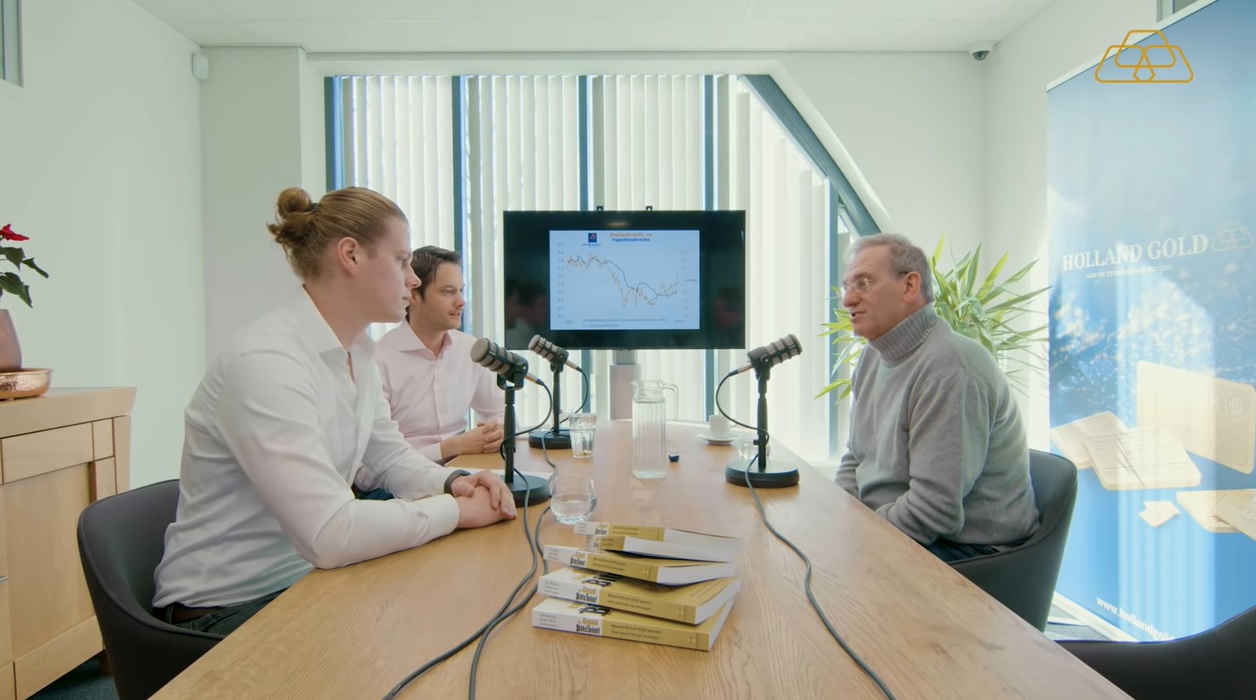
Lex Hoogduin: "Our money system needs an anchor" (click on the image for the video)
By intervening after each crisis with interest rate cuts and, since 2008, also with asset purchase programmes, central banks have more or less hedged the downside risk of financial assets. This has spurred financial markets into more speculative behaviour. As a result, investors have started to take on more risk, while governments have started to borrow more and more money. Take, for example, Italy, which can now borrow so cheaply that it has little reason to put its budget in order. The budgetary discipline that the euro countries laid down in treaties when the euro was launched has been completely forgotten.
According to Hoogduin, our fiscal and monetary policy is highly asymmetrical, in the sense that governments and central banks do far too little in good economic times to cut spending and raise interest rates, respectively. As a result, central bank policy rates have almost exclusively fallen over the past 35 years. Monetary and fiscal policy is therefore asymmetrical. Austerity is not popular and therefore hardly ever happens, so there can be no economic correction.
Because there is no correction, the economy does not have a chance to rebalance itself and eliminate excesses. By constantly lowering interest rates and stretching monetary policy, we have been able to prevent a correction in the financial markets, but that cannot be sustained indefinitely. After all, the policy rate cannot be lowered much further without turning negative.
The fall in interest rates has yielded great investment gains over the past 35 years, but Hoogduin is worried about what could happen in the next 35 years. Interest rates can no longer fall as sharply as they have in recent decades. And that can have far-reaching consequences. The former central banker refers to the bond market, where there is actually no return to be made. The yield on government bonds is low, while the upside potential is very low due to high prices. The downside potential, on the other hand, is very high, because interest rates have more room to rise than to fall. Bond prices could then fall sharply.
Rising interest rates are also unfavourable for the stock market and housing market. If valuations come under pressure, some of our fictitious assets will evaporate. This could lead to an economic tipping point. If there is selling pressure and interest rates start to rise, the central bank will have to continue QE to buy those bonds. But even that is not a sustainable strategy, according to Hoogduin.
Although the ECB buys government bonds via the secondary market, as long as the central bank does not sell these bonds, this is indeed monetary financing, according to Hoogduin. There have been several court cases about this in recent years, but the ECB has always been proven right based on the idea that these purchase programs would one day be reversed. According to Hoogduin, the chance that this will happen in any reasonable period of time has become very small. This weakens the legal basis of QE as a monetary instrument. This is problematic because central banks are likely to have to buy even more if the turmoil in the financial markets increases.
According to Hoogduin, it would be desirable if the monetary system became more anchored. Traditionally, this was done with gold, but the former central banker does not see that option on the table yet. To this end, the gold reserves are currently not well distributed among the countries. Hoogduin also does not think a revaluation of gold to eliminate debts is very likely at the moment.
In recent decades, we have benefited from very accommodative monetary policy, but the future will look less favourable. As an investor, you have to look carefully at specific sectors where there is still growth. According to Hoogduin, these opportunities lie more with value stocks. Bonds are not interesting at all at the moment due to low interest rates and high prices. Hoogduin would prefer to hold cash at the moment, despite high inflation. He expects that the valuations of financial assets will fall and then you can get in cheaply with cash. He also holds a small part of his wealth in precious metals.
This contribution comes from Geotrendlines