9.3
8.892 reviews

English
EN


Italy's five largest banks have collectively put €2.75 billion into an emergency fund to help smaller banks in uncertain times. support. According to the Italian newspaper Il Messaggero, the banks Intesa Sanpaolo, UniCredit, Banco BPM, Ubi Banca and Banca Monte dei Paschi have each set aside an amount of €550 million to solve problems at smaller banks.
The Italian banking sector is under pressure due to the Italian government's debt problems. The national debt is more than 130% of GDP, but that does not stop the new government from spending more money than it receives next year. The European Commission has rejected the Italian budget, because they believe that Italy is doing too little to keep its debts under control.
This issue is making investors nervous, with the result that yields on Italian government bonds are rising and the value of debt is falling. This could also have an impact on the Italian banking sector, which, according to figures from the European Central Bank, is about €375 billion in debt securities of their own government on the balance sheet. If the value of these government bonds continues to fall, this could jeopardise the buffers of Italian banks.
Concerns about rising interest rates in Italy also seem to be having an effect on the value of bank stocks. The following chart shows that there has been a particularly strong correlation between Italian 10-year yields and the index of Italian bank stocks in recent months. This suggests that there is a strong interconnectedness between banks and the government and that problems with public finances can spill over into the banking sector.
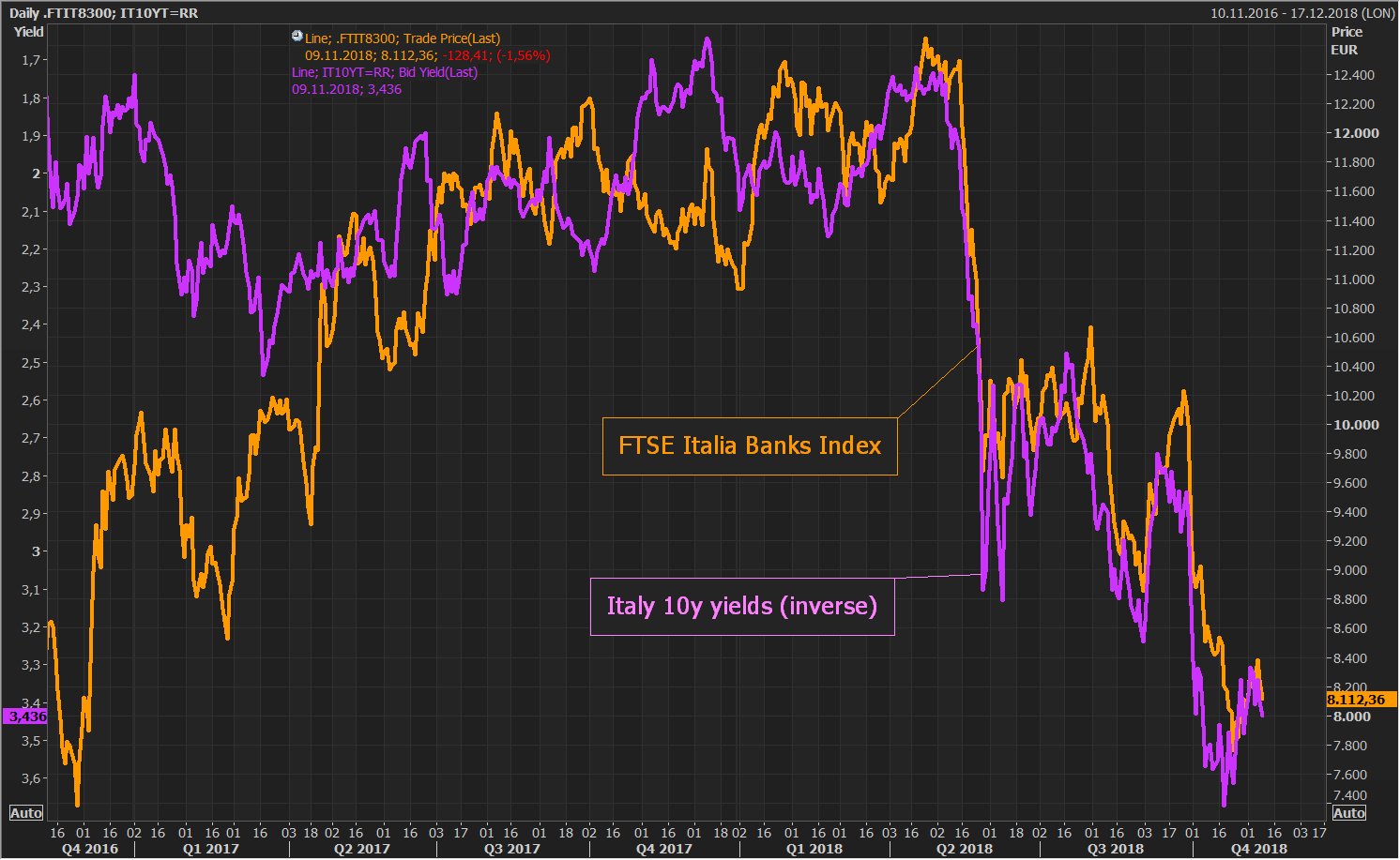
Italian 10-Year Yield vs. Italian Bank Stocks (Chart via Holger Schaepitz)
The Italian central bank has calculated that the government has been close to €1.5 billion more interest than if the interest rate had remained at the level of April this year. Next year, the government will have to pay more than €5 billion extra in interest charges, an amount that will rise further to around €9 billion the following year. An increase in interest charges means that the Italian government will have to make even more efforts to put its budget in order and bring the public debt back to a sustainable level.
This contribution was made from Geotrendlines


