English
EN


By: Frank Knopers
The war in Ukraine has changed the economic outlook worldwide Deteriorated. This is what the International Monetary Fund (IMF) writes in its latest report on the global economy. Economists from this organization expect global growth of 3.6% this year, while in January they expected growth of 4.4%. By comparison, the global economy grew by 6.1% last year due to a rapid recovery from the corona crisis.
According to the IMF, the war is affecting the economy in several ways. The most immediate effect is the increase in the price of energy and raw materials, which increases inflation worldwide. High energy prices are hitting European consumers in particular, while emerging countries are also experiencing problems due to high food prices. The IMF predicts an average of 5.7% inflation in developed economies this year and even 8.7% in emerging economies. In addition, there are also indirect effects due to economic sanctions and the logistical problems that arise from them.

IMF foresees sharply higher inflation in 2022 (Source: IMF, Bloomberg)
On the positive side, the IMF is still factoring in growth in the global economy, both in developed and emerging economies. But compared to last year, we have to reckon with a deterioration. In 143 countries, which together account for 86% of the global economy, gross domestic product (GDP) growth this year will be lower than previously thought.
"In the space of a few weeks, the world is going through another gigantic transformative shock. Just when a sustainable recovery from the coronavirus pandemic seemed in sight, the war has created the very real prospect that much of that recovery will be wiped out", writes IMF chief economist Pierre-Olivier Gourinchas in the foreword to the report.
The eurozone in particular is feeling the effects of this new crisis. In January, the IMF was still expecting 3.9% growth for this year, but now it is only 2.8%. The U.S. economy appears to be much less vulnerable, because it is less dependent on raw materials from Russia. Growth expectations for the U.S. fell from 4% to 3.7%, down less than ten percent.
China is also less vulnerable, according to the IMF. The growth forecast for the world's second-largest economy fell to 4.4% from 4.8%. This is also a much smaller decrease than in Europe. The biggest losers are the two countries that are at war. Ukraine's economy is set to shrink by 35% this year, while Russia's economy is estimated to shrink by 8.5%.
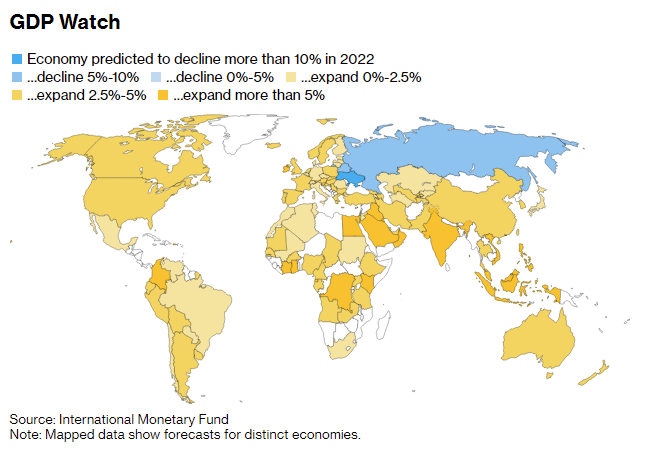
IMF expects economic contraction in Ukraine and Russia (Source: IMF, Bloomberg)
These growth rates are based on a scenario in which the war in Ukraine does not escalate further and Western countries do not tighten their sanctions against oil and gas from Russia beyond what was proposed at the end of March. This means that there is still a lot of uncertainty in the forecasts.
The IMF has therefore also calculated a scenario in which the sanctions against Russia will become stricter by the middle of this year. In this scenario, the prices of energy and other raw materials will rise even further and logistics chains will be further disrupted. In this scenario, the growth of the world economy is 2% lower and that of Europe is even 3% lower.
In addition to geopolitical risks, there are other risks to the economy. For example, the IMF points to the possibility of new variants of the coronavirus emerging. In China, a new outbreak is already leading to new lockdowns, causing long queues at the port of Shanghai. This can result in higher prices and poorer product availability.
Finally, the IMF also points to the risk of rising interest rates and a tightening of monetary policy by central banks. In particular, a rapid interest rate hike by the Federal Reserve could lead to problems, as it strengthens the dollar and makes debt in this currency more expensive. In the long run, this could become problematic for emerging economies with a lot of dollar debt, because they have to roll over loans continuously.
On a positive note, the global economy continues to show growth and global trade is also still growing, expected to be around 5% this year.
This contribution comes from Geotrendlines
 Have a look at us YouTube channel
On behalf of Holland Gold, Paul Buitink and Joris Beemsterboer interview various economists and experts in the field of macroeconomics. The aim of the podcast is to provide the viewer with a better picture and guidance in an increasingly rapidly changing macroeconomic and monetary landscape. Click here to subscribe.