English
EN


Concerns about the sustainability of government debt are increasing. For years, low interest rates made high debt levels manageable, but that dynamic is now changing. What is driving these growing concerns?
In many European countries, the debt ceiling of 60% of GDP is being exceeded by a wide margin, while within the G7 most countries also have debt levels above 100%. At the same time, interest rates are rising, increasing financing costs for governments. To limit these costs, countries are increasingly opting for short-term debt, which raises their sensitivity to further interest rate increases.
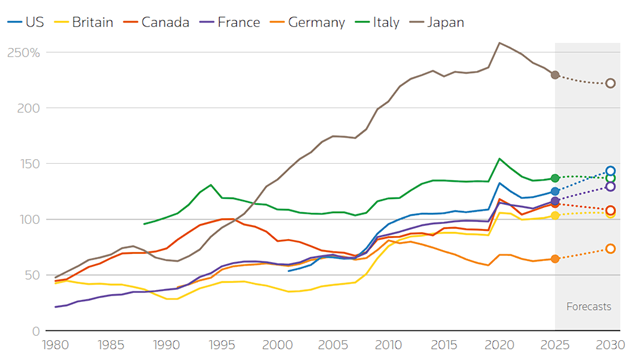
Debt-to-GDP ratio G7 (source: Reuters)
Germany is an exception within the G7, as it is the only country without a debt ratio above 100% of GDP. The country is known for its strict fiscal discipline, but a shift is visible here as well. The so-called Schuldenbremse, which limited the budget deficit to 0.35% of GDP, has recently been reformed, creating more room to take on debt. According to ZDF heute, more than €180 billion of government spending is financed through borrowing, the second-highest level in the country’s history.
Pressure is also increasing in other major European economies. For example, credit rating agency Fitch Ratings downgraded France’s credit rating following political tensions surrounding efforts to reduce the budget deficit. Structural factors such as ageing populations, higher interest expenses, and rising spending on climate and defense are putting further pressure on public finances. Without an improvement in fiscal discipline, the debt burden is likely to increase further over time.
After a long period of low interest rates, central banks have raised rates sharply to combat inflation. This makes refinancing debt more expensive and increases financing costs.
At the same time, high levels of government debt, weakening fiscal discipline, and inflation uncertainty are driving higher risk premiums on government bonds. Investors demand higher yields as compensation for the risk of unsustainable debt levels and potential default.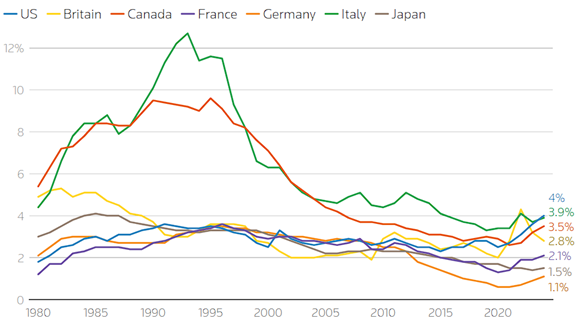
Interest payments as a percentage of GDP (source: Reuters)
In addition, demand for government bonds is changing structurally. Central banks, particularly in emerging economies, have reduced their exposure to government bonds and have increased their gold holdings, partly in response to the freezing of Russia’s foreign currency reserves.
Institutional investors are also moving away from the traditional 60/40 portfolio, with bonds becoming less attractive as a diversification tool. According to J.P. Morgan, alternative investments are therefore no longer optional, but essential.
This declining demand for government bonds may lead to structurally higher interest rates and financing costs, putting long-term pressure on the sustainability of government debt. In such an environment, the appeal of assets without counterparty risk, such as gold, increases. Investors are increasingly seeking protection against monetary uncertainty and rising debt levels.
Due to higher financing costs on long-term bonds, governments have according to Reuters increasingly issued short-term government bonds. While this reduces interest expenses in the short term, it also introduces additional risks.
Short-term debt needs to be refinanced more frequently. In an environment of high or rising interest rates, higher financing costs are therefore transmitted more quickly to government budgets. Unexpected increases in financing costs can create budget shortfalls, further increasing pressure on public finances.
Interest rate hikes, concerns about high levels of government debt, and weakening fiscal discipline—combined with inflation uncertainty and declining demand for government bonds—are leading to higher financing costs for governments.
In response, governments are increasingly issuing short-term bonds. While this may reduce interest expenses in the short term, it also increases sensitivity to rising rates. As these debts must be refinanced more frequently, higher interest rates or fiscal setbacks can more quickly translate into additional pressure on government budgets.
Also take a look at our YouTube channel
On behalf of Holland Gold, Paul Buitink and Yael Potjer interview various economists and macroeconomic experts. The goal of the podcast is to provide viewers with better insight and guidance in an increasingly fast-changing macroeconomic and monetary landscape. Click here to subscribe.