English
EN


House prices have risen particularly fast in recent years and are now at a Record. Low interest rates allow people to borrow more money for a house, causing prices to rise. But how expensive are houses actually measured in gold? In this article, we compare house prices from 1969 to 2020 against the gold exchange rate. What did a house cost on average in terms of gold in recent decades?
On the CBS website, we found figures on average house prices in the Netherlands, which we combined with a historical data series from the World Gold Council. These figures show that since 1969 people have paid an average of just over 13 kilos of gold for a house, but that prices have fluctuated greatly from time to time. Not only because of the long-running cycles in the housing market, but also because of large movements in the Gold price.
In the early 1980s, housing was the cheapest. The gold price was relatively high at the time, while high interest rates had a negative impact on house prices. Mortgage rates rose to well over ten percent in those years, which meant that potential homebuyers could borrow much less. At the lowest point of the housing market, an average home changed hands for less than 5 kilograms of gold. After that, house prices picked up again, while the gold price started a long downward trend.
Expressed in gold, house prices peaked in 2004, when an average home yielded about 24 kilos of gold. At the time, the gold price was still relatively low, while house prices continued to rise due to generous lending by banks. At that time, an average home was four to five times more expensive than it was in the early 1980s. After that, the precious metal started a new upward trend, with its value increasing fivefold on balance between 2004 and 2020.
In recent years, house prices have risen sharply, as has the price of gold. As a result, house prices have been fluctuating in a range between six and eight kilos of gold for almost a decade now. Over the past ten years, a home has cost an average of 7.34 kilos of gold. As a result, house prices in terms of gold are currently relatively low, as the graph below shows.
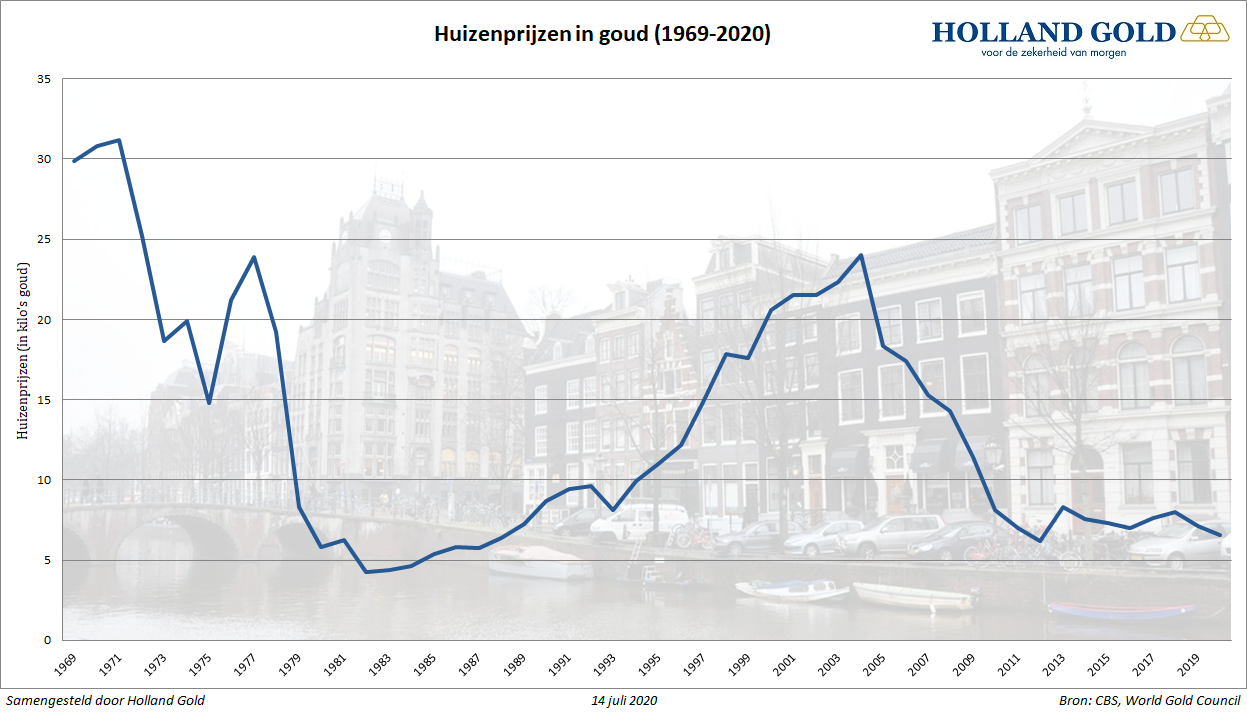
House prices in gold (click for larger version)
If we look at the long-term development of the gold price and the housing market, it is difficult to draw an unambiguous conclusion. Of course, an average house from 1969 is not comparable to an average house from 2019. On average, homes are becoming larger and more luxurious, making it difficult to compare over a period of several decades.
Based on these figures, you could conclude that houses are not that expensive at all in terms of gold at the moment. Gold also seems to be a better investment than real estate, because the price of gold is more than 70 times higher than in 1969, while house prices are now 15.5 times higher. On the other hand, a house can be rented out, while the storage of gold involves costs. Which investment is best for you therefore depends on your investment horizon and your risk profile. In a well-diversified investment portfolio, both real estate and gold are interesting.

House price development versus gold price (click for larger version)
Disclaimer: Holland Gold does not provide investment advice and this article should not be considered as such. Past performance is no guarantee of future results.