English
EN


The Gold price went down sharply last week Down, after the Federal Reserve announced its intention to raise interest rates. The central bank foresees an interest rate of 0.6% in 2023, implying that two rate hikes are on the way. In March, there was not a single rate hike on the so-called dot plot, in which the central bank's board members project their expectations for interest rates. This change of course sent shockwaves through the financial markets. The prices of precious metals and cryptocurrencies fell sharply, while stock markets also plunged into the red.
Investors fear that tighter monetary policy will have a negative impact on the value of investments. The big winner was the U.S. dollar, as it rose sharply against most currencies. A stronger dollar is generally negative for gold and that was also the case last week. The price of the precious metal dropped from €49,400 to €47,800 per kilo, a price drop of more than 3%. The silver price fell from €735 to €700 per kilo due to the prospect of an interest rate increase, losing about 5% of its value. The prices of platinum and palladium also fell in a short period of time.

Gold price plunged after expected Fed change of course
So the market is anticipating an interest rate hike by the Federal Reserve, but it remains to be seen whether that will happen. There is certainly no consensus on interest rate expectations within the central bank's board either. Of all FOMC members, thirteen are pricing in a rate hike, while there are seven who still don't expect a rate hike. And if there is a rate hike, it probably won't happen until 2023. Only seven board members expect an interest rate hike this year, the same number as three months ago.
Investors' reaction to a possible change of course by the Federal Reserve therefore seems somewhat exaggerated. For example, the central bank has not said anything about possible adjustments to its asset purchase program. That will continue at a rate of $120 billion per month, which will increase the balance sheet even further. Recently, the Fed's balance sheet total already passed $8 trillion, almost doubling since the start of the corona crisis.
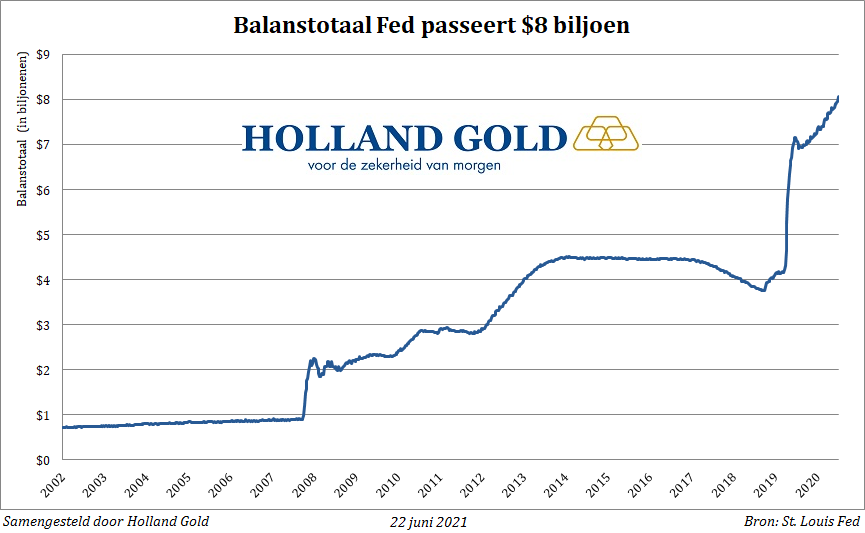
Federal Reserve's balance sheet total continues to rise
The only change is that the Fed's dot-plot now suggests that interest rates will start rising again sometime in 2023. Whether that will happen remains to be seen, as interest rates have been on a downward trend in recent months. Interest rates on long-term government bonds are not rising any further, while interest rates on short-term loans are not rising any further. seems to be falling further to zero. What also remained snowed under is that the Federal Reserve last week announced two key interest rates Customized. It raised interest rates on excess bank reserves (IOER) and reverse repo operations (RRP) to prevent market rates from falling below zero.
The Federal Reserve is suggesting that it will raise interest rates sometime in 2023, while at the same time it needs to implement a number of emergency measures to prevent rates from falling further. In recent months, she has also emphasized that high inflation is the result of temporary factors. This can be interpreted as an excuse not to raise interest rates for the time being, even now that inflation is well above the 2% target. Given these developments, we are not too worried about a rapid rate hike.
A stronger dollar and higher interest rates are theoretically unfavorable for precious metals, so it's understandable that the market has been anticipating that since the Federal Reserve's last meeting. Still, we think the market is overreacting, as monetary policy is unlikely to change in the short term and medium term. Interest rates remain historically low, also because there are scarcity is of high-quality collateral. A situation that has only become more problematic due to central bank purchase programs.
Even if interest rates were to rise slightly in the coming years, it would still be attractive to own precious metals, as interest rates would still be negative after adjusting for inflation. Savings no longer earn interest, while the prices of goods rise every year. As a result, more savers will turn to alternatives. Historically, periods of negative real interest rates are favorable for precious metals. Last week's price drop may offer a good opportunity to get in or buy more.
Disclaimer: Holland Gold does not provide investment advice and this article should not be considered as such. Past performance is no guarantee of future results.
This contribution was made from Geotrendlines