English
EN


In recent months, the price of gold has fallen considerably, especially in dollars. But how does the price of gold develop in other currencies? Hollandgold took the numbers and made an overview of the return on gold in 2014. Based on figures from the World Gold Council, we compared the gold price of 3 October with that of 1 January 2014.
What is striking is that for residents of some countries, it is not a bad year at all to own gold. For example, the gold price in Russian rubles has already risen by 20% this year and the gold price in euros for 2014 is up 9%. At almost 8%, the yield on gold in Swiss francs is not much lower than that of the euro, because the central bank prevents this currency from appreciating too much against the euro. The weaker euro has therefore also taken the Swiss franc with it in the fall downwards.
Other currencies in which the gold price has not (yet) fallen this year are the South African rand, the Turkish lira, the Canadian dollar, the Japanese yen, the British pound, the Australian dollar, the Egyptian pound and the Chinese renminbi.
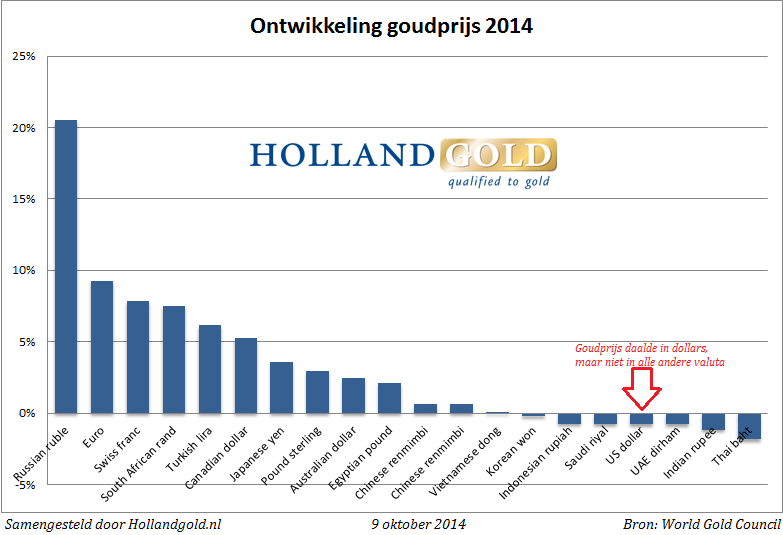
Development Gold price in different currencies, click here for a larger graph
Although the dollar has done well this year, it has certainly not been the strongest currency. The gold price fell even more in the Thai bath, the Indian rupee and in the dirham of the United Arab Emirates.
So it requires some nuance when we talk about a rise or fall in the price of gold. Although the price of gold in dollars has fallen sharply in recent months, the precious metal has not become much cheaper for Eurozone residents. Compared to its peak in March, the price of gold in euros has fallen by only 3.5%, compared to a 13.7% drop over the same period in US dollars.
So the strong dollar is mainly a gift for Americans who Buy gold. For Eurozone residents, the precious metal is up 9% net in the first 9 baskets of this year.