English
EN


Investors looking to benefit from a rising gold price are quickly faced with the choice between physical gold and gold mining stocks. Although both investments offer exposure to the gold price, they differ significantly in terms of risk and return. Which is the better investment?
While gold is a monetary asset with limited external risks, gold mining companies depend on corporate performance and political conditions. Nevertheless, these companies have been able to benefit more from the rising gold price since the 2023 bottom. What explains these differences, and why do both investments have a different risk profile?
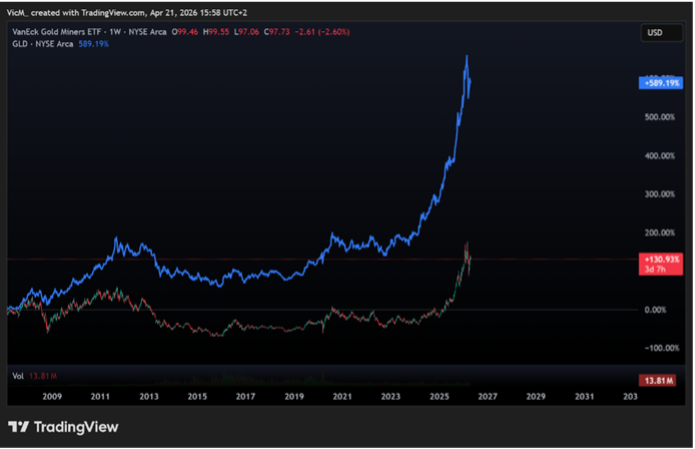
Gold price and gold mining stocks (source: TradingView)
Gold mining stocks are highly dependent on the gold price, as these companies earn their profits from the difference between production costs and the selling price of gold. Because these costs remain relatively stable, a rising gold price can lead to a sharp increase in profit margins. This effect is known as operating leverage.
However, this mechanism also works in the opposite direction. When the gold price declines, margins can quickly come under pressure and in some cases even turn negative. As a result, gold mining stocks generally move more strongly than the gold price itself: they rise faster in upward markets, but also fall more quickly when the gold price comes under pressure.
Still, this leverage does not automatically mean that gold mining stocks perform better over the long term. Since 2007, SPDR Gold Shares, which tracks the gold price, has risen by approximately 580%, while the VanEck Gold Miners ETF delivered a return of only 130%.
This difference is partly explained by the greater volatility of gold mining stocks. During the bear market after 2011, the gold price fell by approximately 40%, while gold mining stocks lost around 80%. Because of these deeper declines, it takes longer for losses to be recovered. At the same time, the period since 2015 shows that gold mining stocks perform more strongly in a rising market: they have risen twice as much as gold itself.
In addition to leverage to the gold price, gold mining stocks are also affected by external risks that do not apply to physical gold. Unlike gold itself, these companies depend on operational performance and political conditions, which further increases volatility.
Operating Costs
The cost of mining gold is often expressed in the so-called All-In Sustaining Cost (AISC). When these costs rise, profitability comes under pressure. Since gold mining is highly energy-intensive, higher energy prices directly feed through into the cost structure.
Costs also increase because gold concentrations in existing mines decline, meaning more material must be excavated to produce the same amount of gold. Rising wage costs also contribute to higher operating expenses. These factors make the profitability of gold mining companies highly dependent on their operating costs and efficiency.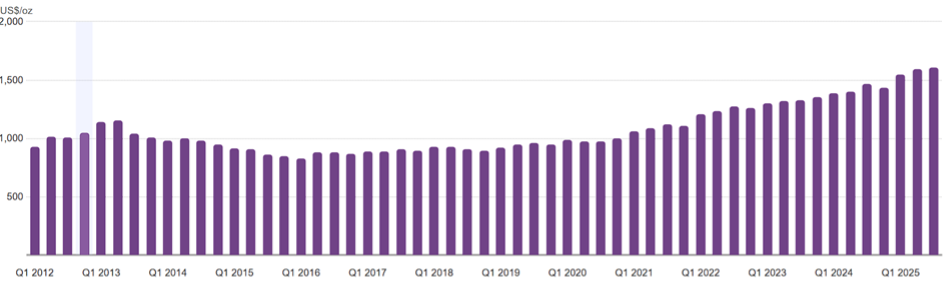
All-In Sustaining Cost of gold. (Source: World Gold Council)
Political and Regulatory Risks
In addition to operational risks, political factors also play an important role. Gold mining companies often operate in countries where governments can exert direct influence over the sector. For example, Bloomberg reported in 2024 that Tanzania’s central bank required mining companies to sell 20% of their production to the government. This often takes place at less favorable exchange rates or in local currency, which comes at the expense of profitability.
In some cases, governments may also classify gold as a strategic asset, thereby restricting exports. Production restrictions can also be imposed, as previously happened in Mozambique due to environmental concerns. Such measures increase the risk for investors in gold mining stocks.
Hedging and Price Risk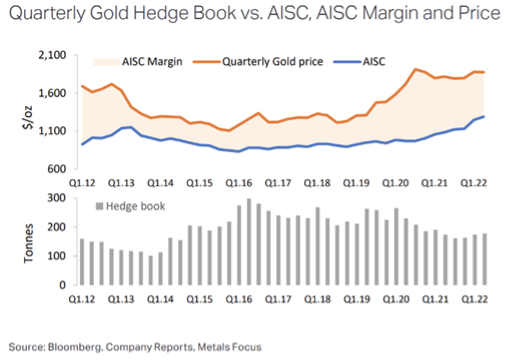
Higher gold prices lead to less hedging (source: Metals Focus)
Finally, strategic choices by management also play a role. Gold mining companies can hedge their price risk by selling future production through futures at a predetermined price. This provides more stable income and protects against falling gold prices, but at the same time limits profits when the gold price rises.
In practice, companies often choose to hedge less during rising markets in order to benefit as much as possible from higher prices. However, this increases sensitivity to declines, as profit margins then come under pressure more quickly.
Although physical gold and gold mining stocks both provide exposure to the gold price, they differ significantly in terms of risk profile. Stocks often rise faster than gold during upward markets due to operating leverage, but they also fall more sharply during adverse conditions. A prolonged rise in the gold price does not automatically mean that stocks will perform better, partly because of the severe declines they can experience.
Gold mining stocks face many external risks: operational challenges, political interference, and strategic decisions by management. Those who want safe exposure to gold choose physical gold. For investors who want to speculate on a rising gold price and are willing to take more risk, gold mining stocks may offer attractive returns.
Also take a look at our YouTube channel
On behalf of Holland Gold, Paul Buitink and Yael Potjer interview various economists and macroeconomic experts. The goal of the podcast is to provide viewers with better insight and guidance in an increasingly fast-changing macroeconomic and monetary landscape. Click here to subscribe.