English
EN


A few months ago, investors were still worried about an inverted yield curve, because it would be an indication of a new recession. Analysts at Goldman Sachs are not convinced, as they expect No recession in the coming years. In fact, the economy would even be recession-proof. A bold prediction, given that the bank was also completely wrong in 2007.
According to Goldman Sachs, all the fundamentals that have driven economic growth in recent decades are still intact. Two Goldman Sachs economists, Jan Hatzius and David Mericle, write about this in a new report.
"While new risks may emerge, none of the sources of the last recessions – oil shocks, high inflation and financial imbalance – are cause for concern at this time. Therefore, the prospect of a soft landing is more promising than people generally think."
This conclusion by Goldman Sachs is in stark contrast to the image in the financial media. In recent months, much has been written about geopolitical risks, an inverted yield curve and, of course, the trade war. Not to mention the prospect of Brexit and the economic slowdown in Germany and China.
All of these factors were a cause for concern last year, but some of these risks have since faded into the background. The U.S. and China reached a trade agreement, which means that new import tariffs are no longer applicable. Interest rates on government bonds also rose, so that there was no longer an inverted yield curve.
According to the Federal Reserve, the Probability of a recession, as measured by interest rate differentials on U.S. Treasuries, fell to 24%. Compared to recent years, it is still an elevated level, but not as critical as a few months ago. Then the recession indicator approached the level of 2007-2008.
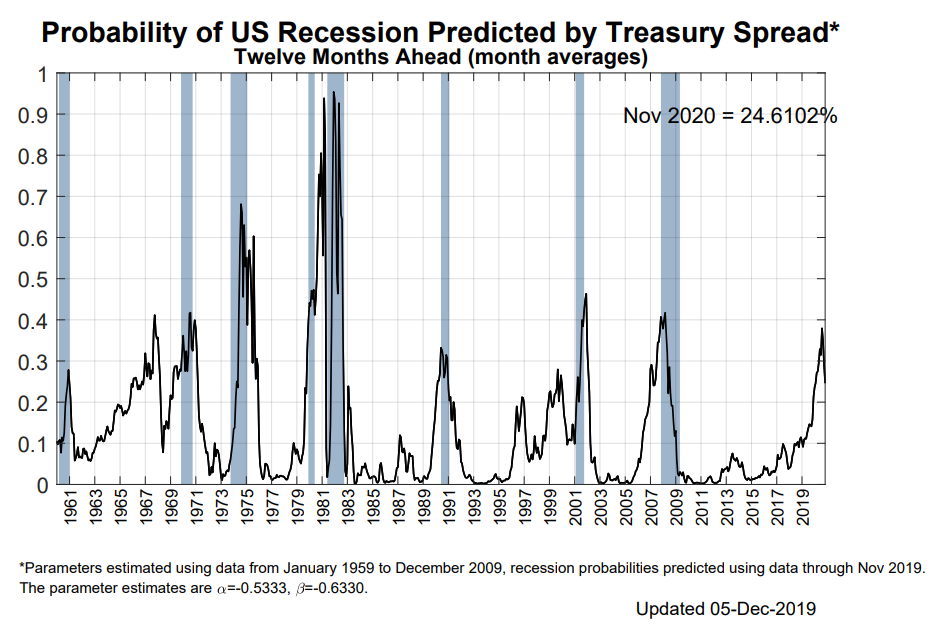
Chance of a recession has decreased somewhat (Source: New York Fed)
Goldman Sachs' economists aren't saying there aren't risks. For example, elevated stock prices and sharply increased corporate debt continue to pose a threat to economic stability. Still, the chances of a soft landing would have increased, thanks in part to the trade deal and intervention by the Fed.
As mentioned, Goldman Sachs' optimism does not always work out well. Even on the eve of the previous crisis, economists at the bank were mostly positive about the economy. At the end of 2007, Goldman Sachs forecast a gain of more than 10% in the stock market for 2008. It ended up being a disastrous year, in which the S&P 500 index fell by 37%. Is Goldman Sachs' optimism another contrarian indicator?
Also Read: