English
EN


The silver market has a surplus of 35.3 million troy ounces this year, according to a new forecast from Thomson Reuters GFMS. According to the research firm, that's an increase from last year, which is largely caused by declining demand for coins and bars. Industrial demand for the precious metal was also somewhat lower, while the production of silver mines showed a small increase for the first time in two years.
The Silver Institute Writes In its interim report for the silver market that the inventories of so-called exchange traded funds will fall by 0.5 million troy ounces this year. This decline follows a series of seven years in which stocks of these types of investment products have been steadily increasing. The numbers confirm the relatively weak sentiment in the silver market. This year, the price of the precious metal has averaged $15.89 per troy ounce, down 7% from the average value of $17.05 per troy ounce in 2017.
Thomson Reuters GFMS expects demand for investment silver to fall 12.2% this year to 124.8 million troy ounces. This decline is mainly attributable to the US market, where sales of new Silver Coins and ingots are under pressure due to a large supply of old coins and bars. Demand for the precious metal has also been disappointing in other parts of the world, as investors wait for more movement in the Silver price.
Industrial demand for silver is estimated at 585.4 million troy ounces this year, down 1.8% from last year. Due to a cutback in the subsidy policy in China, less silver has been processed in solar panels this year. On the other hand, more precious metals were used for the production of electronics. The precious metal is a good conductor of electricity and is therefore widely used in printed circuit boards and switches. More silver is also used by the automotive industry, because more silver is used in an electric car than in a car with a conventional combustion engine.
After a decline last year, the global supply of silver is set to increase by 0.3% this year to 998.4 million troy ounces. This increase is entirely attributable to an increase in the production of silver mines. After two years of decline, silver mined will increase by 1.6% this year. The secondary supply from scrap silver will fall by only one percent this year. Since 2015, the supply of scrap silver has been fairly stable, because the silver price also shows little movement.
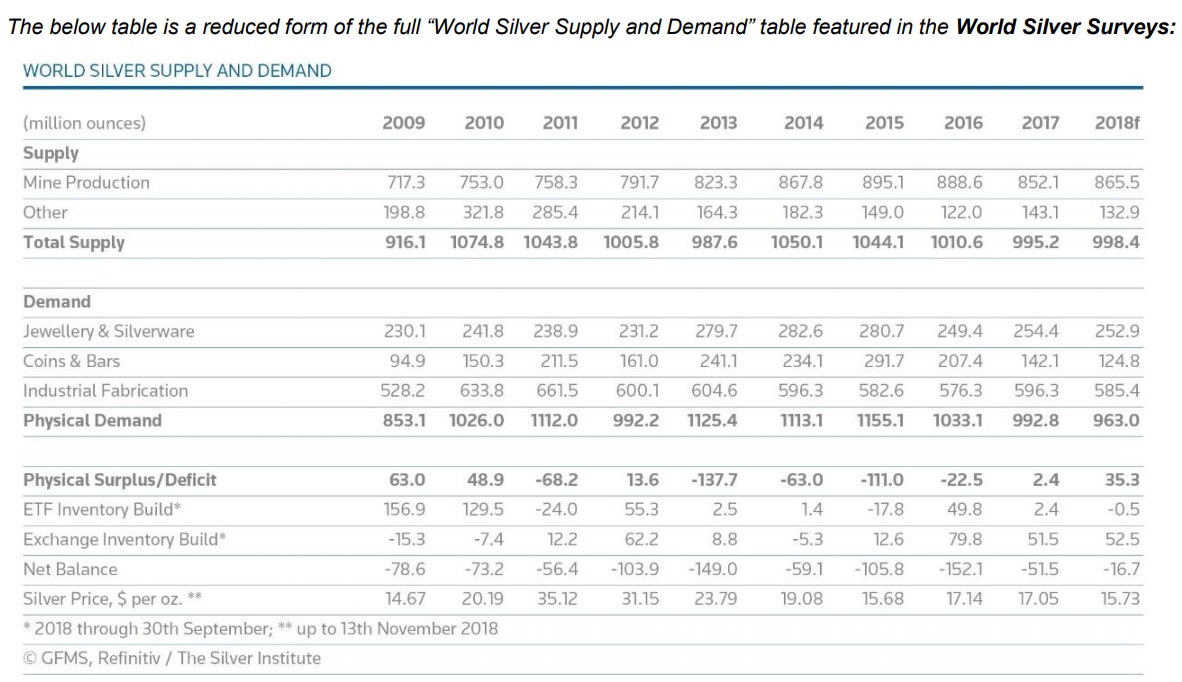
Supply and demand of silver since 2009 (Source: Silver Institute)
This contribution was made from Geotrendlines