English
EN


The Eurosystem's central banks have become the largest creditor of the Eurozone in recent years. For example, central banks of the member states now have a third of the total public debt of all euro countries on their balance sheets. Since 2014, they have been engaged in bond-buying programmes for more than €3 trillion under various ECB mandatesBought up. Of these, the largest part consists of government bonds. The end does not seem to be in sight for the time being, as the central bank continues to buy debt securities under the leadership of Christine Lagarde.
On average, Eurosystem central banks now hold one third of the total public debt of the euro area on their balance sheets. However, there are large differences between the euro area countries. For example, the Dutch Central Bank has bought half of the issue of Dutch government bonds, while the share for Italian government bonds at the Banca d'Italia is less than thirty percent. As a result of the ECB's monetary policy, the supply of government bonds on the financial markets is shrinking. As a result, liquidity in the bond market threatens to deteriorate further.
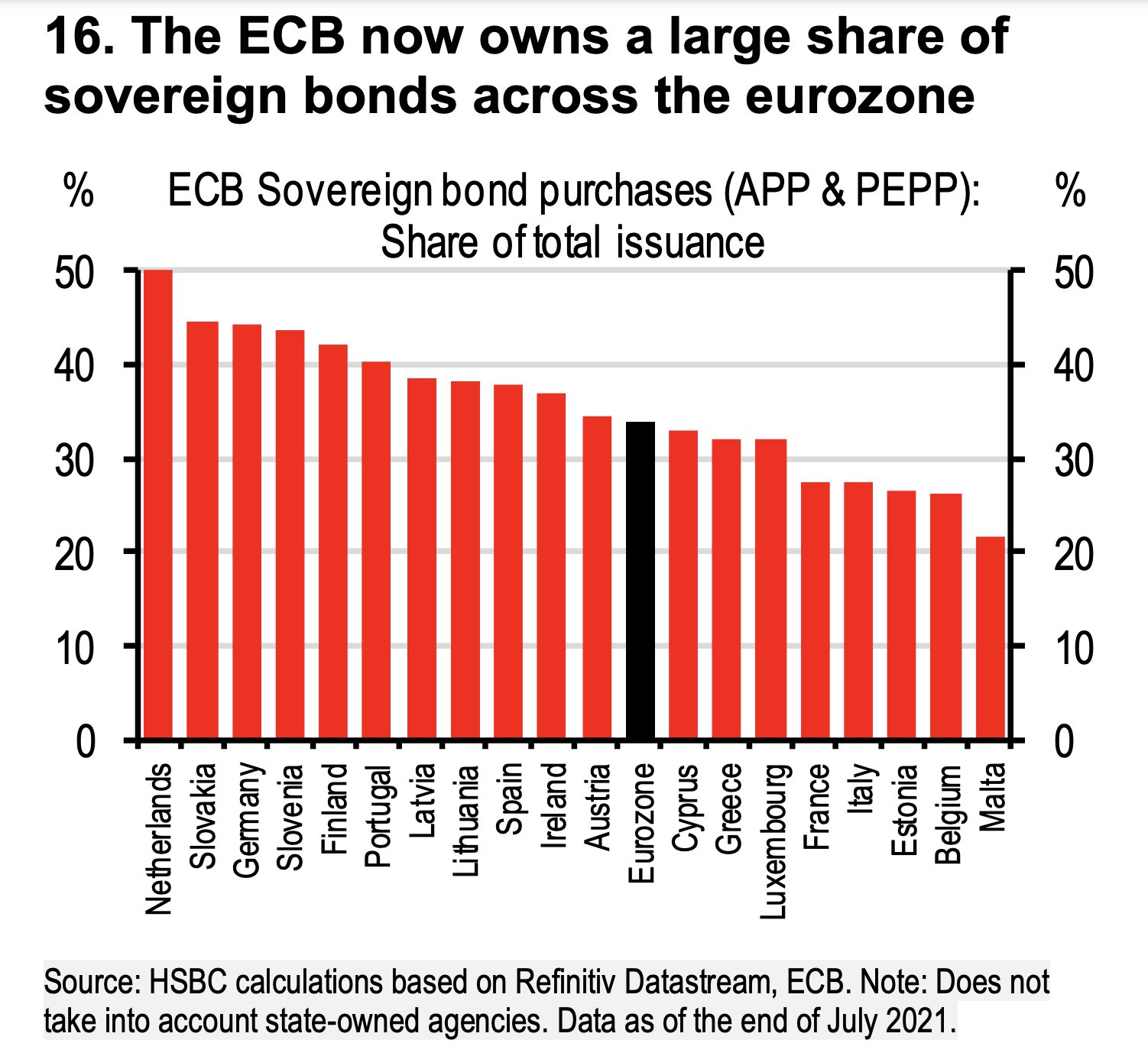
ECB owns one-third of eurozone sovereign debt (Source: HSBC, via Twitter)
In 2014, then-ECB President Draghi introduced a large-scale bond-buying program to pull the European economy out of the doldrums. Buying bonds would lower interest rates, making it even cheaper to borrow. This policy seemed to work at first, but in recent years we have mainly seen adverse effects. Government bonds do not yield returns, savers have to pay interest and houses have become unaffordable for most first-time buyers.
The ECB says it stimulates the economy with its bond-buying programmes, but in practice it turns out to be a lot more unruly. Contrary to what many people think, the bond-buying program does not bring extra money into the economy. The central bank buys government bonds from banks, which receive reserves in return. Reserves that banks cannot lend to consumers and businesses. In fact, banks have to pay interest to hold these reserves with the central bank.
The effects of the bond-buying programme can therefore only be observed indirectly, in the sense that lower interest rates tempt people to borrow more. Governments in particular have been making use of this since the corona crisis, because they allow national debts to rise further to support the economy. The question is whether this is a desirable and sustainable development.
This contribution was made from Geotrendlines