9.3
9.038 reviews

English
EN


If a country has weak growth due to structural problems, then a change in the exchange rate should not be the solution. ECB President Draghi said this during a meeting this week.speech in the Slovenian capital Ljubljana. With this statement, he responds to the common criticism that the euro deprives countries of the opportunity to devalue their currencies.
Some believe that Europe would be better off if we did not have a common currency and countries could devalue their currencies. But what we have seen is that countries that implement reforms do not depend on a flexible exchange rate to achieve sustainable economic growth. And for those countries that have not implemented reforms, it remains to be seen how beneficial a flexible exchange rate is. After all, the exchange rate cannot be the answer if the low growth is caused by structural and deep-rooted problems.
With these words, Draghi emphasizes that the central bank will not give politics room to influence exchange rate policy. Instead of giving in to the desire for a weaker currency, Draghi says that countries should try to structurally reform their economies in order to increase their competitiveness. The devaluation of the currency only provides a temporary impetus and does not offer a structural solution. Perhaps that is why Germany is so much more productive than the southern countries.
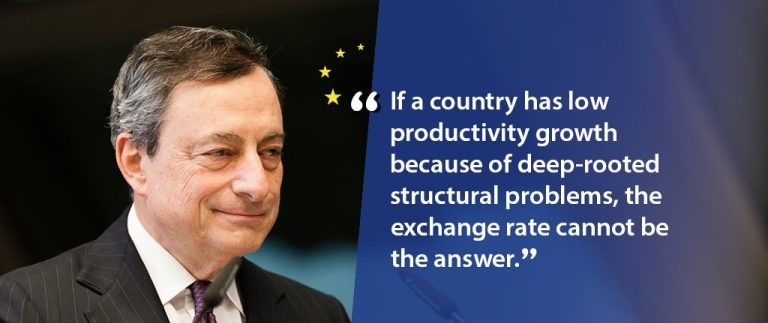
Draghi: "Devaluing is not a solution"