9.3
8.889 reviews

English
EN


By: Frank Knopers
The prices of cryptocurrencies are once again under heavy pressure. Bitcoin lost almost 30% of its value in a week, while Coinbase's share price even plummeted by 40% in the same period. Coinbase, one of the largest trading platforms in the cryptocurrency world, reported disappointing earnings. Not only was the number of transactions in the first quarter of this year 44% lower than in the previous quarter, the number of active users also decreased. And this week, a major stablecoin also crashed. What's wrong?
In November last year, the market value of all cryptocurrencies rose to a record of $2.9 trillion and alone Bitcoin represented a value of more than $1 trillion. Since then, the value of the crypto market has halved. One possible explanation is a change in investors' perception of risk. Rapidly rising interest rates are causing investors to sell their riskiest assets, including tech stocks and cryptocurrencies. The decline in the value of cryptocurrencies since November last year has been accompanied by a sharp correction in tech stocks.
The negative sentiment in the crypto market was also reflected in a different way this week. A day after the U.S. central bank issued a report about the dangers of stablecoins, the price of stablecoin TerraUSD crashed. This crypto coin is not backed by collateral, but uses an algorithm to keep the price stable. The developers of the coin use another crypto coin called luna for this purpose. Traders can always trade in their terraUSD for $1 worth of luna, a cryptocurrency whose value can fluctuate freely.
This system functioned well in an upward market, as the algorithm made the stablecoin terraUSD increasingly popular and the value of luna increased. However, when it was announced at the beginning of this week that the company behind the stablecoin had to lend part of its collateral in Bitcoin, the sentiment changed. Many traders sold both crypto coins, causing the value of luna to plummet and the algorithm to stop functioning. The price of luna dropped to $3.76 on Wednesday, while it was at $82 a week earlier. As a result, the stablecoin terraUSD also fell, from a value of around $1 to just $0.30.
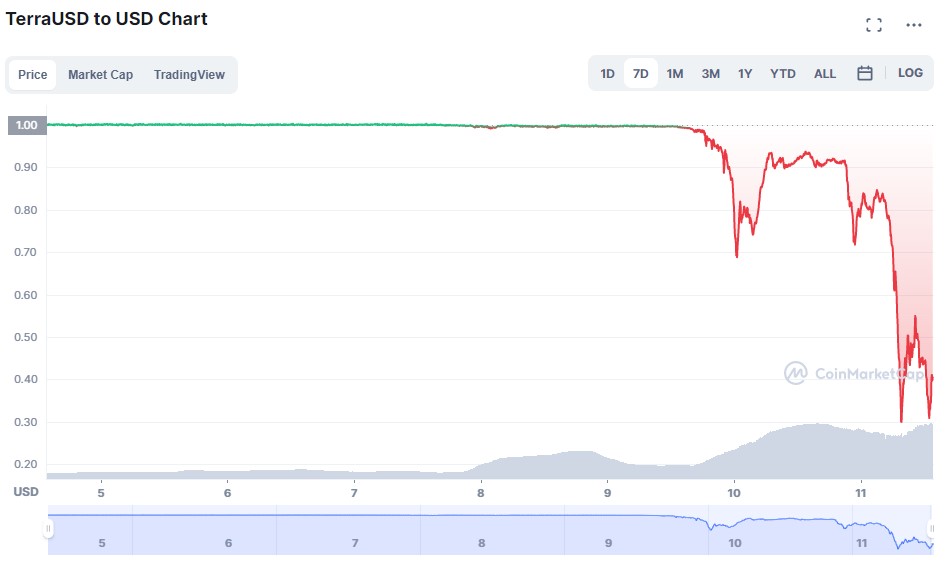
The stablecoin TerraUSD falls through the ice
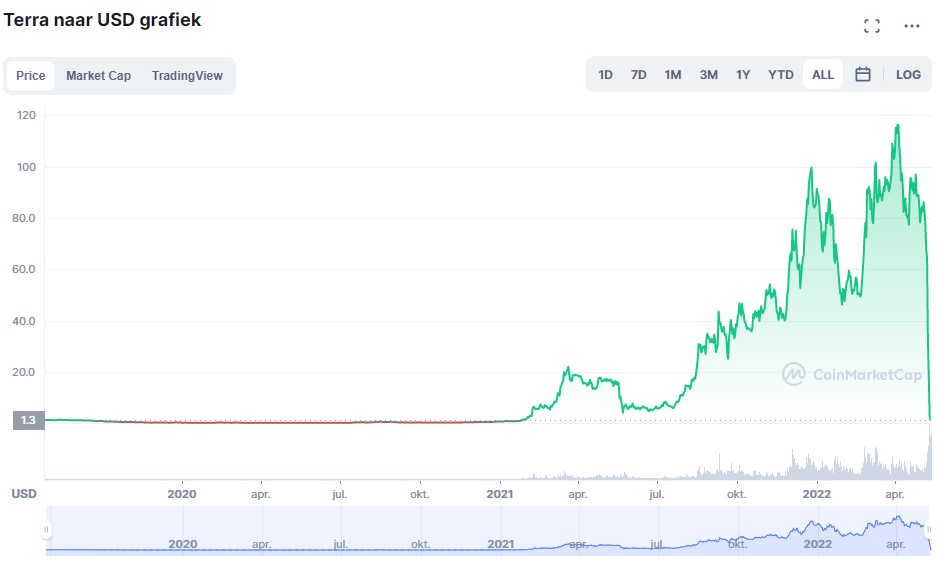
Price of the crypto coin luna also crashes
As a result of this sudden crash, $30 billion worth of luna and $13 billion worth of terraUSD have evaporated. This is a worrying development, because stablecoins play an important role in the crypto market. Stablecoins are popular because their fixed rate makes them suitable for facilitating transactions between different crypto coins. Just as currency traders trade most currencies via the dollar, so traders often trade crypto traders via stablecoins. In doing so, they bypass a conversion to, for example, euros and dollars via the regular banking system. This conversion is not always possible, as banks are generally reluctant to transact in cryptocurrencies.
The question is not only whether terraUSD will recover from this blow, but also whether this crash will have any consequences for other stablecoins. For example, there is still a lot of uncertainty about stablecoin Tether, the third largest cryptocurrency with a market value of $82 billion. This virtual currency is said to be backed by government bonds and shares, but exactly how much is still unclear. The crash of terraUSD will make the market look even more critically at other stablecoins, such as Tether.
The U.S. central bank has been warning about the risks of stablecoins for some time. They perform an essential function in the cryptocurrency market, but operate outside the realm of financial regulators. Moreover, the market is highly concentrated, as the three largest stablecoins – Tether, USD Coin, and Binance Coin – have a combined value of $180 billion with an 80% market share among stablecoins.
It is assumed that these crypto coins are always exchangeable for dollars, but they are backed by assets that cannot always guarantee this coverage. When many people sell their stablecoins at the same time, it can undermine the stability of the crypto market and therefore the rest of the financial system, according to the US central bank.
The question is what to do next with cryptocurrencies. For the time being, this relatively young asset class appears to be more correlated with popular tech stocks than with inflation or geopolitical risk. In that perspective, gold has built up a better track record. The gold price has also fallen somewhat due to rising interest rates, but not nearly as fast as the price of Bitcoin. Until recently, #hodl The Crypto Investor's Motto (buy and hold), now it's #wagmi. An abbreviation that stands for 'We are all going to make it.' It suggests that crypto investors have tempered their expectations somewhat.
This contribution comes from Geotrendlines
 Have a look at us YouTube channel
On behalf of Holland Gold, Paul Buitink and Joris Beemsterboer interview various economists and experts in the field of macroeconomics. The aim of the podcast is to provide the viewer with a better picture and guidance in an increasingly rapidly changing macroeconomic and monetary landscape. Click here to subscribe.


