English
EN


The Chinese government raised $6 billion this week with the issue of new dollar bonds. It is the third year in a row that China has entered the capital market to borrow US dollars. China is borrowing more and more in this currency, as the amount is twice as high as last year and three times as high as in 2017. This bond auction creates a reference point for Chinese companies that also want to borrow in dollars.
Interest in China's dollar bonds was even greater, as investors were willing to lend $20 billion. More than three times as much as the supply. As a result, the Chinese government was able to market the debt securities at a lower interest rate. For short-term government bonds, the interest rate was 25 basis points lower than planned, for long-term government bonds the benefit was 10 basis points. See the table below.
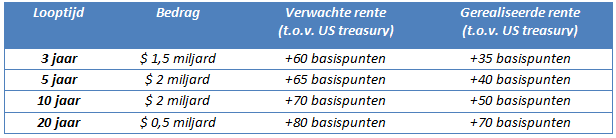
Chinese government raised $6 billion with dollar loan (Source: Bloomberg)
China is borrowing more and more dollars to keep its economy going. For example, Chinese companies have already issued $195 billion worth of bonds since the beginning of this year. At that rate, the old record of $211 billion will be broken in 2017. In total, the Chinese economy has borrowed $740 billion in dollars, most of it by companies and developers.
Because of the large dollar debts, the Chinese economy constantly needs more dollars to repay or roll over loans. This is a major risk, because the availability of dollar liquidity cannot be guaranteed. When banks that provide dollar loans turn off the credit tap, Chinese companies can run into problems rolling over loans. If the Chinese government does not problem this could cause problems in the future.
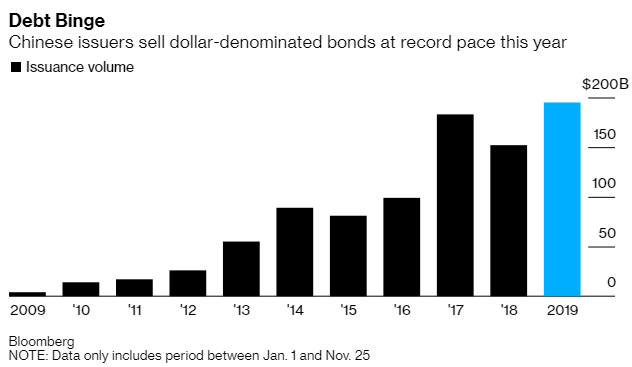
China is borrowing more and more in dollars (Source: Bloomberg)
To reduce its dependence on the dollar, China is trying to promote its own currency in international trade. Last year, for example, China launched the first Oil contracts in yuan. It has also entered into currency swaps with various central banks in recent years, making it easier to trade with the Chinese currency. In October, the Chinese central bank extended its Currency Swap with the ECB. The question is whether this will be enough to deal with the next crisis. In any case, China is playing it safe, because the country has also been Bought gold.
This contribution comes from Geotrendlines