9.3
8.683 reviews

English
EN


Central banks need to buy more government bonds to prevent interest rates from rising. That is the conclusion of analysts from both Goldman Sachs and JP Morgan. According to calculations by the latter bank, governments will collectively need to borrow $2.1 trillion more this year, while the demand for government bonds is $1.9 trillion. This $200 billion difference between supply and demand could lead to a rise in Treasury yields. If central banks want to prevent that, they will have to buy even more debt, according to JP Morgan.
Due to the corona crisis, governments have had to take drastic measures to support the economy. As a result, budget deficits have risen sharply worldwide. To prevent investors from worrying about the sustainability of these debts, central banks have decided to buy more government bonds. This gives governments more certainty that they can continue to borrow cheaply, especially now that national debts are rising and countries have to borrow a lot of money.
According to JP Morgan, while there is a lot of demand for government bonds, it is not enough to absorb the extra supply. This is because pension funds, insurers and central banks will buy fewer government bonds than usual this year. Central banks are therefore withdrawing more government bonds from the market, as shown in the graph below by Bloomberg Show me.
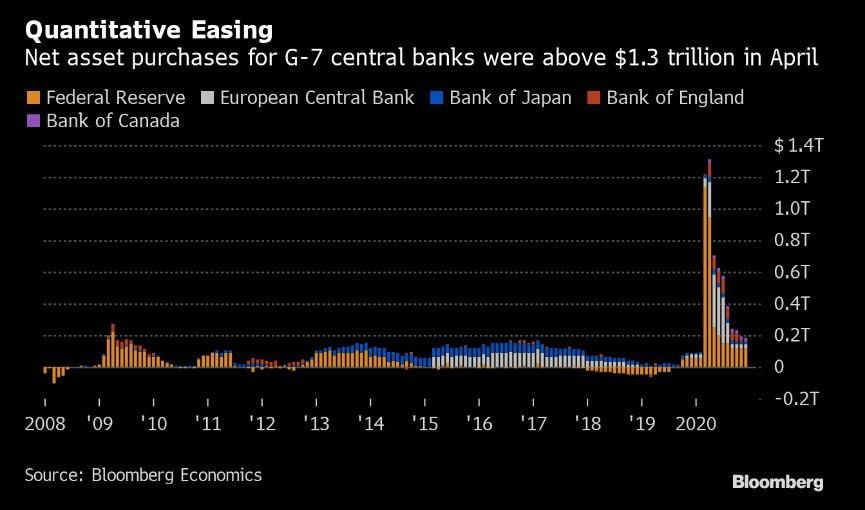
Central banks are buying bonds on an unprecedented scale (Source: Bloomberg)
Analysts at Goldman Sachs also believe that More monetary easing necessary to keep market interest rates under control. If they don't, interest rates will rise further and it will become more expensive for governments to borrow money. For countries with high levels of public debt, this can lead to problems. According to the bank's analysts, it will become more expensive to borrow money, especially for the United States. For example, the US budget deficit is expected to rise to $3.7 trillion.
"Increased supply reinforces the case for higher interest rates and a steeper yield curve. Central banks have to buy a substantial part of the new issuance of government bonds.", writes strategist Avisha Thakkar in a newsletter to clients. Goldman Sachs cites the Bank of England's bond-buying program as an example, which is not enough to cover the issuance of new debt securities.
With the large-scale purchase of government bonds, central banks are trying to calm the financial markets. They are also trying to boost inflation expectations. To date, with limited success, because interest rates on government bonds were already falling before central banks lowered interest rates. However, the asset purchase programmes have ensured that interest rate differentials between countries have narrowed.
At the same time, accommodative monetary policy is causing a flight to precious metals. Investors fear that the monetary policy of central banks will eventually lead to more currency devaluation. Those worries will only increase if central banks buy even more debt.
This contribution was made from Geotrendlines


