English
EN


The four most prominent central banks in the world already control a fifth of the total public debt of their own government, according to the Financial Times. The Federal Reserve, ECB, Bank of Japan and Bank of England have been buying government bonds on a large scale since the outbreak of the financial crisis, with the aim of calming financial markets and bringing interest rates down further.
These four central banks — plus the central banks of Sweden and Switzerland — collectively have about $15 trillion in assets on their balance sheets, $9 trillion of which is in the form of their own country's government bonds. That is almost 20% of the total national debt of $46 trillion that these countries have.
At $4.9 trillion , the ECB has the largest balance sheet total of any central bank, of which nearly $2 trillion is government bonds. The Federal Reserve's balance sheet has swelled through several rounds of monetary easing to a total of $4.47 trillion, of which about 50% is U.S. Treasuries and another 40% is mortgage loans. Japan has also kicked the proverbial money printing press into high gear in recent years, as its balance sheet total is already larger than that of the Federal Reserve at $4.53 trillion. And 85% of that even consists of government bonds.
Buying government bonds was once intended as a temporary measure to calm the financial markets, but the tool worked so well that all major central banks have become addicted to it. The big question is how to proceed, because sooner or later central banks will have to normalize their monetary policy to prevent inflation from getting out of hand. When the Federal Reserve tapered its stimulus program in 2013, it was accompanied by more volatility in the financial markets. Emerging economies in particular came under pressure at the time, as they proved to be very vulnerable to an appreciation of the dollar.
Next week, Jackson Hole's annual meeting is on the agenda, where central bankers and leading economists will discuss the state of the global economy and desired monetary policy. According to the latest reporting the ECB will not announce a major policy change here.
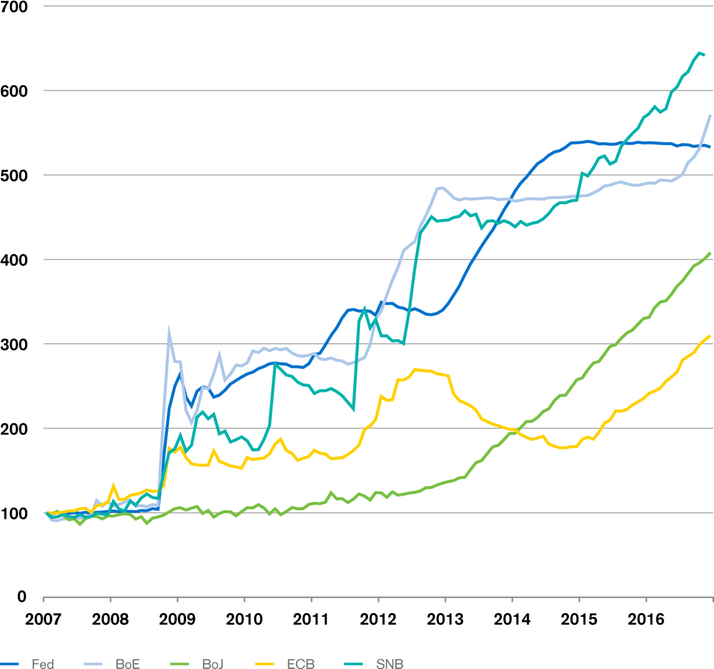
Central banks' balance sheet total has exploded over the past decade (Source: Credit Suisse)
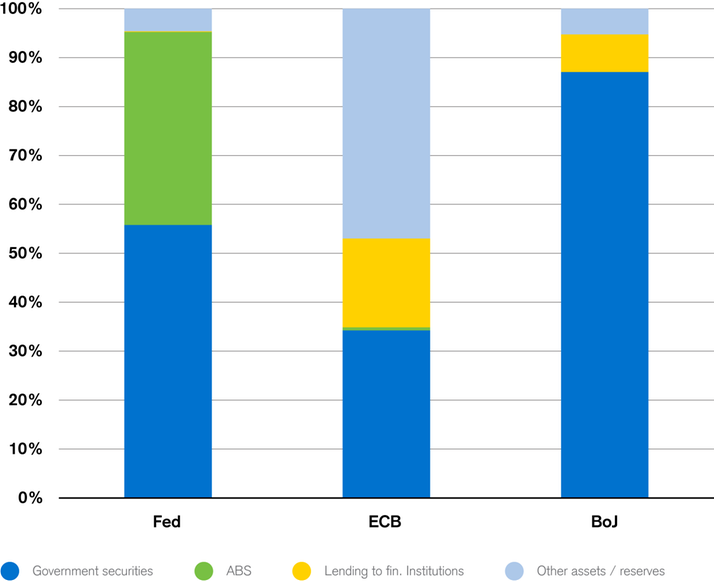
Central bank balance sheets consist largely of government bonds (Source: Credit Suisse)