English
EN


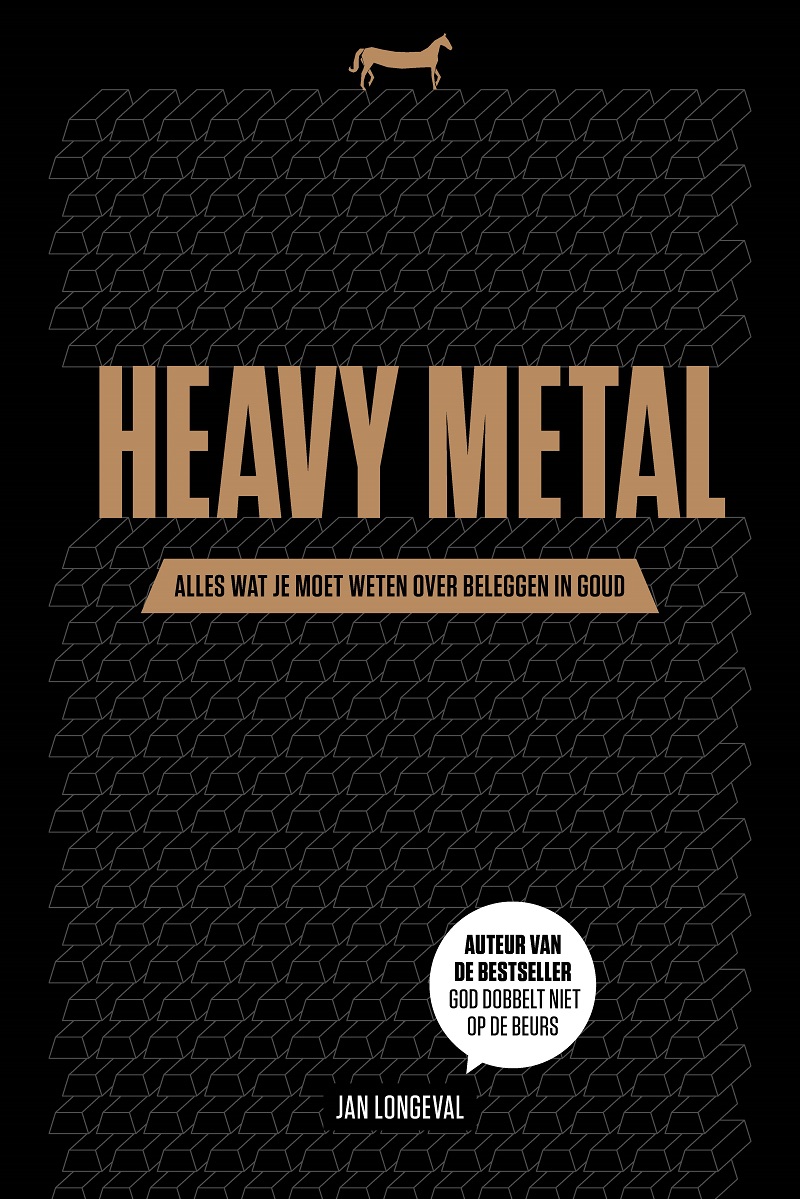
Gold offers protection against shocks in the financial system and therefore deserves a place in every investment portfolio. That's what stock market expert Jan Longeval writes in his new book 'Heavy Metal'. While numerous money systems have fallen apart throughout history, the precious metal still manages to retain its value. With nearly $17 trillion in bonds yielding negative returns and savings no longer rewarded, more high-net-worth individuals and investment funds will make the move to gold, Longeval expects.
After his Bestseller 'God doesn't play dice on the stock market' Longeval takes us in his new book 'Heavy metal' into the world of gold. Why has the precious metal had such a strong appeal for centuries? And why is it that in times of crisis we always fall back on the yellow metal, which runs like a golden thread through history? We spoke with Longeval, who previously worked as an asset manager at Bank Degroof Petercam and is now director of the Belgian financial consultant Kounselor. Where does his enthusiasm for gold come from?
It's a combination of factors. I look with increasing amazement and suspicion at the massive global debt build-up, which can be related to the rise in the price of gold and the advance of cryptocurrencies such as the Bitcoin. It translates a growing distrust into government money, which can be traced back to 1971, when Nixon cut ties with gold and money. Since that date, inflation has risen structurally, which is a new phenomenon. After all, the price level in 1971 was more or less at the same level as the price level in the sixteenth century. That can't be a coincidence.
These evolutions force you to think deeply about what money is, or better, what money has become. That's why I wanted to write a book with a double dimension. A book about gold in all its facets and about money in all its facets. Both are inextricably linked. You can't have a valuable opinion about gold or about the Bitcoin if you don't understand what money actually is. The other reason is that, although I have been investing professionally for thirty years and have been investing in precious metals for several years, I found myself knowing little more about the subject matter than the usual clichés. Superficiality is a cardinal sin for an investor. That's why I went very deep into research to understand gold.
Many rule out a return to a gold standard, where you could exchange paper money for gold at a fixed rate, because they think that the gold standard was the cause of the Great Depression of the 1930s. The gold standard would have been too rigid and thus got in the way of monetary stimulus to help the economy recover. There are also frequent references to the economist John Maynard Keynes, who is said to have once said that 'the gold standard is a barbarous relic'.
 Both arguments are false. The book, which is half a history book, explains that the Great Depression was not caused by the gold standard, but by government mismanagement. For example, there was the Smoot-Hawley Act of 1930, which paralyzed international trade with huge import tariffs. The Federal Reserve wanted to eradicate the speculative excesses of the 1920s at all costs. It pursued monetary mismanagement by raising interest rates in order to defend US gold reserves and avoid a devaluation of the dollar. This was despite the fact that the economy had already weakened considerably at that time. It could have opted for a reduction in interest rates and a devaluation, which Roosevelt did only in 1934 by raising the official price of gold by 67%.
The point I want to make is that it was not the gold standard that was or is the problem, but the way you deal with the gold standard. And Keynes is misquoted. In reality, he said that the "gold standard is already a barbaric relic." Later, during the Bretton Woods conference, he proposed the 'bancor', a basket of currencies that included gold.
Since 1971, we have been living in a world of fiat money, in which the monetary system no longer has a stable anchor like gold. Under the gold standard, there was a structural brake on money creation and debt accumulation, which is essentially the same thing. After all, the banking system had to contain a certain gold reserve in relation to the money that the banks created through loans. Without a golden handbrake, the debt situation and monetary policy are completely derailed.
The book shows that over the centuries all monetary excesses have ended in total chaos, after which people always went back to the icon of 'good money', which is gold. Gold is the money of God, as they say. This may also happen in the future. A new financial crisis will highlight the need for a new monetary anchor. A return to the gold standard will have to be done very cautiously. The money supply has increased exponentially since 1971, while the gold reserves of the central banks have remained broadly the same.
It is therefore inconceivable that we will return to a classical gold standard, in which a large part of the money supply is guaranteed by gold via a high 'reserve ratio'. A return can only happen gradually and in combination with a more disciplined government policy that increases confidence in the system. It will have to be a trade-off. Growing confidence allows for a gold standard with a low reserve ratio. If trust in the government were ever total, you could even have a gold standard without the government having a single gram of gold in reserve.
I don't believe in a new monetary role for silver. Silver had already lost that character for good at the end of the nineteenth century. A dual currency standard has proven to be far too complex in the past. Silver today is primarily an industrial metal and behaves as such, unlike gold, which has partly retained its monetary character.
There are at least two lessons to be learned. The first is that a hard currency policy is an economic boon for a country. I quote from the book: 'At the beginning of the seventeenth century, the guilder was the Dutch currency, but due to the busy trade with foreign countries, there were between eight hundred and a thousand different coins in circulation, many of which were deliberately depreciated. Exchange offices cheated and were adept clippers...
In 1609, the Amsterdamsche Wisselbank was founded, a public institution modelled on the Italian exchange banks, to put things in order. It had to centralize the money exchange and to steer the payment system in the right direction "As well as to prevent all steygeringhe [overvaluation] and confusion in the stuck of the currency", an objective that is also pursued by today's central banks...
The Amsterdamsche Wisselbank was an immense success. Amsterdam became the international hub for issuing ('pulling') and cashing bills of exchange. Precious metals flowed to the city like water, which also allowed it to grow into Europe's most important trading center for precious metals. The new 'bank guilder' of the Amsterdamsche Wisselbank was very popular at home and abroad, because the bank did not value the currency. The success of the guilder translated into low interest rates, which allowed the Netherlands to fully develop its industry and international trade. Partly due to the dominance of the Dutch East India Company (VOC), the guilder became the most important trading currency in the world.'
The second lesson is that innovation also boosts the economy. The Amsterdamsche Wisselbank was one of the first giro banks, which allowed merchants to pay quickly and safely. I think the Netherlands still has these qualities today. The combination of innovative capacity, entrepreneurship, swagger and ambition combined with a frugal government is something that you should continue to cherish.
After years of being net sellers, central banks have been net buyers again for a decade. It is true that only the central banks of the emerging countries act as net buyers. The central banks of the West do not buy more gold. A survey shows that 40% of the central banks in emerging countries hold gold reserves in anticipation of a realignment of the international monetary system, in which gold will again play a role.
China and Russia in particular are fed up with dollar dominance. America is abusing the dollar to impose its will on the rest of the world. Every transaction that passes through the U.S. dollar clearing system is within the reach of the U.S. justice system. America has 8,000 trade sanctions outstanding and uses the dollar to enforce these sanctions. In addition, it is clear that we are warming up for a new cold war, this time between America and China.
China cannot and does not want to dethrone the dollar with the yuan, because it would then have to open up the Chinese capital markets. China is opting for a detour. It has publicly expressed its preference for the introduction of a bancor in Keynes's idea: a basket of currencies in which each country's currency would be weighted in accordance with its economic importance and secured by hard assets such as gold. McKinsey estimates that China's real gold reserves are three times higher than what the official figures show.
The corona crisis has exacerbated the debt situation. At the end of 2019, global debt stood at $250,000 billion, or more than three times global gross domestic product. Due to the corona crisis, we are now getting pretty close to 300,000 billion dollars. In the book, I calculate that the hidden debts still amount to at least 100,000 billion dollars. It's getting out of hand. The enormous mountain of debt is prompting the government to resort to extreme measures more and more often.
The government is throwing in ever larger support programs, financed with government bonds that are then massively bought up by the central banks. The billions fly out the door like children on a free summer afternoon. In doing so, they push interest rates below zero, which is actually too crazy for words. A growing number of investors feel that this situation is fundamentally unhealthy and are looking for a way out of the current financial system. And then, inevitably, you end up with gold and, for some, crypto.
Did you know that your bank deposit legally belongs to the bank? In today's crazy monetary universe, all money is actually credit. And banks have a bad habit of failing regularly. Gold has no counterparty risk, it cannot go bankrupt. It is imperishable. It's compact. Gold is portable wealth. Thanks to gold and silver, the Israelites were able to take their possessions with them when they left Egypt to escape Pharaoh's yoke. In the epilogue, the book of Genesis is used to give the role of gold and silver its proper place.
We are trapped in the Supercycle of Debt. The economy is debt-addicted and needs an ever-increasing dose for the same economic kick. And this time, unlike the 1950s and 1960s, we will not be able to grow out of debt. The ageing of the population and declining productivity gains mean that Europe will grow by less than 1% per year in the coming decades. Sooner or later, this will go completely wrong. And then you want gold (laughs).
Gold is an insurance against chaos more than it is against inflation. Gold holds its value over many decades or even centuries, but over shorter periods of time, gold does not always offer protection against inflation. It owes that reputation to the 1970s, when America turned to massive money creation after the Nixon shock, causing inflation to skyrocket. The gold price then achieved a top performance. But in the 1980s and 1990s, the price of gold stagnated while inflation accumulated at 130%, greatly eroding the value of gold.
Gold does offer protection against chaos. During recessions and stock market crashes, gold almost without exception performs well, making it suitable as a diversification in the portfolio. This is not the case for silver, which, along with platinum and palladium, goes down during an economic downturn. Gold is an excellent insurance policy. A policy you hope you'll never need. To make a difference, a position of 5 to 10% is needed. Today, gold is an interesting alternative to supposedly safe government bonds. It is better to have no interest than a negative interest rate.
The way you invest in gold depends on why you invest in it. If you seek protection from calamity, you are condemned to physical gold. It's the only way to stay out of the financial system, even if you quickly spend 1 to 5 percent on buying and selling costs. Because the production of gold bars costs less than that of coins, as an investor you pay a smaller premium – or more price compared to the market price – for bars than for coins. If you want to actively capitalize on the gold price, listed funds or trackers that invest in physical gold themselves are the best option. Their expense ratio fluctuates around an acceptable 0.2 to 0.4 percent. I combine both: physical gold for the long term, trackers for the short term.
It is no coincidence that the Bitcoin is called e-gold. The whole concept is a digital imitation of gold. Bitcoins are invariably depicted as a gold coin. Bitcoins are 'mined'. The Bitcoin protocol creates an artificial scarcity, while gold is naturally scarce. The problem is that in addition to the Bitcoin, you have thousands of other crypto coins, which goes against the idea of scarcity. And technology is changing rapidly. Who knows, maybe the Bitcoin is the new Nokia. The Bitcoin has the advantage of being the first among cryptocurrencies, but also within the Bitcoin you have branches that create alternative bitcoins.
There is also the political risk that governments will curb the advance of private cryptocurrencies. They see it as a threat to their monetary hegemony. By the way, the Chinese government has launched its own crypto coin this year. And those who take refuge in Bitcoin to withdraw their money from the government should consider that more than half of all the 'hashpower' with which bitcoins are mined is in the hands of four Chinese companies that are de facto under the control of the Chinese Communist Party. Today you see a power struggle between gold and Bitcoin. It is not inconceivable that the Bitcoin will one day win the argument. Money is a psychological fact. If the market wants to believe that e-gold is better than real gold, then it will be. I'm still putting my money on gold.
The new book 'Heavy Metal, Everything you need to know about investing in gold' by Jan Longeval costs €28.50 and is now for sale at bookstores such as Bol.com and Standaardboekhandel.be.