English
EN


The end of the dollar's hegemony has been predicted several times in recent decades. The discussion about the dollar was revived after Russia's invasion of Ukraine. Different economists Predicted This was followed by the arrival of a new gold-backed currency. But is it likely that this coin will be created? And does a strong BRICS bloc actually mean that the dollar will fall and lose its status as the world's reserve currency, or will the dollar remain the dominant currency in the future?
The BRICS countries, a group of emerging economies, are holding a meeting in Johannesburg this week. According to Reuters the possible accession of new countries in particular is an important topic being discussed. Multiple countries have expressed interest in joining the BRICS, including Saudi Arabia, Iran, the United Arab Emirates, Indonesia, Argentina, and Ethiopia. The New Development Bank and economic cooperation between the countries will also be discussed.
Recently, a possible new BRICS currency, a new currency that would be backed by gold, has been in the news several times. However, not every economist is so sure of the arrival of such a currency. Jim O'Neill, the economist who first described the term BRICS, called the proposal "Ridiculous'. Also Frank Knopers expressed his doubts on Holland Gold; "The gold-backed coin is mostly wishful thinking. It is not easy to come together as a group of countries and start a currency union. The question then is who will take the lead and what exactly the gold cover will look like,' Knopers said.
Although a gold-backed currency does not yet appear to be introduced, closer cooperation between BRICS countries could spell the end of the dollar's hegemony. With Russian foreign assets frozen and the dollar increasingly used as a weapon, some economists believe the dollar will decline in importance. Central banks, for example, already hold fewer dollar reserves. Credit Analyst Zoltan PozsarExpect a new situation in which not one currency is dominant, but a scenario in which the dollar will give way to alternatives, such as the euro or the renminbi, in some parts of the world. In other areas, however, the dollar will remain dominant.
Trade
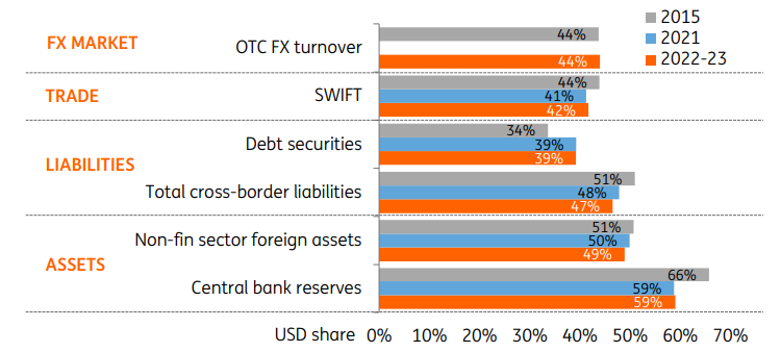
The use of the dollar compared by segment. (Source: ING)
One research by ING de-dollarisation is not yet at an advanced stage. For example, the dollar's share in various segments has not increased or decreased sharply. However, it is possible that the dollar will lose ground as a means of payment due to the rise of the renminbi. China is in the process of shutting downCurrency swap agreements, making it easy for other countries to obtain renminbi.
In addition, China is working on an alternative to SWIFT and more and more contracts are being concluded in renminbi rather than dollars. As a result, the renminbi is becoming more popular, but according to ING, this is mainly at the expense of currencies such as the British pound. The euro does not yet seem to be suffering much damage from the rise in the renminbi. The use of the dollar decreased slightly, because the dollar was sold in Russia after the invasion.
It is quite conceivable that cooperation between BRICS countries will become closer in the future. In that case, it is also quite possible that the renminbi will continue to grow. The fact that there is a desire to become less dependent on the dollar was again confirmed by Putin; 'The objective, irreversible process of de-dollarization of our economic ties, is gaining momentum'. So there is a good chance that more and more contracts will not be concluded in dollars. This may not yet be clearly visible in the figures, but that could change in the coming years.
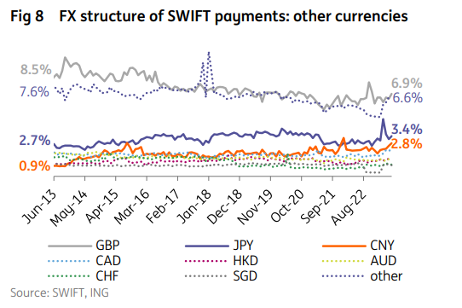
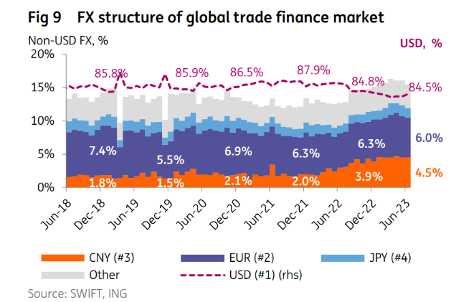
The structure of payments via SWIFT. (Source: ING)
What is striking is that the dollar's share in the Debt securities has increased; In other words, relatively more debt securities were issued in dollars. This debt does not only come from the extensive eurodollar market, but also from the further increase in government debt. This is indicative of the dollar as the world's reserve currency. Due to the dominant role of the dollar, the Americans no longer have a brake on debt, as economists haveWim Boonstra explained on the channel of Holland Gold. As a result, the national debt of the Americans has risen sharply in recent years.
According to ING, the dollar remains the dominant currency in the debt market. The euro is only a minor competitor, as the financial markets in Europe Far from complete be. And since the market for 'Panda bonds'(international bonds issued in renminbi) is still very small, the renminbi is still a long way from competing with the dollar in this respect. ING also looks back on the fall of the British pound as the world's reserve currency. The dollar took over the role of the pound as more and more debt was taken out in dollars worldwide. Such a turnaround does not yet seem to be the case.
Therefore, there is still a lot to be done before the dollar's dominance really comes to an end. Currently, the vast majority of debt is still issued in dollars, euros or British pounds. The New Development Bank has set itself the goal of providing thirty percent of its own financing in local financing.
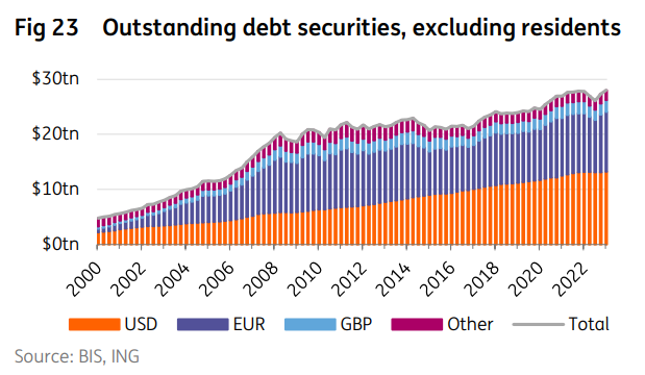
Structure and growth of debt. (Source: ING)
The report also shows that central banks are reducing dollar reserves. Even before the war in Ukraine, central banks held fewer dollars, but in 2022 the reduction of dollar reserves accelerated. According to ING, this trend does not have to continue. This is because the dollar is becoming more attractive again due to the high interest rates of the Fed and because central banks protected the exchange rate of their own currency last year by intervening in the foreign exchange market. The central bank then exchanged dollars for the local currency to protect the rate, reducing dollar reserves.
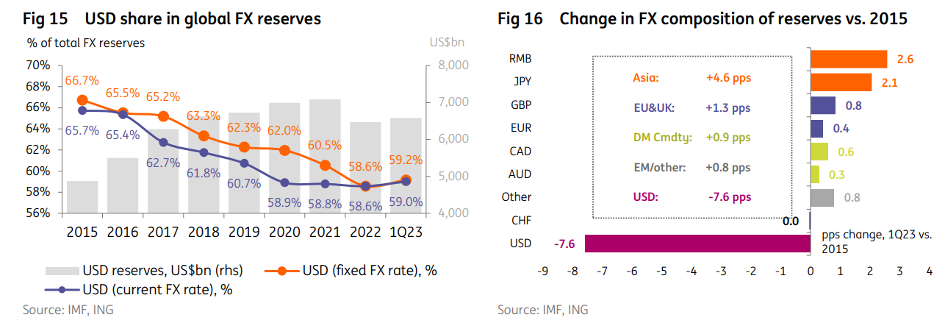
Structure and change of reserves. (Source: ING)
Nevertheless, there is a clear trend in the graphs above. It is quite possible that countries will also want to hold fewer dollars in the coming years, as the dollar is more clearly used as a weapon. In addition, some of the dollars seem to have been replaced by Asian currencies such as the renminbi and the Japanese yen. We also see that central banks are responding to the geopolitical turmoil and replenishing their gold reserves. For example, China In July, for the ninth month in a row, gold reserves. The chance that dollar reserves will eventually return to old levels therefore seems small.
So there is still no consensus on the future role of the dollar. Some economists, such as Zoltan Pozsar, think that the end of absolute hegemony is near. Other economists, such as Mathijs Bouman, are keeping an open mind for the time being; "As long as the big companies like Google, Facebook and Tesla come from America and they switch so easily there, my bet would always be on the dollar," the economist said in a debate on Holland Gold.
The fact is that this process depends on many factors, such as developments in international trade, the geopolitical situation, and the emergence of new companies. It is also possible that the current figures on the share of each currency in different segments do not yet say much, as any process of de-dollarization is likely to take a very long time. In this way, the process of de-dollarization can spread over a long period of time. We will continue to monitor developments closely in the coming period.
 Have a look at us YouTube channel
On behalf of Holland Gold, Paul Buitink and Joris Beemsterboer interview various economists and experts in the field of macroeconomics. The aim of the podcast is to provide the viewer with a better picture and guidance in an increasingly rapidly changing macroeconomic and monetary landscape. Click here to subscribe.