English
EN


Next year, the Bank of Japan will launch the Largest shareholder on the Japanese stock market. If the central bank continues to buy shares at this rate, it will overtake the largest pension fund next year. The Bank of Japan already has ¥28 trillion worth of equities on its balance sheet, but plans to add another ¥6 trillion annually. That means the central bank will own about ¥40 trillion worth of equities by the end of 2020, more than the national pension fund.
In recent years, the Japanese central bank has been buying shares of companies in addition to government bonds to boost inflation. To date, without much success, as inflation in Japan is still Stubborn low. The economy is so indebted that there is little economic growth, so the central bank tries to achieve growth by pumping more money into the economy. For example, the central bank's balance sheet total has increased spectacularly since 2012, from ¥150 to ¥560 trillion. As a result, the balance sheet total is now larger than Japan's gross domestic product.
The Bank of Japan is already the largest shareholder of 23 publicly traded companies, including Nidec, Fanuc and Omron. Of almost half of all listed companies, the central bank is one of the ten largest shareholders. The central bank does not buy shares directly, but does so through so-called exchange traded funds (ETFs).
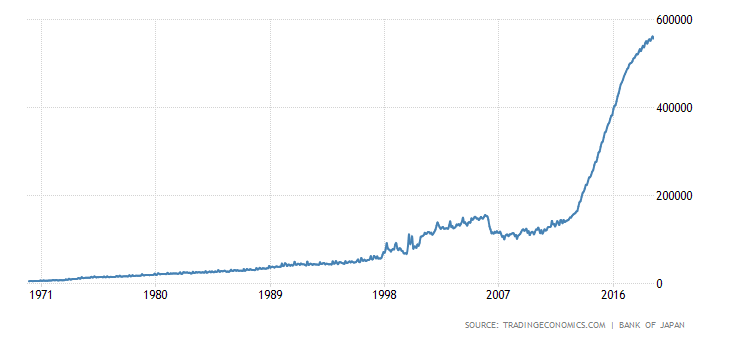
Balance sheet total Bank of Japan (Source: Trading Economics)
Japan's central bank is on track to become the largest shareholder, while it has also already taken over a large part of the national debt. In February, it was ¥465.8 trillion of government bonds on the balance sheet, more than half of all government bonds currently in circulation. The central bank buys bonds and equities to keep the market 'stable', but the policy is certainly not without risks. In the past, it often turned into hyperinflation, as confidence in money evaporated.
Internationally, there is also more criticism of Japan's aggressive monetary policy. The Organisation for Economic Co-operation and Development (OECD) Warns that the asset purchase programme takes away market discipline. Companies are rewarded for being included in a stock index, rather than following a business strategy that delivers returns. As a result of central bank intervention, share prices are rising, including those of companies that are doing poorly. This makes it more difficult for investors to make a rational assessment.
Another risk is that the Bank of Japan will not be able to change its course just like that. Just the announcement that she is going to buy fewer shares could cause stock prices to plummet. The same applies to the government bond-buying programme. There is no going back without jeopardising financial stability.
Also Read: