English
EN


Many investors are wondering how it is possible that U.S. Treasury yields are barely rising, despite the fact that the Federal Reserve has stopped its bond-buying program, that it has already raised interest rates seven times, and that countries such as China and Russia have stopped accumulating more U.S. Treasuries. Even the Trump administration's fiscal stimulus plans seem to have little impact on the interest the country pays on its national debt.
While U.S. Treasury yields have risen since 2016, historically the current interest rate of U.S. Treasuries has risen from almost 3% for 10-year bonds still exceptionally low. Interest rates are comparable to five years ago, when the US central bank was still withdrawing government bonds from the market. How is it possible that interest rates are not rising further? And who finances the U.S. deficits?
The answer to these questions is to be seek in the banking sector, because figures from the Federal Reserve show that financial institutions have had a lot of government bonds (so-called Treasuries) on their balance sheets in recent years added. When the Federal Reserve tapered its bond-buying program in late 2013, commercial banks had $1.8 trillion in U.S. Treasuries on their balance sheets, but that amount has now risen to $2.55 trillion.
Since the central bank turned off the proverbial printing press in 2015 and put debt back on the market, it has managed to reduce its position by just $210 billion, while commercial banks added nearly $500 billion in debt to their balance sheet totals over the same period. So the commercial banks bought more government bonds than what was sold by the Federal Reserve and other central banks in the world.
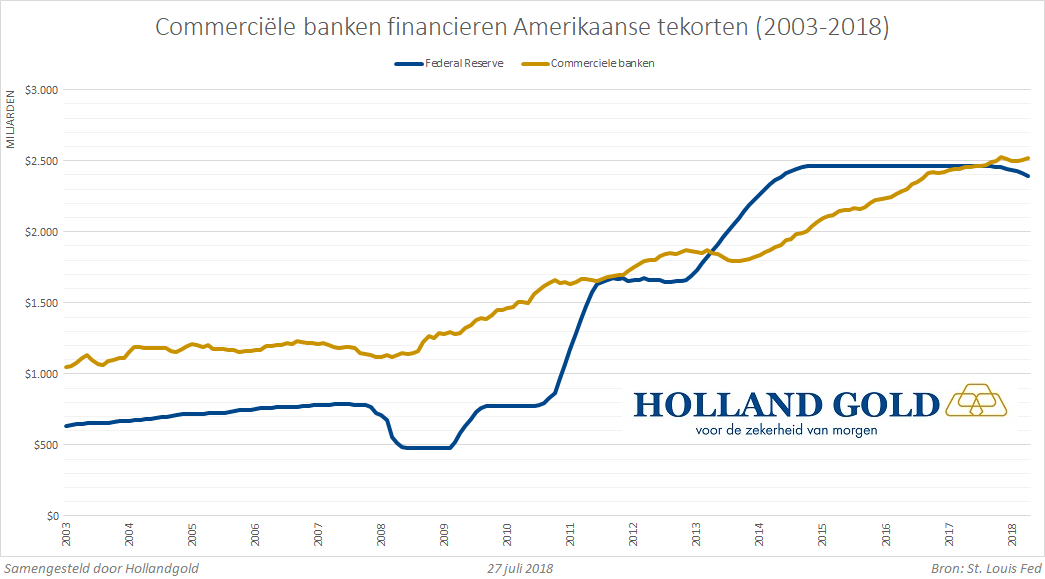
Commercial banks finance U.S. deficits
The large commercial banks therefore have a significant share in the financing of the US national debt and the rising budget deficit. But why are they buying the debt that many investors no longer want? The most important explanation for this can be found in the rules of the banking system.
Government bonds are still used in the current financial system marked as a completely risk-free investment, with the result that banks do not need to hold reserves for it. The Basel III guidelines state that there are no capital requirements for public debt or for debts guaranteed by governments. And that means that, on paper, there is no risk for banks to lend money to the U.S. government.
Banks also do not have to fear the price risk of government bonds, because they have been allowed to hold government bonds on special bonds since the outbreak of the financial crisis. 'Held to maturity'Accounts. As a result, the bonds are valued at face value and not at market value, which falls when interest rates rise.
So, banks can make virtually risk-free returns by lending money to the U.S. government. They do not incur any price risk during the term if they leave the bonds on the balance sheet for the entire term.
As long as the United States can finance its deficits in this way, interest rates are likely to remain low, even as other countries reduce their dollar reserves. Despite this, it is worrying to see that the rest of the world has all but stopped accumulating dollar reserves and that countries such as China and Russia are diversifying by trading in other currencies and buying gold.
This contribution was made from Geotrendlines