English
EN


This article has been automatically translated from Dutch. Click here to see the orginal article including all links to sources.
That prices have risen, you had already noticed. But by how much exactly? In this first Week in Review of 2026, we present the 2025 returns of the three most popular precious metals in a clear and structured overview. We then turn to the expectations for 2026. Will gold, silver and platinum continue their ascent this year?
Gold surged to a new record in the week leading up to New Year's Eve, climbing well above €124,000 per kilo, but ultimately closed 2025 lower at €117,969 per kilogram. Our 'Precious Metal Tax Filing 2025' overview shows that the LBMA-determined reference value for one kilogram of gold on 1 January 2025 was €80,641.79. This results in a return of more than 46% in euros for gold over 2025.
Platinum also hit new highs during the Christmas holidays, briefly trading above €67,000 per kilo and €2,094.40 per troy ounce. However, platinum corrected soon after and closed 2025 at €56,181.80 per kilo, or €1,747.45 per troy ounce. Platinum began 2025 at €877.58 per troy ounce, translating into a return of more than 99% in euros.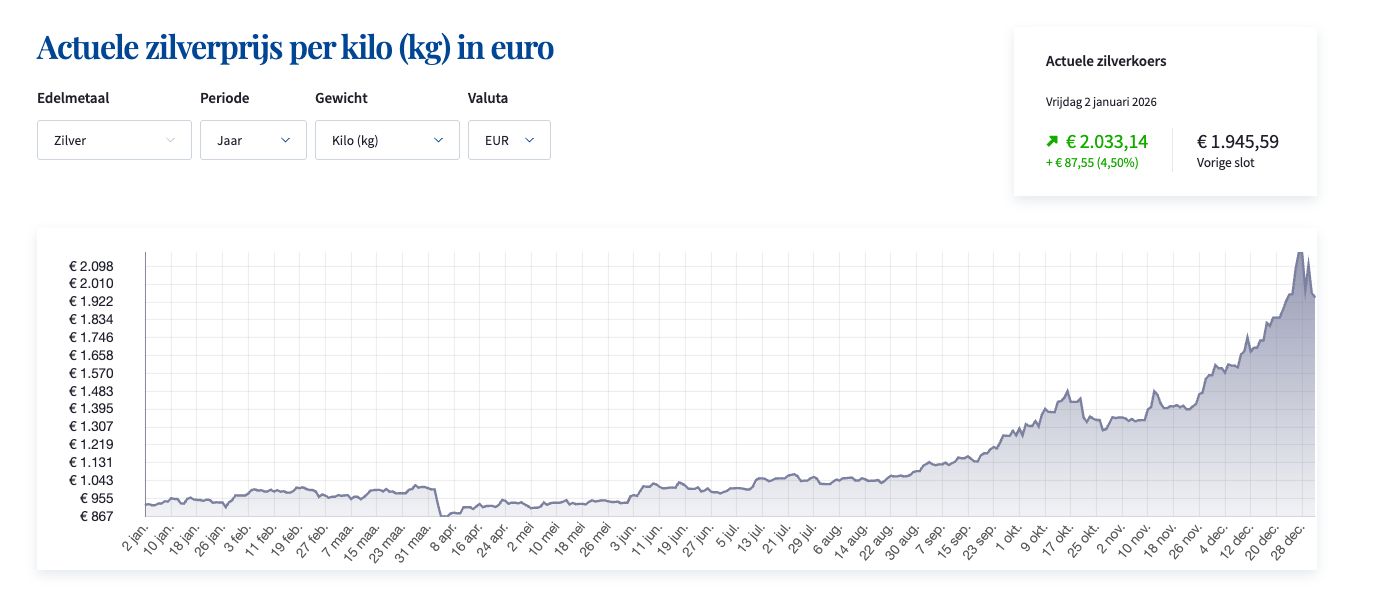
The silver price also delivered a spectacular performance, touching a new record of more than €2,235 per kilo in the days leading up to the new year. This level did not hold, and silver closed 2025 at €1,945.59 per kilogram. Silver opened the year at €892.50 per kilo, resulting in a 118% return in euros, more than doubling its opening price. Silver was the best-performing precious metal of 2025.
Bloomberg reports that these were the highest precious metal returns since 1979, with metals outperforming the Dutch AEX Index (+7.3%) and the US S&P 500 (+16.5%). Bitcoin was also beaten, posting a negative return of around -6% for the year.
Precious metals started 2026 with fresh gains. But after such an extraordinary year, can we still expect further upside for the remainder of 2026?
In the Christmas Special of the Holland Gold Podcast, Sander Boon and Frank Knopers expressed the expectation that 2026 could bring new price records. They cited ongoing geopolitical uncertainty around the global monetary system, declining trust in politics, expanding debt levels and inflationary pressure as key drivers.
According to Frank and Sander, gold could rise to €150,000 per kilo in 2026. In the event of major geopolitical or monetary shocks, prices could go even higher. In such scenarios, they expect gold to outperform silver. A recent Spotify listener poll from the Holland Gold Podcast indicates that more than half of respondents expect silver to be the best-performing precious metal of 2026.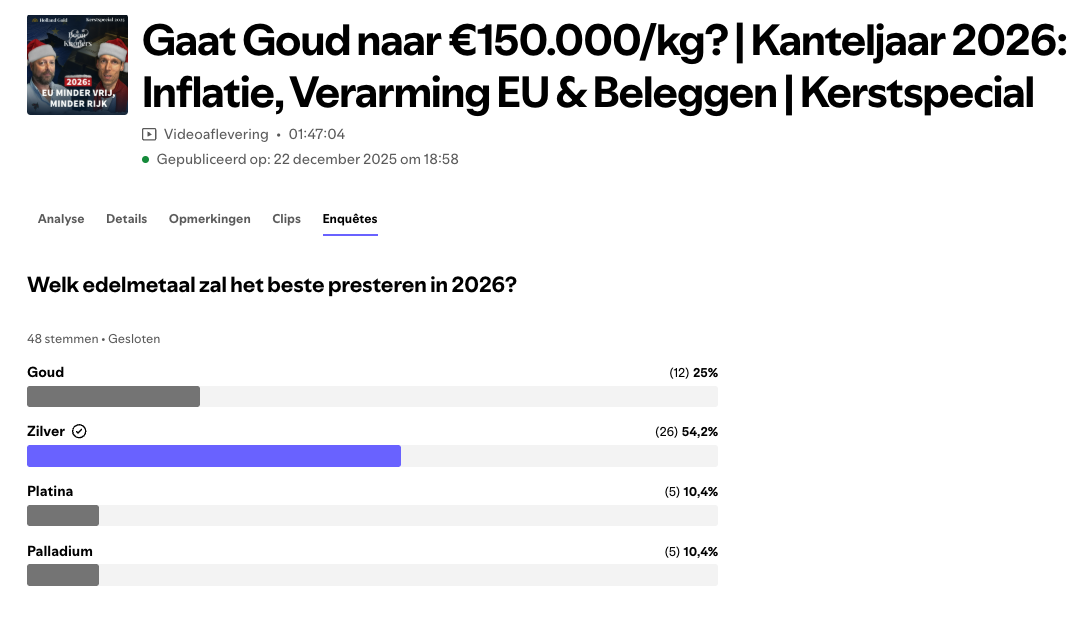
Zerohedge highlights similar factors supporting metals, including geopolitical shifts prompting central banks to build strategic reserves, concerns about US government creditworthiness, the weakening of the dollar and persistent inflation eroding the purchasing power of paper currencies. They also point to structural imbalances between supply and demand.
According to Zerohedge, these forces are unlikely to disappear in 2026. As a result, they expect gold, silver and platinum to continue delivering strong returns. They also note that BRICS nations remain committed to reducing their reliance on the dollar system. This trend is expected to support gold demand, as central banks and governments increasingly view gold as a reserve asset outside the dollar framework.
In addition, Zerohedge observes that deglobalization and rising resource nationalism are providing further support for metals. Recent developments show that China plans to restrict silver exports, adding fuel to an already tight market. Silver and platinum have faced structural deficits for years, and gold production continues to be constrained by high costs and a lack of new mine developments.
While price increases in 2026 may be less explosive than in 2025, Zerohedge believes the broader trend remains upward. If the Federal Reserve cuts rates further in 2026 — which they see as likely — and governments fail to address debt sustainability, demand for hard assets could rise further. In such a scenario, confidence in government-issued debt securities may continue to decline.
Jeroen Blokland made a similar assessment on our podcast, stating that the Fed has effectively restarted the proverbial money printer, expanding its balance sheet again. According to Blokland, inflation could reaccelerate later this year, even if inflation figures decline in the near term.
Otavio Costa also expects more rate cuts than the market currently anticipates, viewing them as necessary to keep government debt affordable. He argues this will support demand for hard assets. Likewise, Jack Hoogland sees conditions aligning for further monetary stimulus from central banks not only in the US, but also in China and Europe. According to Hoogland, falling inflation or even deflation in the eurozone — partly driven by a relatively strong euro — will prompt the ECB to stimulate more aggressively in 2026. The global money supply is expected to rise, which he sees as a positive environment for precious metals.
Earlier in December, we referenced World Gold Council analysis outlining multiple scenarios for 2026, ranging from a possible price decline to a 30% rise. On balance, the WGC remains constructive on gold, concluding that factors such as slowing economic growth, accommodative monetary policy and persistent geopolitical risks are more likely to support gold than undermine it.
The bulls — investors expecting further price increases — are clearly in the majority at the start of 2026. A positive signal for your precious metals portfolio, but a less positive one for global stability. As Paul Buitink remarked in his Christmas message: 'The world has not become more stable.'
More critical voices have also been heard, particularly regarding what some view as overly rapid price increases in the silver market. For example, silver could become too expensive for certain industrial applications. We will continue tracking the precious metals market and keeping you updated throughout 2026 — on our channels and in our podcast. Expectations are high, and the story continues.