9.3
8.670 reviews

English
EN


This article has been automatically translated from Dutch. Click here to see the orginal article including all links to sources.
Gold and silver once again reached historic price records this week. The rally fits into a broader trend in which investors are increasingly turning away from debt instruments and fiat currencies in favor of precious metals. During the World Economic Forum, Ray Dalio even warned that the monetary order is breaking down. What is going on?
Today, we once again saw new record prices for precious metals. Overnight, the gold price reached a peak of €135,915 per kilogram. In dollars, gold rose to $4,966 per troy ounce, just below the psychological threshold of $5,000. This puts gold at a return of more than 14 percent since January 1.
The gold price on Friday morning, 23 January (source: Holland Gold)
Silver is performing even better and also came close overnight to an important symbolic level. Just a few months ago, silver broke through $50 per ounce, while overnight the silver price reached $99.36. A new record was also achieved in euros. Shortly before seven o’clock this morning, the silver price stood at €2,716 per kilogram, good for a return of more than 38 percent since January 1.
In last week’s selection, we discussed the relationship between rising government debt and the flight into precious metals such as gold and silver, using the United States and Japan as examples. Today, we build on that analysis.
Ray Dalio, founder of Bridgewater Associates, is considered one of the world’s most influential investors and billionaires. Dalio is currently present in Davos at the World Economic Forum, where he stated in an interview that the monetary order is breaking down.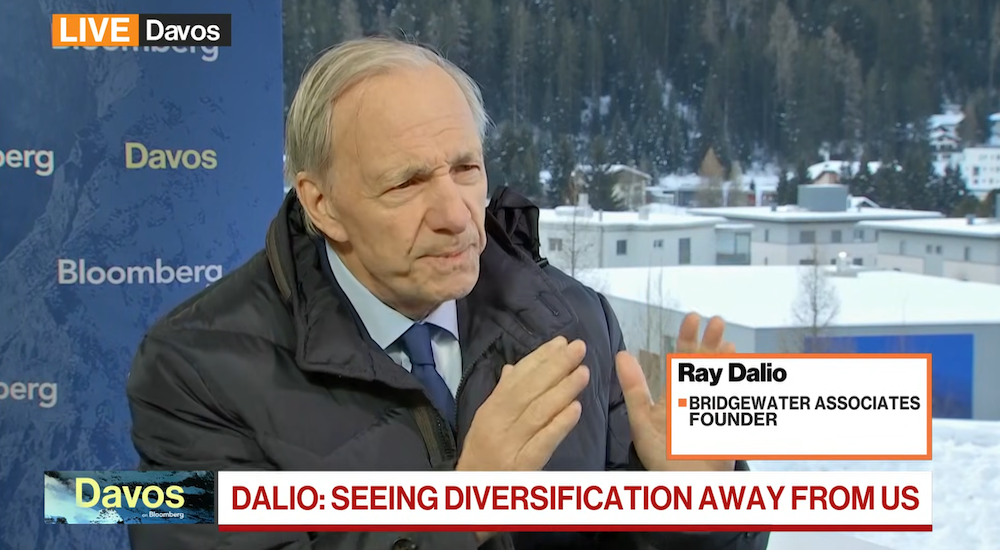
Dalio during an interview in Davos (source: Bloomberg)
Dalio explained that by this he means that fiat currencies and debt are no longer being held by central banks as stores of value in the same way as in the recent past. He spoke of an emerging capital war and sees a declining willingness to buy U.S. assets. According to him, countries that hold large quantities of U.S. dollars and government bonds will also be less inclined to finance U.S. deficits as confidence erodes. At the same time, the United States continues to issue large amounts of new debt.
However, this is not only about a shift away from the dollar or from the United States, but from all fiat currencies, including the euro. He advises investing less in bonds and more in gold. According to Dalio, gold should structurally make up 5 to 15 percent of a portfolio, and under current circumstances even more. On what makes gold so attractive, Dalio previously said that gold is the only asset that does not represent a debt or liability of someone else.
China’s holdings of U.S. Treasuries are declining, while its gold reserves are at record highs (source: Otavio Costa)
Dalio points out that central banks have been shifting away from debt and fiat currencies in favor of gold for some time now. China may be the clearest example of this. China’s holdings of U.S. Treasuries are at their lowest level in 18 years, while its gold reserves are at a record high.
Poland, which has significantly expanded its gold reserves in recent years, also announced this week that it will once again buy more gold. The Polish central bank wants to increase its gold reserves by another 150 tons to 700 tons, as a geopolitical hedge. “Our primary objective is to build an appropriate portfolio for these geopolitically unstable times, a portfolio that provides Poland with stability, security, and credibility,” said a member of the board of the National Bank of Poland.
Bloomberg writes that central banks are a key driver behind the gold rally. According to Bloomberg, they accelerated their purchases in 2022, after Russian foreign reserves were frozen following the large-scale invasion of Ukraine. That measure underscored the appeal of gold, which—unlike financial assets—cannot be blocked or frozen.
Long-term yields on government debt, such as that of the United States, have been rising for some time. The major concern is that central banks may lose control over these yields. Michael Zinn, managing director at UBS, sees investors shifting toward gold. According to him, markets are particularly concerned about developments in the Japanese bond market, which amounts to $7.5 trillion.
Last week, we already wrote about Japan, which has the highest debt-to-GDP ratio in the world. According to economist Robin Brooks, a form of debt crisis is now emerging there. Brooks argues that in a debt crisis in developed economies, the national currency loses value even when interest rates rise—whereas higher interest rates would normally lead to a stronger currency. This is because the central bank can implement policies to limit rising yields. The risk premium that would normally be reflected in higher interest rates instead shows up in the exchange rate, causing the currency to lose value.
This week, Japanese Prime Minister Sanae Takaichi dissolved parliament and called early elections for February 8, in an attempt to convert her popularity into a solid majority in the lower house. She has previously promised to put an end to what she calls “excessive” fiscal discipline.
Rising yields on Japanese 10-year government bonds (source: CNBC)
A “highly irresponsible” plan, according to Brooks. He argues that markets are losing patience with governments that are chronically unable or unwilling to reduce their public debt. “This is not the time to pretend that Japan’s enormous debt burden is not a problem. Denial is not a plan,” Brooks writes. We saw this reflected again this week in rising yields on Japanese government bonds.
If yields continue to rise, we can expect a “full-blown debt crisis,” according to Robin Brooks. Before it reaches that point, he believes the Bank of Japan will intervene to cap yields—but in doing so, the yen will ultimately be the casualty, and the currency will lose value.
We are already seeing that the yen is at its weakest level against the euro since January 2000, and as you know, the euro itself is hardly a model of purchasing power preservation. If you were Japanese, would you prefer to keep your savings in yen or in precious metals?


