English
EN


Gold has benefited from unprecedented support measures by central banks and governments in 2020. Due to the corona crisis, more savers and investors sought refuge in precious metals. Gold also benefited from historically low interest rates, which means that savings yield almost nothing. In dollar terms, the gold price rose by almost 25% last year, the best result in a decade. Will the precious metal be able to maintain this positive trend in 2021?
According to the World Gold Council the outlook for gold still looks favorable. At the end of last year, the prevailing mood among investors was that the worst of the corona crisis was over, but now there are more and more signs that prove the opposite. The extension of lockdown measures will cause more companies to run into problems, which will increase the economic damage. Government and central bank support measures can partially compensate for this, but they do pose new risks. Think of rising budget deficits and the prospect of more inflation.
Under these circumstances, it remains attractive to own gold. The precious metal combined high returns with minimal downside risk in 2020. During the year, the so-called drawdown, the maximum price drop, only a few percent. This made gold less risky than equities, whose prices fell sharply in February and March. In fact, at its lowest point, share prices were more than 30% lower than they were at the beginning of the year. U.S. Treasuries had the lowest risk, but also yielded much less return than gold.
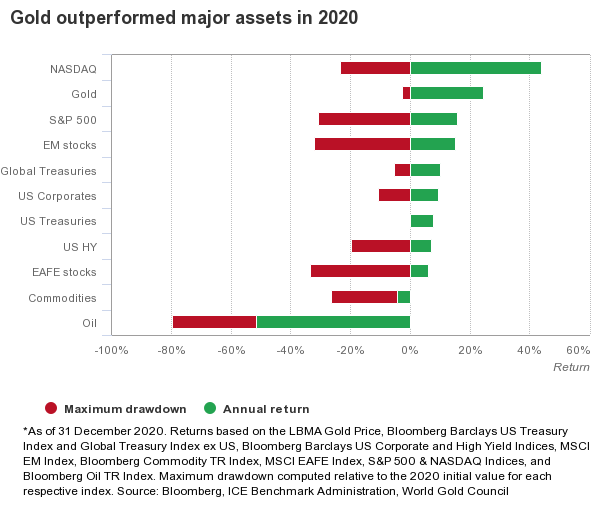
Risk and return of different investments in 2020 (Source: World Gold Council)
Characteristic of the gold market in 2020 was the gradual shift from paper gold to physical gold. In the first quarter, the long position on the futures market reached a record of 1,209 tonnes, but by the end of the year that position had fallen by 30%. This is despite the fact that the demand for Gold bars, Gold Coins and gold ETFs during the year on a remained at a very high level. Thus, investors preferred owning physical bullion.
According to the World Gold Council, this development is related to a Lack of liquidity in the gold market in the spring of 2020, creating a difference between the gold price in New York and London. The price of futures contracts was substantially higher than the spot price, making it less attractive to hold a position in the precious metal via the futures market. For many investors, this was a reason to include physical gold in their portfolios.
Many investors are concerned about the effect of all the monetary and fiscal stimulus on inflation. The money supply has increased sharply worldwide since the start of the coronavirus pandemic, as governments have spent much more money than usual. The expectation is that all that extra money will eventually cause more inflation, as that money circulates in the economy and drives up the price of goods. In addition, central banks such as the ECB and the Federal Reserve have indicated that they will expect higher inflation. tolerate.
According to the World Gold Council, this scenario is favorable for gold, as the precious metal has historically performed well at Rising inflation. In years when inflation exceeded 3%, the price of gold rose by an average of 15% per year. But also in the case of deflation the precious metal appears to offer attractive returns, as these periods are often accompanied by falling stock prices, low interest rates and increasing stress in the financial markets. The graph below shows that the Gold price has so far been fairly in line with global money growth.
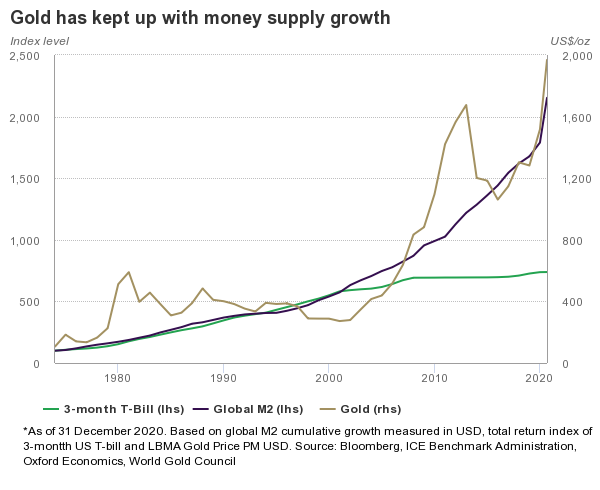
Gold price rises in line with money growth (Source: World Gold Council)
In 2021, the gold market is expected to benefit from increasing demand from China and India, the two most important markets for physical gold. Due to the corona crisis, there was a lot of drop in demand in 2020, because people had less money left to buy gold due to loss of income. In fact, many people had to sell some gold during the crisis to make ends meet. As a result, the gold price on the local market was for some time bearing Then there is the international gold price.
As these countries recover from the corona crisis, the demand for gold jewellery will also increase again. If this trend continues and the demand for gold in these important markets picks up, it could have a positive effect on the gold price in 2021. Especially if investors in Western countries continue to buy precious metals. The first signs point to this, because it is also very busy in the gold market this month.
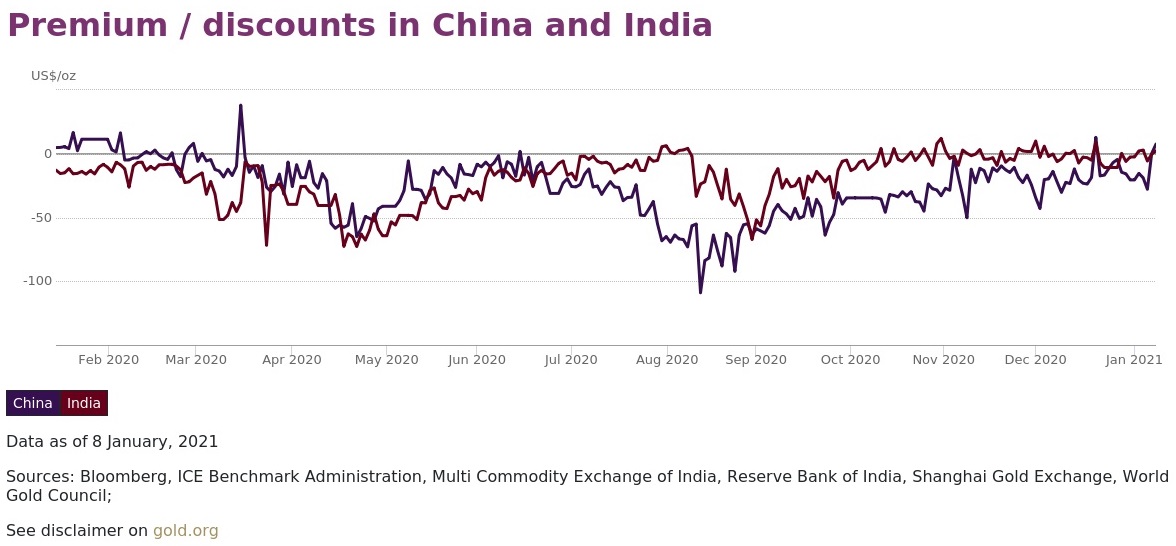
Gold price was lower in India and China during the corona crisis (Source: World Gold Council)
Based on these market developments, we expect the gold price to continue to rise in 2021. The increase may be less exuberant this year, for example if central banks buy less gold and the severity of the corona crisis decreases. As a result, the demand for gold as a safe haven may decrease. At the same time, interest rates are expected to remain low for a long time, making the precious metal an attractive alternative to savings. These low interest rates still work in gold's favour, especially if inflation continues to rise.
This contribution was made from Geotrendlines