9.3
8.892 reviews

English
EN


From Monday, European banks will have to comply with stricter rules of Basel 3. A few days later, these rules will also apply to American banks and next year also to British banks. And that has consequences for the gold market, because under Basel 3 it will be more expensive for banks to hold gold. Physical gold will be given a risk-free status, but banks will now have to set aside more reserves for unsecured positions in gold. You can read about the effect this has on the gold market in this article.
In response to the financial crisis from 2007 to 2009, the Bank for International Settlements (BIS) in Basel decided that stricter rules were needed to make the banking sector more resilient to the next crisis. In the run-up to the financial crisis, many banks had a lot of long-term loans outstanding, which they financed with short-term loans. When the housing market crisis broke out in the United States, banks ran into problems. They had a relatively large number of packaged mortgage loans on their balance sheets. The creditworthiness of banks came under pressure, making it much more difficult to roll over short-term loans.
At the time, the financial system was in danger of coming to a complete standstill, resulting in a major banking crisis. Several banks collapsed and central banks had to intervene to prevent a financial system collapse. In order to reduce the likelihood of a recurrence of this crisis, the Commission Basel Committee on Banking Supervision new rules. These rules require banks to hold more safe assets on their balance sheets. They also need to attract a larger share of the money they lend for the longer term, so that they are less likely to get into trouble in times of stress on the financial markets.
Two terms that are central to the new regulations are Net Stable Funding Ratio (NSFR) and High Quality Liquid Assets (HQLA). The NSFR is a liquidity ratio that prescribes that banks must also finance their outstanding loans with long maturities to a sufficient extent for a long time. This is more expensive than short-term financing, but also less risky. The new Basel 3 rules prescribe the percentage of the amount that banks lend for the long term that they must also finance for a long time, the so-called Required Funding Ratio (RSF). For relatively safe government bonds, it is only 5%, while for mortgages it is 65%. For gold, a much higher ratio of 85% applies. This means that it will be more expensive for banks to hold gold.
The liquidity requirements of Basel 3 also require banks to hold sufficient safe assets on their balance sheets, so-called High Quality Liquid Assets (HQLA). These are assets that banks can sell easily and at a good price, even in times of stress. The highest-valued assets are government bonds and other bonds guaranteed by the government. Corporate bonds and mortgage loans have a lower valuation, but they also serve as safe collateral.
Remarkably, gold has not been granted HQLA status under the new Basel 3 regulations. According to the BIS, there was not enough data to determine whether gold is sufficiently liquid in times of stress. This is remarkable, because the London Bullion Market Association (LBMA) has sufficient figures to show that the precious metal is a liquid and safe haven in times of crisis. These figures show that the precious metal can compete with government bonds and should therefore also be classified as HQLA.
That is why the LBMA already made a statement at the beginning of May profession to the Bank of Central Banks to revise the rules:
"While we support the NSFR's objective of mitigating liquidity deficiencies in the banking system, the NSFR does not take into account the unallocated precious metals balances on the balance sheets of gold banks. Consequently, the cost for gold banks to secure the 85% RSF would significantly increase the cost of transacting on the OTC market at the wholesale level. This will be felt by all market participants. This is likely to impact the trading volumes we see today and – as an unintended consequence of the NSFR – reduce liquidity in the precious metals market."
The new rules of Basel 3 could therefore worsen liquidity in the gold market. It will become more expensive for gold banks to trade gold, which may cause them to wind down or even divest their operations. That will worsen the liquidity of the gold contract market, the LBMA warns. Analysts at Bank of America also expect these new rules to have a detrimental impact on gold contract trading. In a new update at the beginning of this week, they wrote that banks that trade gold incur more funding costs.
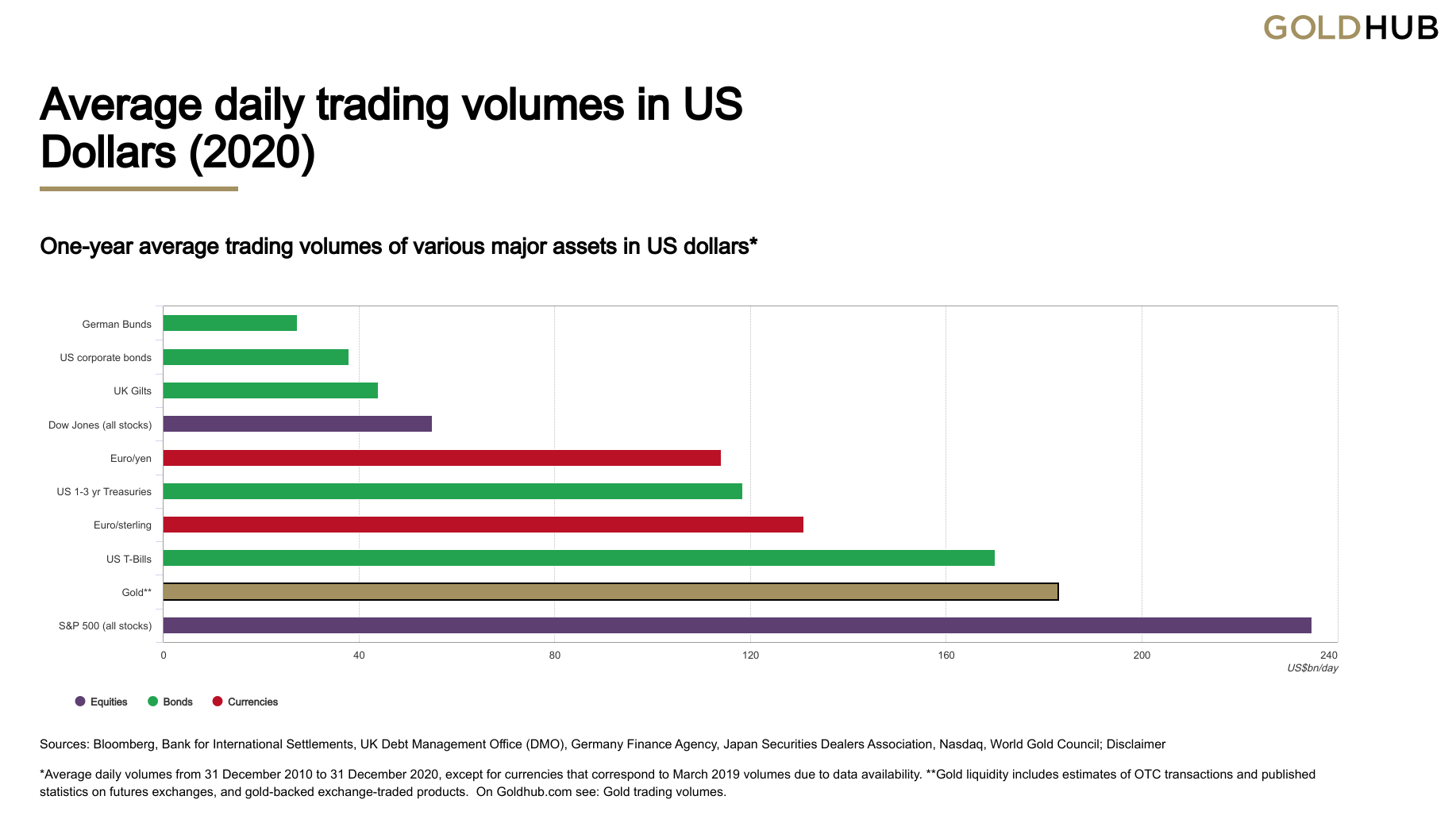
Average Daily Gold Trading Volume (Source: World Gold Council)
The Basel 3 regulation makes a clear distinction between Physical Gold and paper gold. Physical gold retains its risk-free status, which means that banks do not have to assign a risk weighting to it. This is different for paper gold, claims to bullion that have not been assigned and which are also known as 'unallocated' gold. From now on, banks that hold a position in gold on paper must comply with the Required Funding Ratio of 85%.
In this sense, as the bank of central banks, the BIS gives physical gold a different status than paper gold. It makes it more expensive for banks to own and trade gold on paper. According to the World Gold Council, Basel 3's disadvantage of paper gold is undesirable. Paper gold is said to be an important source of liquidity for the gold market. Earlier this month, she wrote about this in the next:
"Unallocated gold is an essential source of market liquidity. Without an unallocated gold market, it will be very difficult to finance (and facilitate) the upstream activities of gold producers and smelters, and the downstream users of gold, such as jewellers and fabricators. The demand for gold in the real economy depends on the unallocated gold market."
Whether Basel 3 will really have that much impact on the gold market is difficult to say in advance. To date, we have not seen any major movements in the gold market that we can attribute to these new rules. However, the BIS does send a clear signal, namely that physical gold should be valued in a different way than paper gold. This makes it more attractive for banks to convert positions in paper gold to physical gold, to the extent possible. As a result, the demand for physical gold may increase. Still, we don't expect Basel 3 to have a major impact on gold prices in the short term.
This contribution was made from Geotrendlines


