9.2
8.875 reviews

English
EN


The demand for Gold bars and Gold Coins reached its highest level in eight years in 2021. This is what the World Gold Council writes in its latest Quarterly report. Worldwide, 1,180.4 tonnes of investment gold were sold, an increase of 31% compared to the year 2020. The biggest rebound came from India and China, where coin and bar sales rose by 43% and 44%, respectively. Demand also increased in Europe and the United States.
Investors and savers bought more investment gold worldwide, but for different reasons. In Western countries, low interest rates and rising inflation gave a boost to the market, with preference shifting from gold ETFs to physical coins and bars. For example, demand for coins and bars in the United States rose 69% last year to a new record of 117 tons. The U.S. Mint sold 1.25 million troy ounces of gold Eagle and Buffalo investment coins. This was the largest volume since 2009.
The gold market in emerging countries such as China and India, on the other hand, recovered from a relatively lean 2020. As a result of the corona crisis, many households ate up their assets, which meant that they bought less gold and sometimes even had to sell it. People in emerging markets who were still able to buy gold were less likely to do so because of lockdowns and a relatively high gold price.
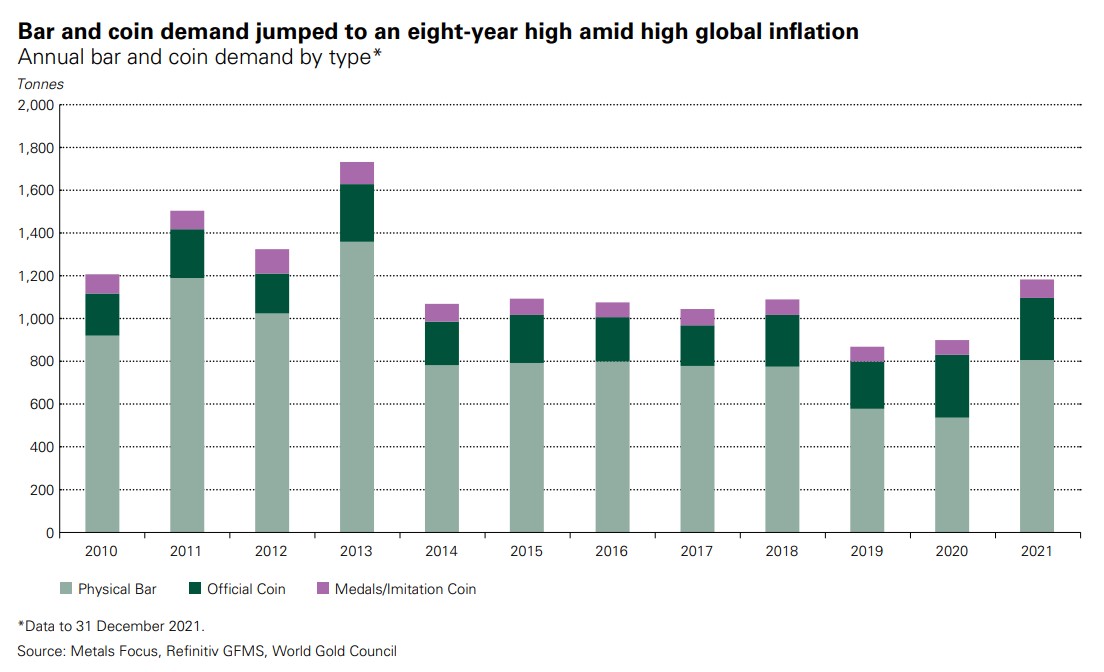
Global demand for coins and bars reached highest level in eight years (Source: World Gold Council)
Last year we wrote about a shift in the gold market, namely from ETFs to physical coins and bars. More and more investors and especially savers nowadays prefer to physically own precious metals. Last year, that trend was very pronounced, because while the demand for coins and bars picked up, the demand for gold ETFs decreased. These investment products, which allow you to buy gold as if it were a share, recorded net outflows of 173.3 tonnes in 2021. Last year, on balance, these funds added 874 tonnes to their stocks.
Another interesting observation is that investors who buy gold ETFs are less likely to sell their positions. We wrote about this last week This article. The most obvious explanation is that mutual funds have less reason to sell their gold again. Until a few years ago, it was more of a tactical move to buy gold, but now more and more investors are structurally including precious metals in their portfolios. The combination of persistently low interest rates and high inflation makes this increasingly attractive. Gold yields well when real interest rates are negative.
Central banks increased their gold purchases to 463.1 tonnes last year, up 82% from a year earlier. As a result, the total gold stock in central bank vaults worldwide rose to almost 35,600 tonnes, the highest level since 1992. Emerging economies in particular added gold to their stocks, but central banks in a number of Western countries also bought precious metals. Not only for more diversification, but also because of increasing geopolitical tensions.
The largest purchases last year were accounted for by Thailand, India, Hungary and Brazil. Uzbekistan, Singapore and Kazakhstan also added a substantial amount of gold to their reserves. Before Singapore it was the first purchase in more than 21 years when the World Gold Council began tracking this data. Another notable buyer was Ireland, which bought gold for the first time since 2008. The central bank of the Philippines was the only substantial seller with sales of more than 30 tonnes.
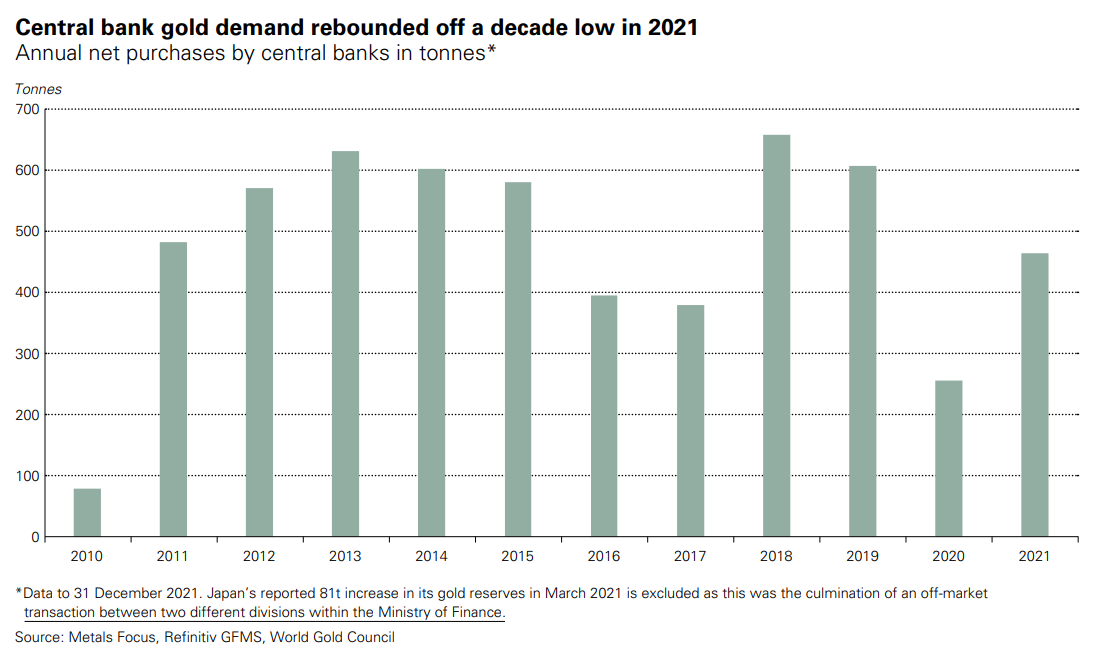
Central banks bought much more gold in 2021 (Source: World Gold Council)
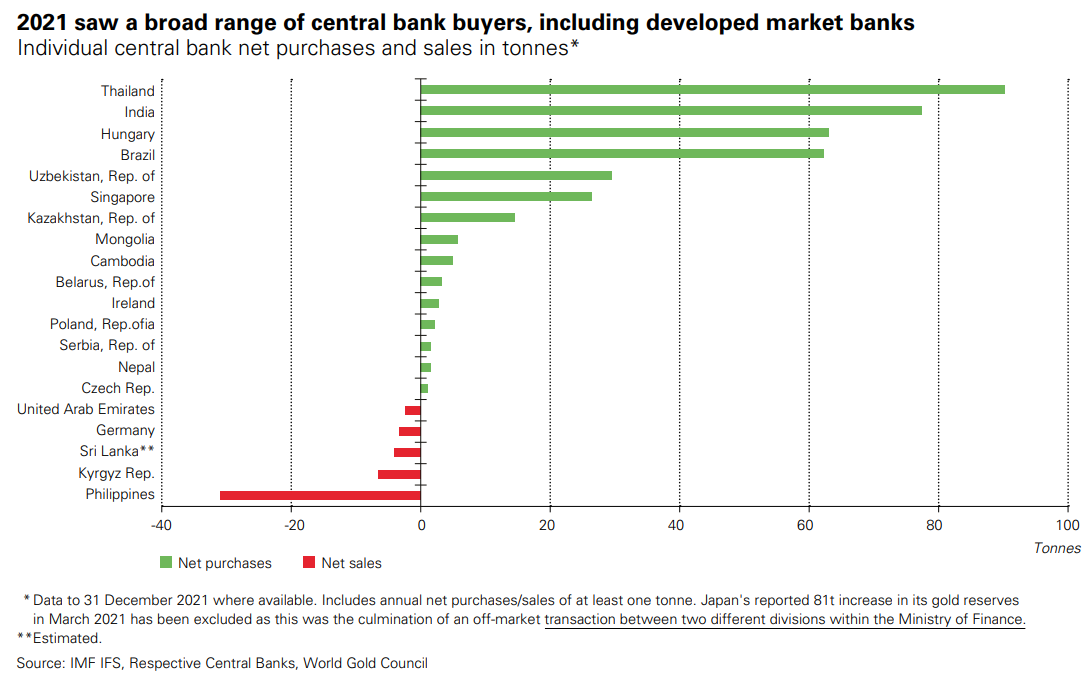
Emerging markets in particular continue to buy gold (Source: World Gold Council)
The World Gold Council writes in its report that the gold market this year will be driven by two important factors. On the one hand, the development of interest rates and, on the other hand, the stock market. The prospect of interest rate hikes by central banks may Gold price while falling stock prices are theoretically beneficial for gold.
Which of those two factors will prevail is difficult to say in advance. However, we have seen this month that the stock market is very sensitive to a rise in interest rates. Many popular growth stocks are valued based on future earnings, which are worth less when interest rates rise. This can lead to high volatility and falling stock prices. So it remains interesting to buy gold in 2022 as well.
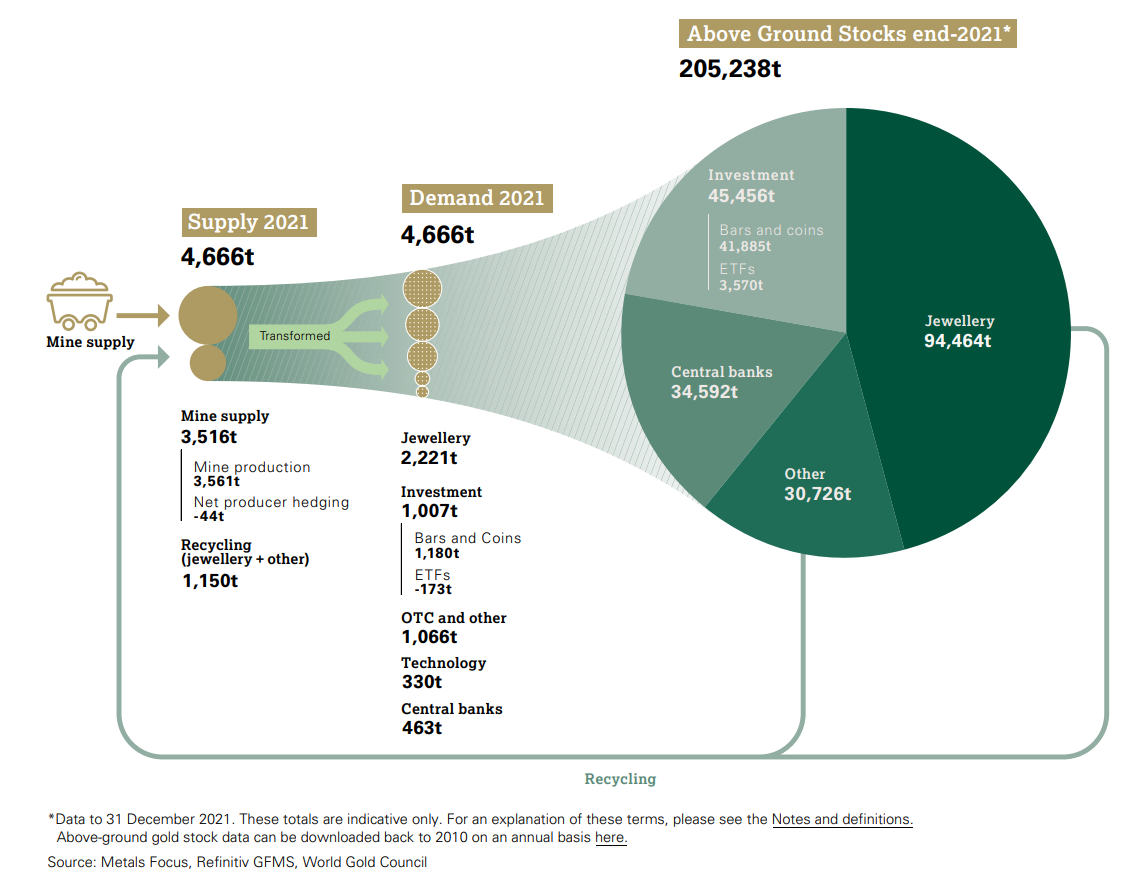
Total above-ground gold reserves in perspective (Source: World Gold Council)
This contribution comes from Geotrendlines


