English
EN


A fall in the price of gold in the first quarter strengthened the demand for investment gold and jewellery. However, investors sold positions in gold ETFs, as the stocks of these funds fell. Central banks bought gold again in the first quarter of this year, but at a slower pace than in the past three years. This is what the World Gold Council in its new quarterly report on the gold market. In this article, we summarize the most important figures from the report for you.
According to the World Gold Council, demand for coins and bars rose to 339.5 tonnes in the first quarter of this year, an increase of 36% compared to the same period last year. In China in particular, the demand for physical investment gold also thanks to a decrease in the number of Gold price. Also, fear of inflation gave a boost to the market for coins and bars. Not only in Asia, but also in Europe and the United States.
In Turkey, the precious metal was even hard to come by. There, demand rose to 44.3 tonnes in the first quarter, almost double the 23.3 tonnes in the same period last year. Due to the high inflation of the lira, many Turks are seeking refuge in precious metals, foreign currencies and cryptocurrencies.
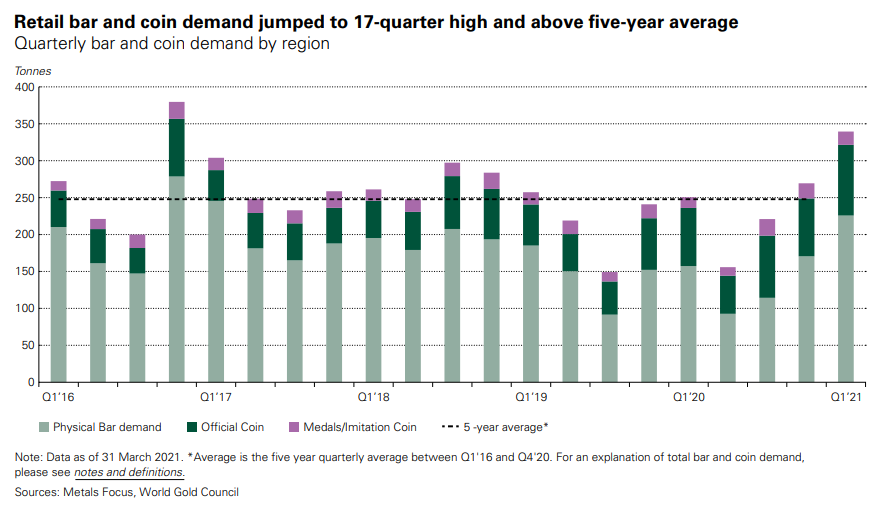
Demand for coins and bars rose to highest level since late 2016 (Source: World Gold Council)
As mentioned, interest in gold ETFs actually declined in the first quarter. These investment products sold 177.9 tonnes of gold in the first quarter, compared to 299.1 tonnes a year earlier. These investment products are easily accessible and generally attract other investors, who react more strongly to price fluctuations.
When the price rises, we often see significant inflows into gold ETFs, but when prices fall, investors usually sell their positions quickly. Gold outflows from ETFs in the first quarter were the largest since the fourth quarter of 2016, as the chart below shows.

Largest outflows from gold ETFs since late 2016 (Source: World Gold Council)
Demand for jewelry last year reached the lowest level ever measured by the World Gold Council. Due to lockdowns, jewellers in many countries had to close their doors temporarily. This was followed by a flight to gold, causing the gold price to rise and price-conscious buyers in countries such as China and India to decline. In the second quarter of last year, the demand for jewelry was only half of normal levels.
The corona crisis also caused a drop in income last year, especially in emerging countries with a weaker social safety net. In countries such as India and China, where people are primarily Buy gold As a means of making ends meet, this caused a major drop in demand. Now that the economy is reopening and countries are easing their lockdown measures, the demand for jewelry is picking up again. However, the market is not yet fully back to pre-Covid levels.
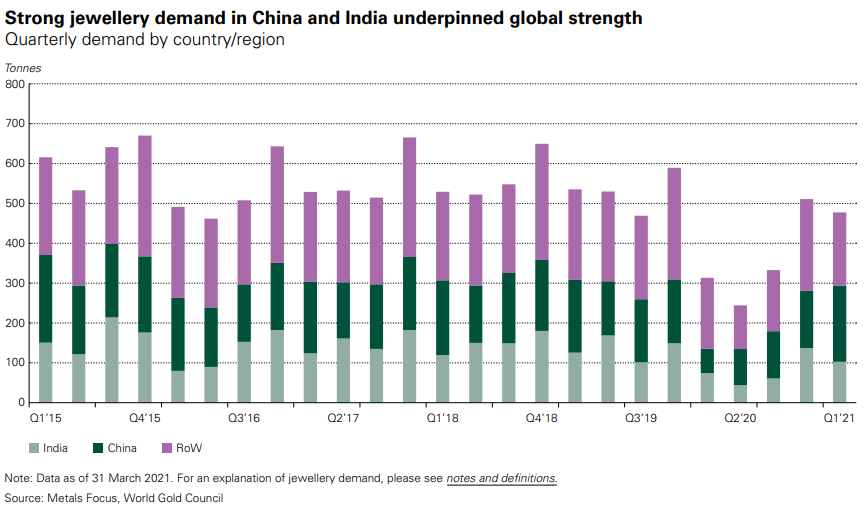
Demand for jewellery recovers after historically bad year (Source: World Gold Council)
Central banks continued to buy gold in the first quarter. Net gold purchases amounted to 95 tonnes, thanks in part to a large purchase of 63 tonnes by the Hungarian central bank. This country tripled its gold supply from 31.5 to 94.5 tonnes. India (+18.7 tonnes), Kazakhstan (+8 tonnes) and Uzbekistan (+23.3 tonnes) also added precious metal to their reserves.
Turkey's central bank sold the most gold in the first quarter, at 31.5 tonnes. This sale is remarkable, because in recent years Turkey was still the largest buyer. The central bank may have had to sell some to slow down the depreciation of the Turkish lira. The Philippines (-24.9 tonnes) and the United Arab Emirates (-6.7 tonnes) also sold some gold in the first quarter.

Central banks bought 95 tonnes of gold in the first quarter of 2021 (Source: World Gold Council)
The supply of gold fell in the first quarter compared to a year ago. Although the production of gold mines recovered after a dip in the corona year (+4%), it was not enough to compensate for a lower supply of scrap gold (-8%). In the first three months of this year, 270.2 tonnes of scrap gold came onto the market, a decrease of 4% compared to the 295 tonnes last year.
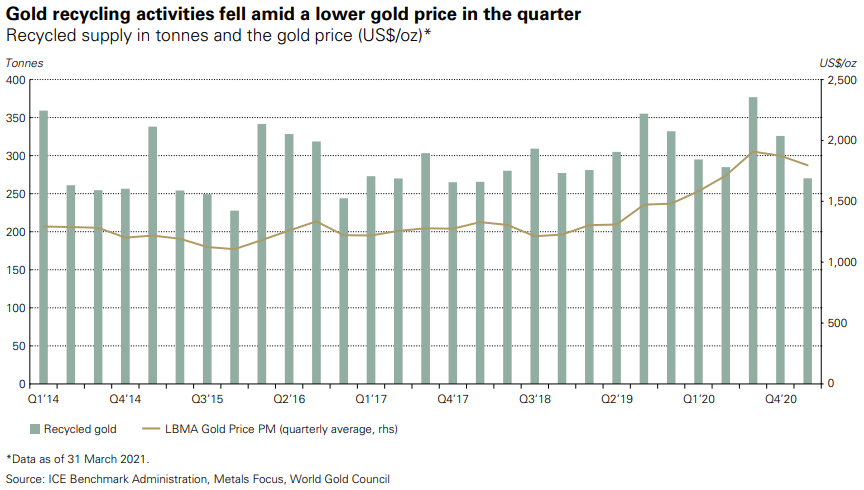
Supply of scrap gold is declining (Source: World Gold Council)
This contribution was made from Geotrendlines