9.3
9.017 reviews

English
EN


Since the Russian invasion of Ukraine, the prices of many commodities have risen sharply. Not only have oil and gas become more expensive, but the prices of foodstuffs such as grain, wheat and sunflower oil are also rising. Fearing potential shortages, some countries have already imposed restrictions on commodity exports. De Nederlandsche Bank In its gloomy scenario, it takes into account inflation of 9.5%, rising unemployment and longer economic growth. These problems can cause a new crisis in a variety of ways.
Higher food prices are annoying for European consumers, but the real problems seem to be in Africa. These countries depend on wheat from Russia and Ukraine for a large part of their food supply. These countries are therefore not only facing higher food prices, but also potential supply problems. If the war in Ukraine lasts for a long time, it could have consequences for food production, for example because farmers cannot sow or harvest. Damage to infrastructure in Ukraine could also hamper the export of wheat and grain. For example, access to the Black Sea is essential for Ukraine to export wheat to African countries.
If food production is disrupted, it will affect countries such as Egypt, Somalia, Benin and Sudan. Some of these countries are even completely dependent on wheat from Russia and Ukraine. Other African countries are also highly dependent on wheat from these two countries, as the graph below shows. This can cause major problems, because the average income in many of these countries is relatively low. In many African countries, people spend up to a third of their income on food, while in Western European countries it is less than ten percent.
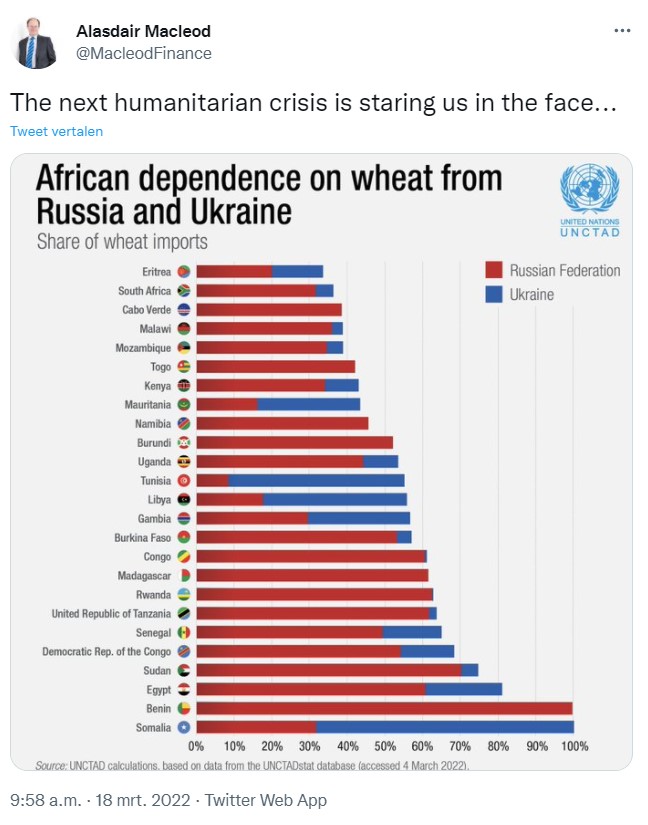
African countries are very dependent on wheat from Russia and Ukraine
Higher food prices are therefore hitting Africa much harder than in Europe. In 2010 and 2011, high food prices were already causing social unrest in large parts of North Africa. That could happen again now if food prices remain high over a longer period of time. Earlier this month, the price of wheat on the international market rose to a record $528 per tonne, more than doubling last summer's average price. Also, prices are now significantly higher than during the Arab Spring, when people took to the streets due to high food prices.
The war in Ukraine threatens to jeopardise global food security. If the fields where the farmers have to sow and harvest are littered with metal remnants of rockets and bullets, shrapnel and unexploded ammunition, this can make part of the agricultural land unusable for the time being. Large agricultural machinery will not be able to work the land. The extent of the economic impact depends on how long the war lasts and how extensive the actual damage to food production is. We have seen that there is also a lot of speculation in commodity prices. As fast as the prices of oil and gas shot up earlier this month, they also went down again afterwards.
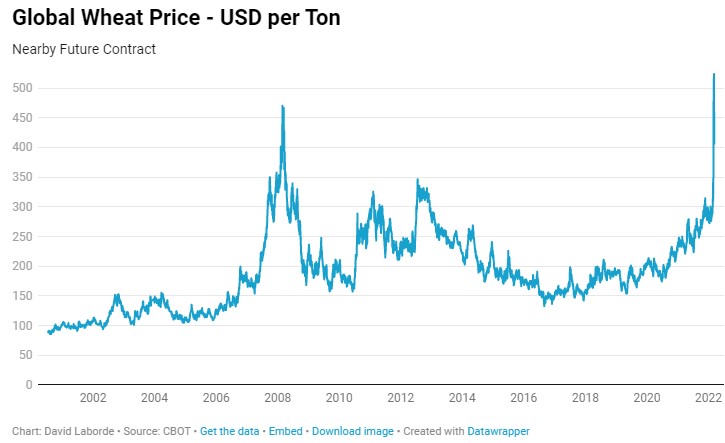
Wheat price has risen to record high this month
High commodity prices are hitting consumers around the world, but extreme volatility is also a problem in its own right. This is less visible to consumers, but it can cause major problems for energy companies and traders. Earlier this month, the European Federation of Energy Traders (EFET), a trade association for energy companies and traders, even sent a letter to regulators and market participants. In it, she warned of liquidity problems and possibly even solvency problems in the energy sector.
Due to the sudden increase in oil and gas prices, traders are currently having to set aside much more money to meet their margin obligations. Compared to the summer of last year, these amounts are now five to six times higher. This means that existing credit lines are sometimes no longer sufficient. Due to the extreme volatility of energy prices, banks are less willing to lend on the basis of the available collateral, which threatens to cause problems for traders.
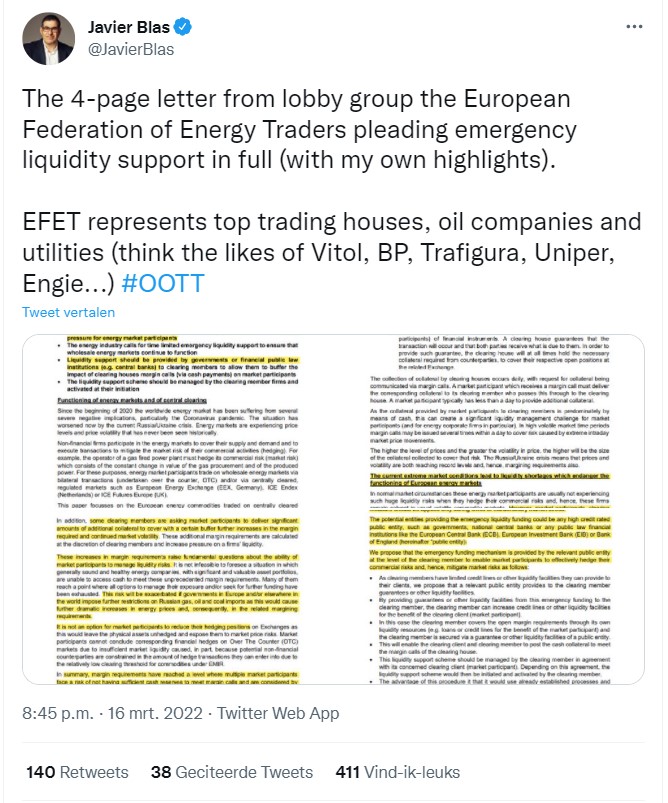
Energy companies and traders warn of liquidity problems
Traders who enter into contracts on the futures market must have a certain amount of money in their account for this purpose, the so-called Margin Requirement. This is not a deposit of the underlying asset, but a margin of safety that the exchange uses as a hedge against a fall in the price of the underlying asset. If volatility increases, it will charge a higher margin. If volatility drops, traders are allowed to take a position with less margin. The margin requirements are now so large that traders and energy companies are no longer sure they can afford them. There is a risk that they will no longer be able to hedge part of their position as a result, which means that they run price risk. When energy prices rise, that risk is for traders, while when prices fall for energy producers.
The EFET warns governments of sanctions that affect Russian exports of oil, gas and coal. Such sanctions could cause a dramatic increase in energy prices, resulting in even higher margin obligations. This could further disrupt the energy market and potentially lead to the bankruptcy of a trader. This could have a domino effect on the financial markets, the trade association warns. To prevent a new credit crisis similar to that of 2008, governments and central banks should support the sector. According to EFET, the ECB or the Bank of England should consider providing liquidity support to traders. This indicates how acute the situation in the energy market is at the moment.
So the West's economic sanctions against Russia are coming back like a boomerang. Not only Russia will experience the negative effects, but European consumers will also notice it in their wallets. In the less wealthy countries, higher prices for food and energy can have a socially and societal disruptive effect, but the rich West is also at risk. Major energy companies and energy traders are grappling with extreme price volatility of oil, gas, wheat, grain and other commodities. If the war in Ukraine and economic sanctions continue for longer, even DNB's gloomy scenario may be too optimistic. Do you want toBuy gold by means of Gold bars or Gold Coins? We are happy to help you with your order.
 Have a look at us YouTube channel
On behalf of Holland Gold, Paul Buitink and Joris Beemsterboer interview various economists and experts in the field of macroeconomics. The aim of the podcast is to provide the viewer with a better picture and guidance in an increasingly rapidly changing macroeconomic and monetary landscape. Click here to subscribe.


