English
EN


Turkey's central bank is trying to shore up the value of its currency, but the bottom of reserves is almost in sight. The Financial Times reports that the Turkish central bank has even been borrowing dollars in recent months to boost its reserves. According to its own statement, the central bank had $28.1 billion in foreign exchange reserves at the beginning of April, but an analysis by the newspaper shows that this figure has been boosted with borrowed money.
The central bank has been making currency swaps with commercial banks in recent weeks, lending dollars in exchange for Turkish lira. These contracts have a short duration, which means that the central bank can't actually use these funds to support the lira. Adjusted for this accounting intervention, foreign exchange reserves therefore amount to less than $16 billion. That would mean that Turkey has almost no foreign currency left to defend the lira.
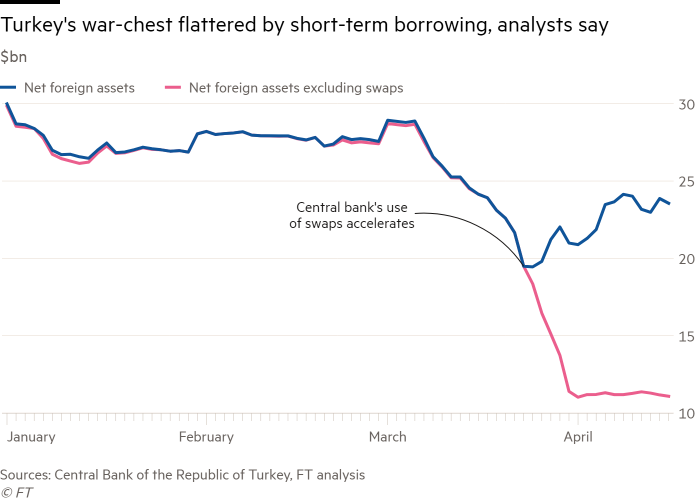
Turkish central bank running out of currency reserves? (Source: Financial Times)
According to the central bank, the use of this type of currency swap is not against the rules, but analysts warn that it is not without risks. It is not good for the credibility of the central bank. Currency specialist Piotr Matys of Rabobank told the Financial Times that this method is a form of 'window dressing', intended to convince the market. It should give the impression that the central bank has more reserves than what is actually present.
A central bank normally holds foreign exchange reserves in order to manipulate the value of its currency. If the value of its own currency falls, the central bank can defend it by buying its own currency using foreign currency. If Turkey's central bank is indeed tight on currency reserves, it would mean that it has little room to defend the lira. The Turkish economy needs to refinance $177 billion in dollar loans over the next twelve months, which means that the demand for dollars in the domestic economy is high.
It is therefore not surprising that the Turkish government has an interest in settling international trade more often in its own currency. For example, the country wants to Russia and Iran trade in national currencies. Due to U.S. sanctions, Turkey is now seeking a Alternative route to be able to trade with Iran. This is also in line with the aim of becoming less dependent on the dollar.
Turkish President Erdogan Criticised the analysis of the Financial Times. According to him, the impression is wrongly given that the Turkish economy is in trouble. Erdogan warned analysts at investment banks not to spread negative opinions on the lira.
In response to the Financial Times' reporting, the value of the Turkish lira fell by 2% against the dollar. At its lowest point, the currency was even at its lowest level against the dollar in six months. This can partly be explained by the strengthening of the dollar, but traders on the foreign exchange market are not confident that the Turkish central bank can prevent a currency crisis.