English
EN


Total U.S. household debt rose to a new record $12.8 trillion in the second quarter, according toNew figures of the Federal Reserve Bank of New York. The increase was partly caused by an increase in the number of car loans and credit card debt. Private debt in the United States is rising for the twelfth quarter in a row, suggesting that Americans are looking to the future with confidence.
In the second quarter of this year, the total amount of car loans rose to $1.19 trillion, half as much as at the outbreak of the credit crisis in 2008. Credit card debt is also slowly increasing again, while this is one of the most expensive forms of credit. Households in the United States are collectively $0.78 trillion in the red with credit card companies, the highest level since 2009. Student debt, while flat in the second quarter, has more than doubled over the past decade to $1.34 trillion.

U.S. household debt on the rise again (Chart via Wall Street Journal)
The increase in private debt in the United States can be interpreted both positively and negatively. From a positive approach, you could argue that Americans have more confidence in the economy and are therefore more willing to borrow money for a house, a car or a study, for example.
On the other hand, it is also conceivable that certain groups of Americans borrow money to supplement their incomes. There are indications of this as well, as the percentage of non-payments on credit card debt has increased significantly in recent quarters. This is despite the fact that there was still a clear downward trend between 2009 and 2016.
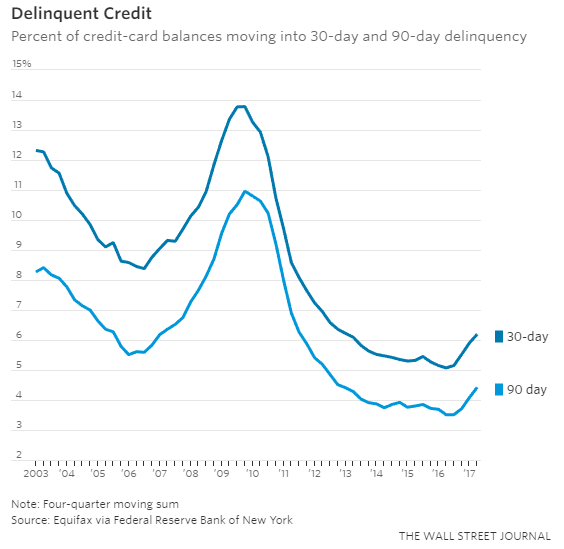
Number of defaults on credit card debt rises again (Graph via Wall Street Journal)
In the second quarter of this year, 6.19% of credit card debts were more than thirty days in arrears, compared to just over 5% a year ago. The number of payment delays of more than 90 days is also on the rise again, although it should be noted that these rates are still very low from a historical perspective.
The increase in the number of defaults on credit card debt is a worrisome development, because with historically low interest rates and a growing economy, you would expect it to become easier to repay debts. The last time the default rate rose so quickly was in 2006, when the Federal Reserve raised interest rates to slow the economy.
Source: Federal Reserve Bank of New York