English
EN


By: Frank Knopers
Central banks see gold as an important reserve and are more likely to consider buying more gold. A new poll by the World Gold Council shows that 25% of the central banks surveyed want to buy more gold in the next twelve months. By comparison, last year it was 21%. Central banks cite high inflation, geopolitical instability and an uncertain economic outlook as reasons to own more gold.
Central bankers are also more concerned about a new financial crisis due to rising interest rates and changes in the international monetary system. For example, they see more economic risks in countries that issue a reserve currency. The United States and Eurozone countries decided to freeze the assets of the Russian central bank in response to Russia's invasion of Ukraine. As a result, there has been more international doubt about the safety of currency reserves in euros and dollars. Gold can benefit from this as a neutral reserve without any political risk.
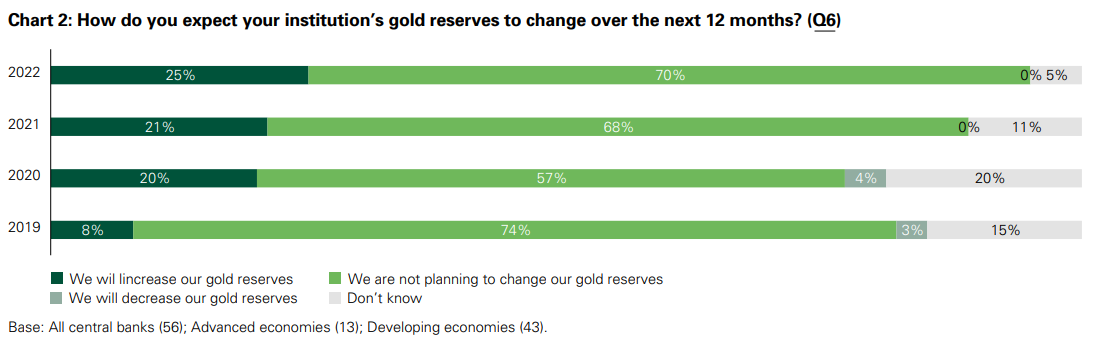
More central banks are considering buying gold (Source: WGC)
For a long time, it was not very interesting for central banks to hold gold. The precious metal did not generate any income, while government bonds did provide returns. But in twenty years, that ratio has changed dramatically. Government bonds have hardly yielded any interest in recent years, while government debts have only continued to increase. Interest rates are now rising again, but that is mainly due to increasing economic and political risks and high inflation.
Central banks' gold holdings still do not yield interest, but they have risen significantly in value in recent years due to the higher Gold price. Historically, the precious metal has performed well in times of economic and geopolitical uncertainty. That is why it is important for central banks to own gold right now. Shaokai Fan, head of the central banking department at the World Gold Council, agrees. In an explanatory note to Bloomberg he says emerging economies have started to look differently at the risks posed by the dollar:
"The geopolitical situation is much more volatile and we don't know how long this situation will last. Gold has proven to be a safe haven under these circumstances. That's one aspect that central banks will consider. Emerging economies are optimistic about gold's future in the monetary system, while being hesitant about the U.S. dollar."
This survey by the World Gold Council was conducted between February 23 and April 29. A total of 57 central banks completed this questionnaire, mostly from emerging economies.
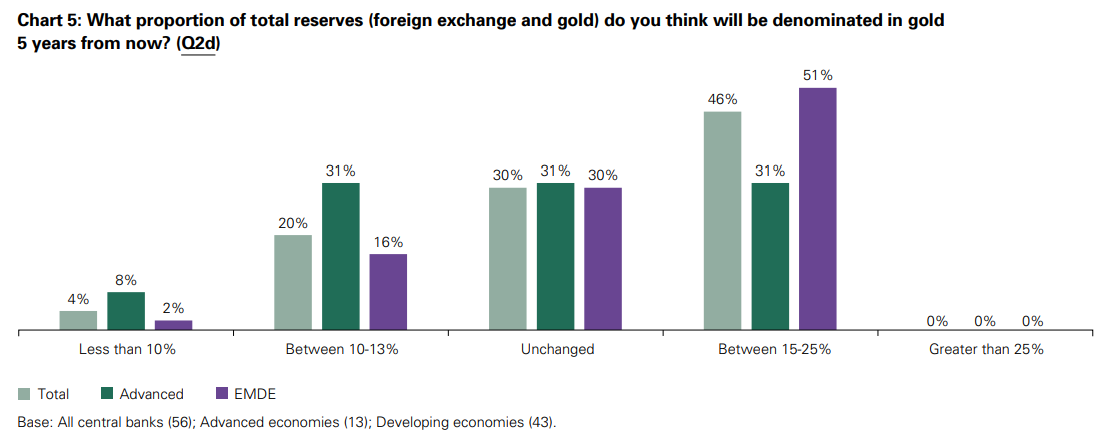
How much gold do central banks want to have in their portfolios within five years? (Source: WGC)
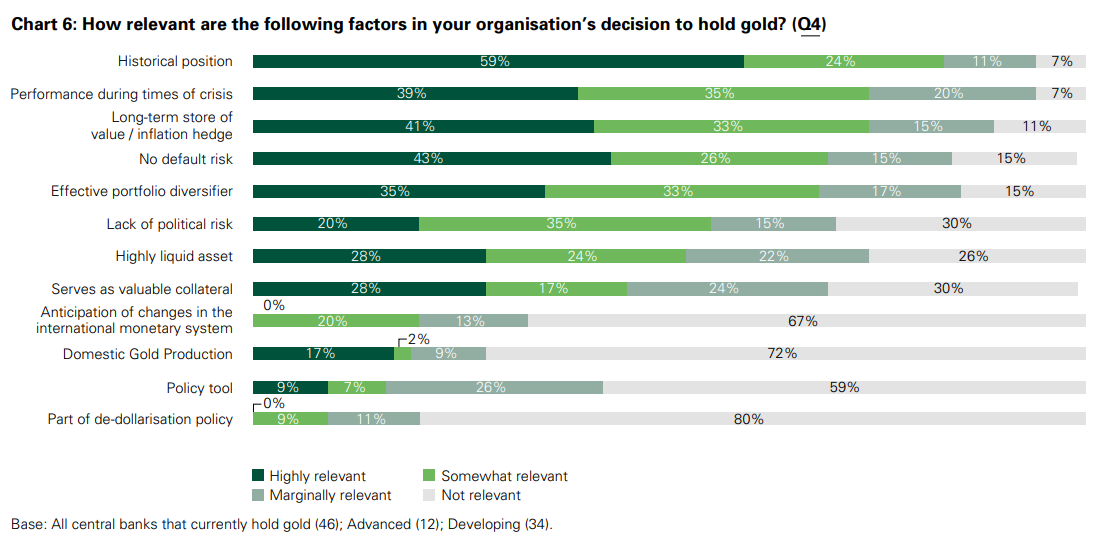
Central banks mainly hold gold to protect and diversify reserves (Source: WGC)
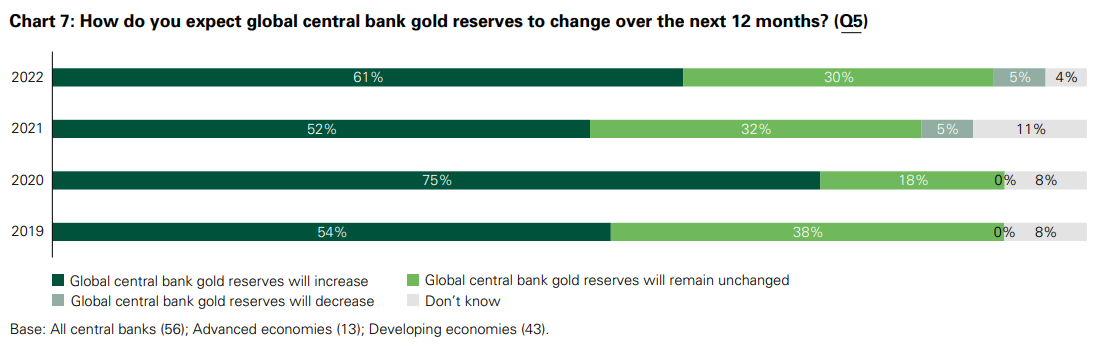
Central banks expect to own more gold as a whole in a year's time (Source: WGC)
This contribution comes from Geotrendlines
 Have a look at us YouTube channel
On behalf of Holland Gold, Paul Buitink and Joris Beemsterboer interview various economists and experts in the field of macroeconomics. The aim of the podcast is to provide the viewer with a better picture and guidance in an increasingly rapidly changing macroeconomic and monetary landscape. Click here to subscribe.