English
EN


Renewed shelling in the Middle East is pushing oil prices back above $100 per barrel. Rising inflationary pressure makes it more likely that the Fed will raise interest rates on 16 September, a headwind for gold. Nevertheless, the yellow metal is holding up well. Bessent is challenging the currency markets: “I am the house now.” What does he mean by this striking statement? Meanwhile, central banks are not standing still either: Spain is concerned about its gold reserves, while China has made its largest gold purchase since 2023.
With the launch of the renewed Holland Gold website, you can now also easily select a period on the price page to view price developments over that period. The chart below shows that the gold price has been highly volatile over the past six months. No one had expected the war between Israel, the US and Iran at the beginning of this year, and it radically changed inflation expectations and the expected interest-rate policy of the US central bank, the Fed. Since the beginning of August, gold has resumed its upward trend.
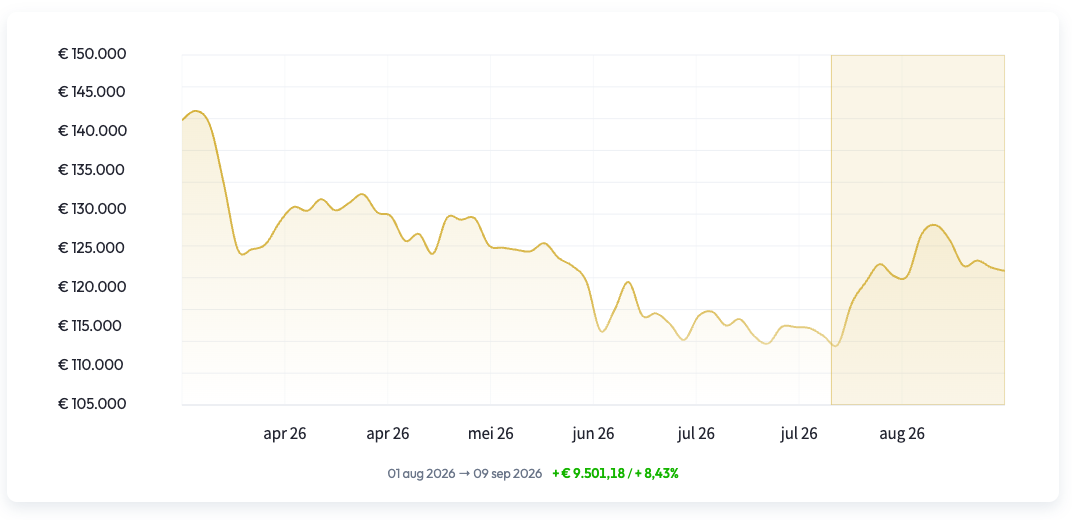 The gold price has risen by 8.4% since the beginning of August. The chart shows the gold price per kilogram over the past six months.
Where former Fed Chair Powell’s Jackson Hole speech a year ago marked the beginning of an unprecedented gold rally, the recent speech by current Chair Kevin Warsh offered little good news. He indicated that he intends to fight inflation, making interest-rate increases more likely, a headwind for gold. Higher interest rates make bonds a more attractive safe haven than gold in the short term. And that is precisely the crux of the matter, because the picture is still not so straightforward.
The intervention by US Treasury Secretary Scott Bessent in August revived the debasement trade. This followed earlier hopes that the Strait of Hormuz would reopen in early August, which had already pushed the gold price higher again. With the escalation in the Middle East in recent days, a reopening of the strait now appears out of sight.
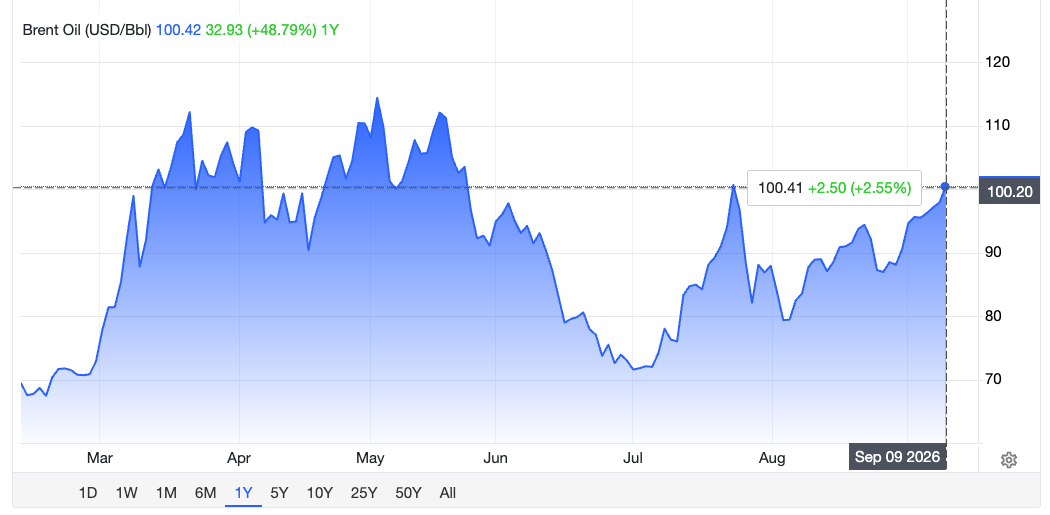 Oil prices (Brent Oil) are climbing back above $100 per barrel, for the first time since July. Source: Trading Economics.
Despite the renewed shelling around the Strait of Hormuz and rising oil prices, the gold price appears to be reacting less strongly than it did earlier in the war. Or at least, the gold price appears to be recovering more quickly.
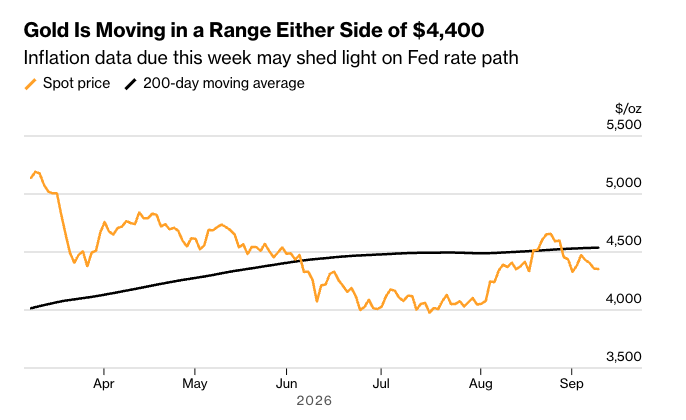 Gold continues to trade around $4,400 per troy ounce (31.1 grams). Yellow line: the spot price of gold in US dollars per troy ounce. Black line: the 200-day moving average of the gold price. (Source: Bloomberg).
Higher oil prices are raising inflation expectations. With a hawkish Warsh at the Fed, markets estimate the probability of a 25 bp Fed rate hike in September at 60%. Normally, that would be a significant headwind for gold. However, currency markets and a weak dollar are providing a counterweight, pushing gold higher, according to Ole Hansen, Head of Commodity Strategy at Saxo Bank A/S. With the dollar under pressure from a strengthening yen and oil prices rising, gold investors are “currently struggling to determine which of several competing themes will ultimately set the tone.”
A strengthening yen and a weakening dollar make gold, which is traded in dollars, relatively cheaper and more attractive to foreign investors. The direction of the dollar and the yen can therefore have a significant impact on gold prices. So what is happening with the yen and the dollar?
“I am the house now,” said US Treasury Secretary Scott Bessent. He is referring to the ‘house’, or the casino itself, suggesting that he stands above the game being played in the currency market. “So if we intervene in the Japanese yen, I have a pretty good idea of what the Japanese are going to do, what the Bank of Japan is going to do, what Japanese policymakers are going to do,” Bessent continued.
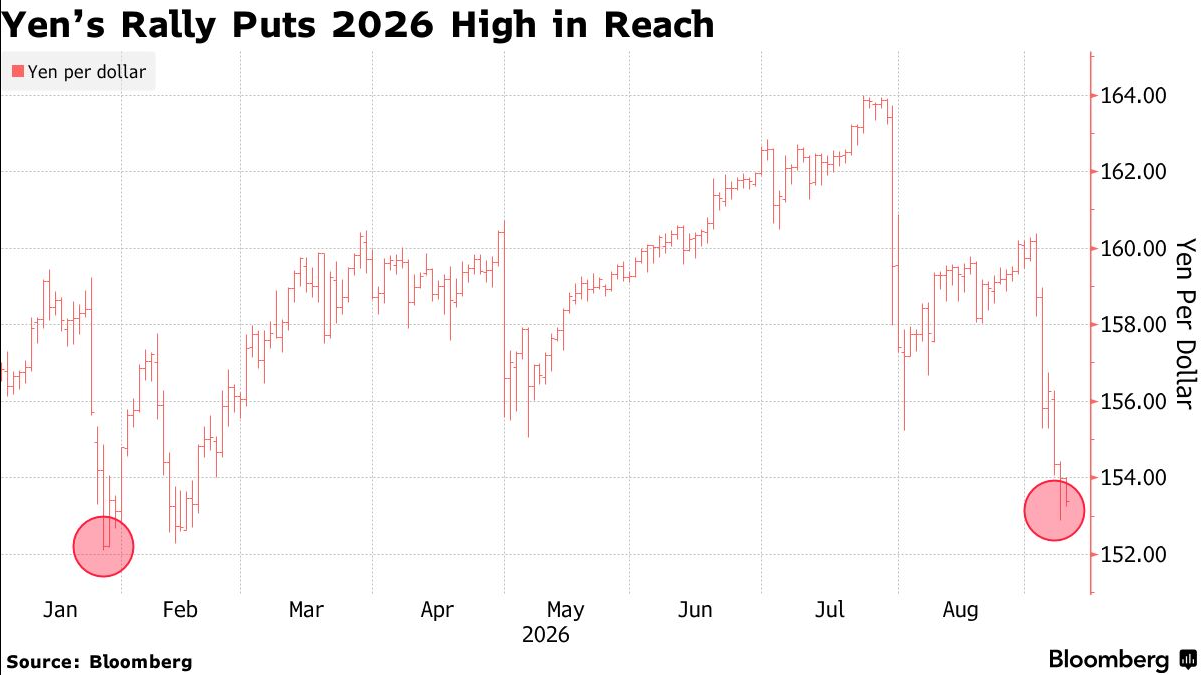 The Japanese yen is once again close to its strongest level since the beginning of this year. The chart expresses the exchange rate as the number of yen per US dollar. (Source: Bloomberg).
In essence, the Treasury Secretary is emphasising that he has inside knowledge and intends to use it. What this is ultimately about is supporting the Japanese yen. As the currency continued to depreciate (fall in value) against the dollar, the dollar became relatively more expensive. This is not only a disadvantage for US producers competing with relatively cheap Japanese products. It is also a problem for Japan, which in turn makes it a problem for the US.
When the yen becomes too weak, imports become too expensive for Japan, an island nation that imports many goods, pushing up inflation. One of the tools Japan itself has to support the yen is to buy yen in the currency markets with dollars. Japan obtains those dollars by selling US Treasuries. And that is precisely where the tension arises. Selling US government debt pushes up bond yields and the cost of servicing US national debt. Bessent wants to prevent this. He has not shied away from market intervention in the past, and the US and Japan coordinated a joint intervention in the currency market to the detriment of the euro and in favour of the dollar and the yen.
Following the example of De Nederlandsche Bank, Spain’s central bank is considering repatriating its gold, El Pais reports. It was major news in recent weeks that the Dutch central bank moved 86 tonnes of gold from the US and Canada to London. Officially, this was because the gold would be more easily tradable in London. But it is difficult not to view the move from a geopolitical perspective and against the backdrop of the changing world order. “Bringing the gold back to Spain would not be a nationalist gesture, but would be about strengthening European strategic autonomy,” says Luis Garvía, a lecturer at the Spanish financial education institute IEB.
This is not only about the unpredictability of the Trump administration, which may make gold safer in London or in European countries themselves. Since Russian assets were frozen in 2022 following the invasion of Ukraine, central banks around the world have become increasingly aware of the importance of their national gold reserves.
Spain’s gold reserves are only about half the size of those of the Netherlands. There are historical reasons for this, but it is also because Spain sold a large proportion of its gold reserves in 2007. This happened at low prices, as gold was regarded as an unprofitable asset at the time. A few months later, the 2008 financial crisis began, after which gold rose to record prices and Spain faced several difficult years.
China has followed a different strategy for years. Following an unprecedented gold rally that pushed gold prices to record highs in January and February this year, the Chinese central bank temporarily scaled back its purchases. Lower prices last month proved to be an attractive buying opportunity, but even as gold prices rose, the Chinese central bank continued to buy increasing amounts of gold. The PBoC (China’s central bank) bought more gold in August than in any month since 2023. This now makes China the seventh-largest public holder of gold in the world.
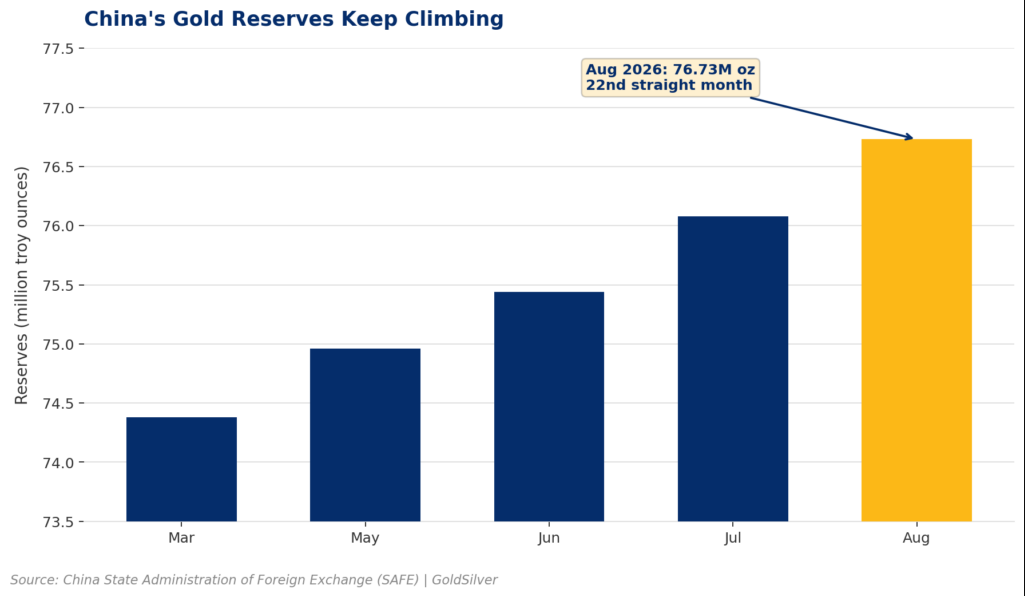 Monthly gold purchases in millions of troy ounces (31.1 grams) by the People’s Bank of China. (Source: Goldsilver).
Key dates to watch in the coming period: