English
EN


We know that the price of gold usually rises in the autumn, because the market picks up due to seasonal demand from India. But how has gold performed in the first months of the year in recent decades? Casey Research made a graph of the average development of the Gold price per month and it looks like this.
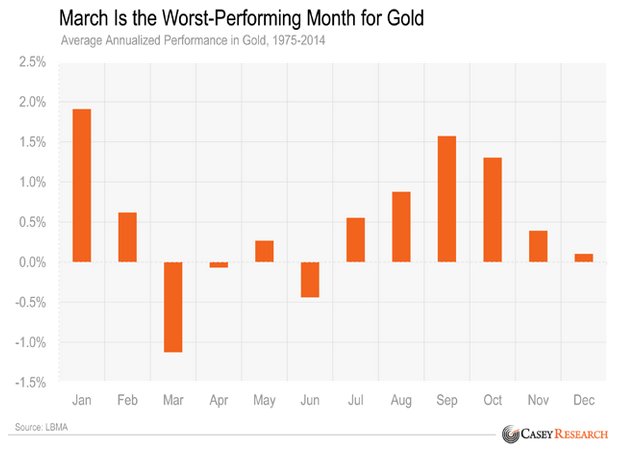
March is historically the worst month for gold
This month, the price of gold fell for nine days in a row, the longest continuous streak of declines since 1973. This is annoying, but it is in line with the pattern we observed from 1975 to 2014. The month of March yielded an average return of about -1.1%, making it historically the worst month of the year for gold.
Of course, we must point out that averages can always be distorted by large outliers. So it's not like the gold price always falls in March and that towards the end of this month it's a good time to buy gold. Nevertheless, it is striking to see that, on average, there are indeed weak and strong periods in the market.
Investors seeking a 'buy and hold' and who spread their purchases over several years can decide to buy gold mainly in the spring and summer on the basis of this observation. Only three months of the year yielded negative returns on average, namely March, June and April. The best month for gold is January with a gain of about 1.9% on average, followed by September with a return of about 1.6%.
In euros, the gold price has already risen by more than ten percent this year as a result of the depreciation of the euro. In dollar terms, gold stands at a very small loss of just over two percent.
Also Read: Is September a good month to buy gold?
Disclaimer: Hollandgold does not provide investment advice. Do your own research before investing in stocks or gold. Past performance is no guarantee of future results.