9.3
8.889 reviews

English
EN


Andre ten Dam started as an independent legal consultant in the early 90s and is also an engineer. He was interested in social affairs, but did not think he would ever become actively involved in them. An interview in 2005 with a deputy director of the Dutch Central Bank in Het Parool changed all that. In the years 2005 to 2009, Ten Dam was involved in the conversion rate of the guilder to the euro. Was the guilder exchanged too cheaply during the changeover to the euro?
On Queen's Day in 2005, Ten Dam reads the interview with Henk Brouwer, then deputy director at De Nederlandsche Bank (DNB), in which Brouwer said that the guilder had actually entered the euro too cheaply. Because of the peg with the German mark, the guilder had become undervalued. In Germany, after the unification, the East Germans were allowed to exchange their Ost-marks 1 to 1 for the hard Deutschmark, which caused high inflation in Germany. In the Netherlands, on the other hand, there was low inflation and strong economic growth in those years, partly due to the Wassenaar Agreement. Due to its close trade relationship with Germany, the Netherlands maintained its link with the mark. As a result, the guilder became undervalued against the Deutschmark in the 1990s.
After the interview with Brouwer, the conversion rate was surrounded by enormous publicity. Ten Dam did not leave it at that either and investigated possible legal action. 'The goal was to find out exactly what had happened and what the financial consequences were. If it would indeed be the case that an incorrect course had been set, I wanted to work for the Dutch through a claim foundation,' says Ten Dam.
Since it was not possible to find sufficient funding, the European Union was ultimately not brought to court before the European Court of Justice and the case was therefore time-barred. The compensation was never paid, but Ten Dam stated in his research that the incorrect conversion rate led to a structural loss of at least 12 percent purchasing power and a 10 percent lower Gross Domestic Product when the rebalancing reactions of the undervalued guilder-euro conversion rate had worn off. In view of the political sensitivity of the issue, he was given the incorrect conversion rate, off the record Also confirmed from several insiders.
Not all economists are of the same opinion as Andre ten Dam. Mathijs Bouman, in-house economist at the NPO, devoted a chapter in his book 'Dutch hubris' to the undervaluation of the guilder. According to Bouman, economic forces would correct the flaw of the euro and the undervaluation would ultimately make no difference. "It worked out exactly like that. Expensive Germany went through a few difficult years after the introduction of the euro, while cheap countries such as the Netherlands grew rapidly. As a result, inflation in Germany in 2000 and 2001 was considerably lower than in the Netherlands. In 2003, the real exchange rate was back to its pre-German unification level," the book reads.
Moreover, as Bouman later indicated in a podcast with Holland Gold, a revaluation just before the introduction of the euro would have been in total contradiction with the idea of a single currency. Countries would first keep the exchange rate stable for a period of time, and then switch to the euro. If the Netherlands were to negotiate the course again, many more countries would probably try to change the course. That would not be desirable, according to Bouman.
Ten Dam sees it differently; 'It is true that in the run-up to the euro, it was agreed that countries would no longer devalue their currency against the mark. Countries would then be able to gain an unfair export advantage over the rest of the world and a devaluation would not be a wise monetary policy. On the other hand, revaluations were allowed, so the Netherlands would have had the opportunity to revalue, even just before the changeover. The Irish have also simply revalued their currency', says Ten Dam.
In his opinion, a revaluation was the remedy for the Netherlands. 'The Dutch economy was overheating. The IMF Netherlands also warned about this at the time. If you don't reevaluate, you will import inflation from abroad. For political reasons, the revaluation did not materialise. Incidentally, the innovative Dutch export sector would also have been able to cope with a balanced exchange rate of the guilder for the Netherlands and then the euro against the rest of the world. And it was precisely because the exchange rate was too low that the Dutch export sector was no longer so stimulated in terms of innovation,' says Ten Dam.
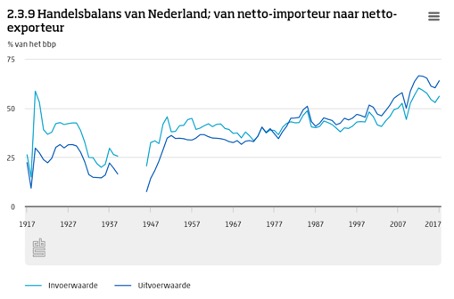
Over the past 35 years, the Netherlands has become a net exporter. (Source: CBS)
In 2009, Andre ten Dam and Harry Geels the result of four years of research. The report describes in detail the loss that the Dutch have suffered due to the incorrect conversion rate. It is striking that in the years following the introduction of the euro, the purchasing power of the Dutch lagged far behind that of the Austrians, while the Austrian economy also relied heavily on the German economy. The Austrian shilling, on the other hand, had not entered the euro undervalued. The sharp increase in consumer prices in particular plays a role in this. As a result of a low exchange rate and an overheated economy, the Netherlands struggled with high inflation, while wages did not rise rapidly. As a result, purchasing power did not increase, as can be seen in the graph.

The purchasing power of the Dutch lagged behind that of other countries. (Source: The Exchange Loss Case: Analysis and Damage Calculation)
The report by Ten Dam and Geels also makes a simulation in which the guilder would have been revalued from 1998 onwards. According to the calculations in the report, the purchasing power developments of the Netherlands and Austria would have shown a much more even pattern if the guilder had also been revalued. 
Purchasing power calculation with a simulation if the guilder had been revalued. (Source: The Exchange Loss Case: Analysis and Damage Calculation
According to Ten Dam, there is no doubt that the undervaluation has led to a loss of prosperity for the Dutch. Many insiders also confirmed this to Ten Dam. A former director of DNB once said (anonymously) to Ten Dam;
"It is true that the Netherlands entered the euro at a less favourable rate than would have been desirable from the point of view of Dutch prosperity. But, as is so often the case, there are sometimes compelling reasons to accept such a loss because it serves the greater political purpose. And that was the creation of EMU! …. This is a problem with structural undervaluation of the guilder, and that was well recognized at the time. …. It cannot be denied that a too low entry rate of the guilder leads to a loss of capital and a less favourable price and thus a loss of purchasing power."
The discussion about the undervaluation of the guilder and the consequences is extremely interesting. There are two sides to the story. It is difficult to say exactly what the situation would have been for the Netherlands if the guilder had been revalued, but the research by Ten Dam and Geels enriches the debate.


