English
EN


The war with Iran is creating new geopolitical uncertainty and, according to Jack Hoogland, could further reinforce an existing trend: the growing popularity of nuclear energy and the shortage of uranium. He expects an exceptionally strong bull market.
As could be expected, Trump gave the market a signal on Monday that the war with Iran will likely be limited in duration. If that war drags on for too long, Americans will hold him accountable in the midterm elections, and his final two years as president are unlikely to be particularly comfortable.
Markets will certainly continue to fluctuate, but it is now becoming much easier for investors to look beyond this war. Last week I already told our readers that this war will not reduce the (future) shortages of silver, copper and uranium. On the contrary, it is likely to make them significantly larger. One consequence of this war can already be seen in the tweet below.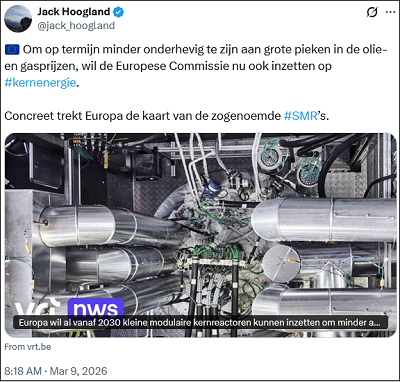
Belgian public broadcaster VRT reported last weekend that the European Commission wants to invest in nuclear energy, in order to reduce future exposure to spikes in oil and gas prices.
One look at the chart below immediately shows why this is so important.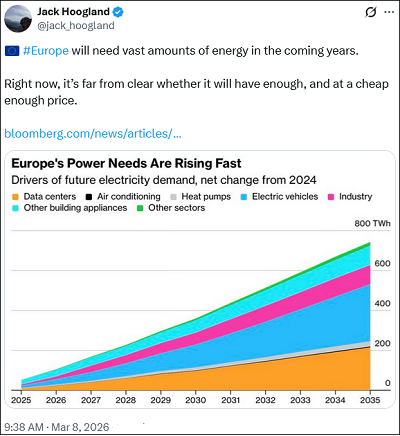
According to BloombergNEF and the European Commission, European electricity demand will rise from 52 TWh in 2025 to 744 TWh in 2035. That is an increase of more than 1300% in just ten years.
Last week I also explained that both Spain and Belgium are shifting back toward nuclear energy. We are now seeing the same development in California, and in the tweet below we see that Taiwan is making the same shift. 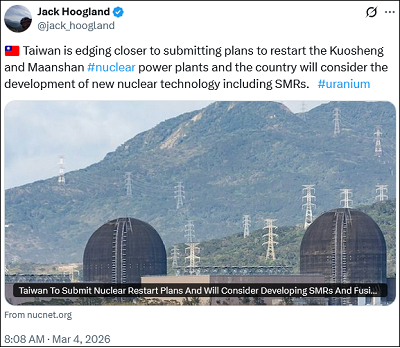
Taiwan shut down all of its nuclear power plants, but now wants to reopen previously closed reactors and invest in small modular reactors (SMRs). In what are, apart from Germany, among the last countries that wanted to abandon nuclear power, we are now seeing a clear shift back toward nuclear energy.
China, meanwhile, is already building nuclear power plants at full speed. Last week, however, the Chinese government announced that it will accelerate construction of new nuclear plants even further. In the tweet below we see that the 2030 target has been raised to 110 GW of nuclear power capacity. 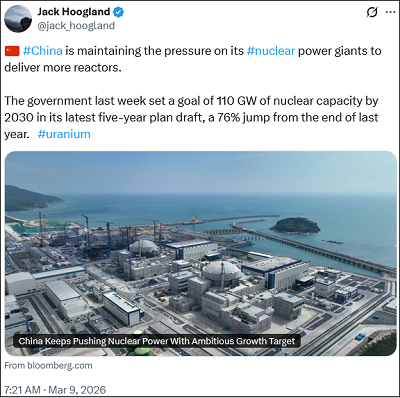
Chinese uranium demand will therefore increase by no less than 76 percent in the coming years.
Global uranium demand is rising ever faster, while it is already clear that far too little can be produced over the next 15 years. This means uranium prices could rise sharply, while uranium mining stocks may surge as well.
Last week I already explained why the bull market in uranium could become the largest we will experience in our lifetime. The news of the past week shows that this bull market may become even bigger than we expected just a week ago.
Jack Hoogland worked for the American bank Citigroup in Amsterdam, Düsseldorf, Madrid and Brussels as Financial Analyst, Risk Manager and Finance Director. He has followed financial markets since the late 1980s and, after the credit crisis, increasingly focused on macroeconomics and the financial system. Read more from Jack Hoogland.