9.3
8.889 reviews

English
EN


Interest in gold jewellery, coins and bars increased further in the third quarter. Due to the recovery of the economy, the demand for jewelry increased in countries such as India and China, while coins and bars are still very popular in countries such as Germany and the United States. This is what the World Gold Council in a new quarterly gold market report.
Central banks bought a substantial amount of gold in the third quarter, while they sold gold in the same period last year. Despite this, overall demand for the precious metal fell 7% in the third quarter as investors sold shares in gold ETFs. Last year, these investment products were still very popular.
The Gold price Moved mostly sideways in the third quarter and averaged $1,789 per troy ounce. That was 6% lower than the average price in the same period last year, when the precious metal hit a new record of more than $2,075 per troy ounce. Around that time, many investors got into gold ETFs and stocks of these investment products rose to a record 4,000 tons. Since then, gold stocks have fallen to 3,600 tons, a move that has been accompanied by a decline in the price of gold. In this article, we discuss the key findings from the report.
Due to the coronavirus pandemic, the demand for jewellery in emerging economies fell to an all-time low last year, but this year there is already a recovery. Compared to the third quarter of last year, the demand for gold jewellery increased by 32% in China and by 58% in India. Global demand for jewellery rose by almost half to 442.6 tonnes in the third quarter.
The jewellery market is therefore showing a strong recovery, although demand has not yet returned to pre-Covid levels. The first graph shows this well. If the global economy continues to recover and consumer disposable income in emerging markets increases, this recovery can continue to support the gold price.
The second graph makes it clear that China and India together represent more than half of the global jewelry market. That's because consumers in these countries use gold jewelry as a form of savings. They buy it not only as decoration, but also as a way to store wealth. Jewellery with a high carat and a relatively low premium is very popular in these countries.
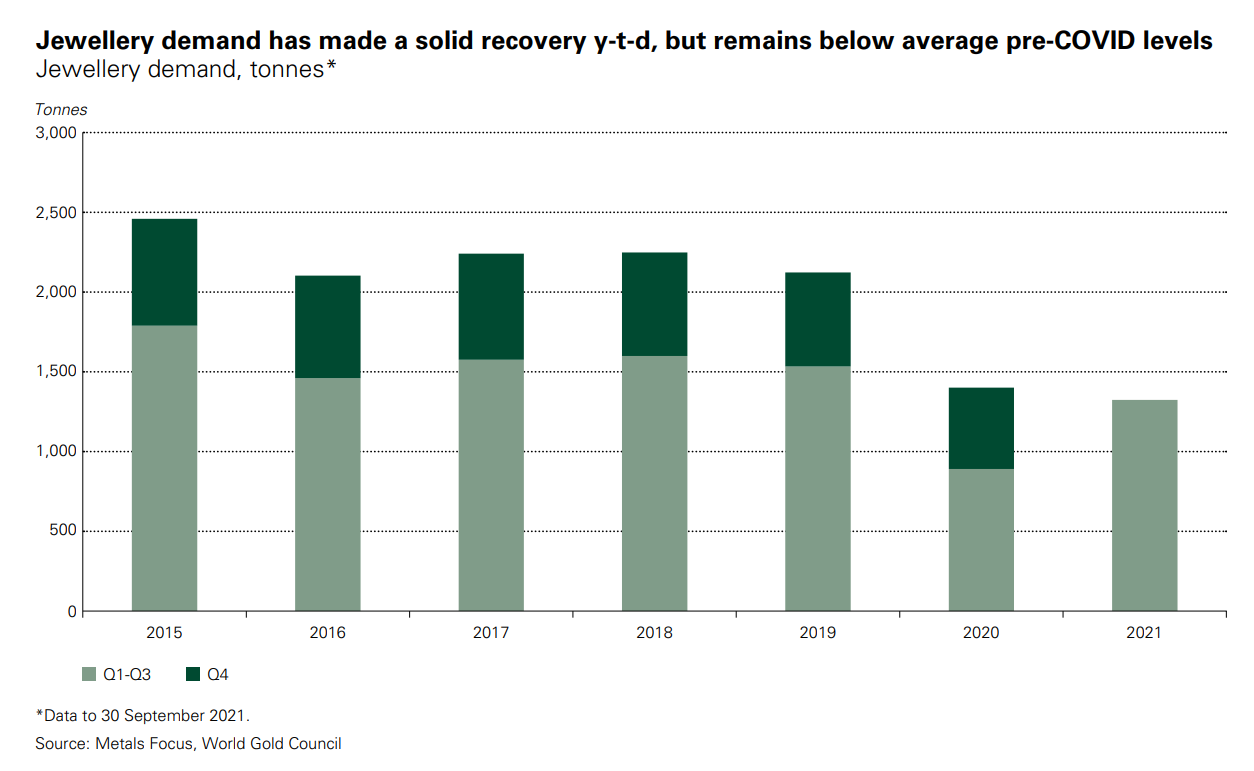
Demand for gold jewellery recovers from corona pandemic (Source: World Gold Council)
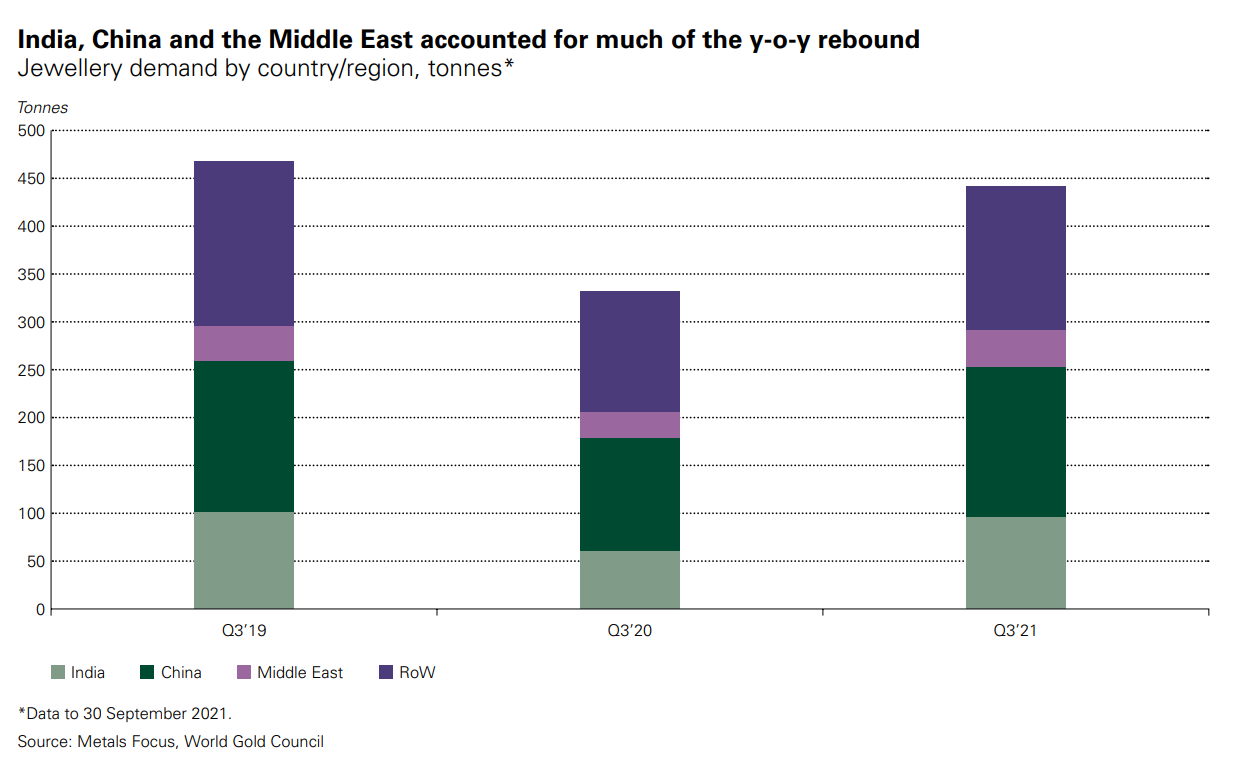
China and India together represent more than half of the global jewellery market (Source: World Gold Council)
The market for investment gold showed a twofold picture last quarter. On the one hand, the demand for gold ETFs, investment products that allow people to invest indirectly in physical gold, decreased. These investment instruments were still very popular last year, especially among Western investors, but this year the interest is a lot smaller.
On balance, the inventories of gold ETFs fell by 26.7 tonnes in the third quarter, compared to an increase of 273.9 tonnes in the same period last year. Incidentally, more than one hundred percent of this decline was attributable to American ETFs. European and Asian gold ETFs did see an increase in their gold stocks in the third quarter.
While interest in ETFs declined in the third quarter, demand for gold coins and gold bars increased. In the third quarter, global demand for these investment products rose to 262 tonnes, an increase of 18% compared to the same period last year. Total demand for coins and bars in the first three quarters was the highest since 2013 at a total of 857 tonnes.
Gold coins and bars are in demand worldwide this year, suggesting that more people prefer the physical possession of gold. Especially in Germany and the United States, the coins and bars were very popular. This can probably be explained by rising inflation in combination with persistently low interest rates. The following chart shows that the demand for coins and bars is already almost as high as it was in all of 2019 and 2020.
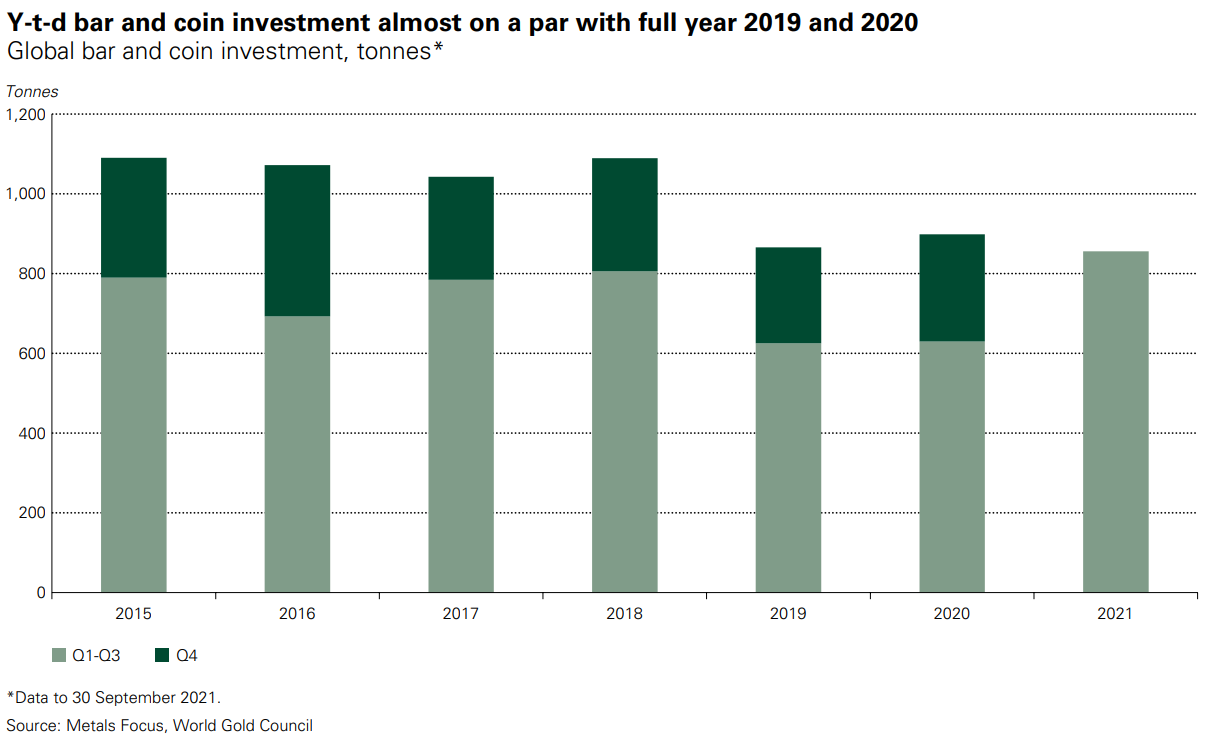
Demand for gold coins and bars is already almost at the same level as all of 2019 and 2020 (Source: World Gold Council)
The gold stocks of gold ETFs generally move in the same direction as the price of gold. That's because this form of Buy gold is especially popular among investors. They generally show more interest when the price rises and less when the price falls again or moves sideways. The huge influx of investors into the gold market caused the gold price to rise to record highs last year.
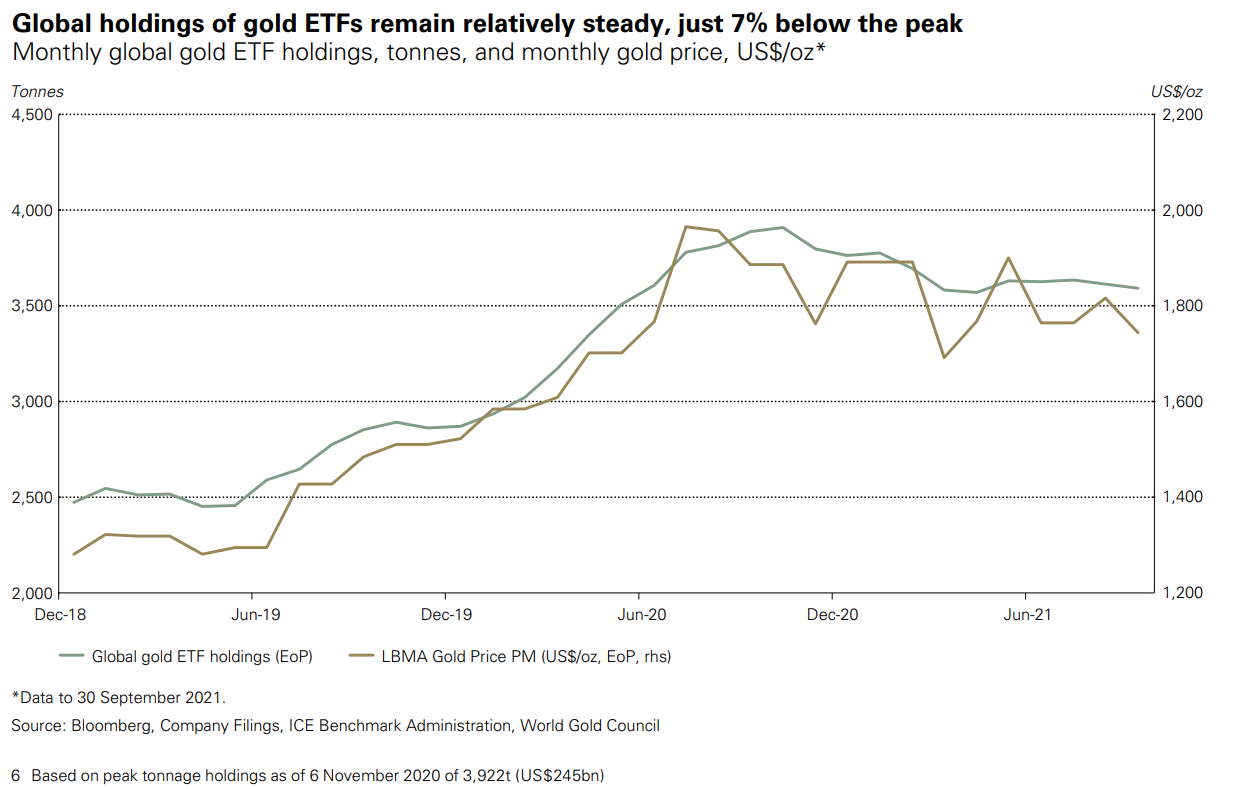
Gold price and stocks of gold ETFs are moving in the same direction (Source: World Gold Council)
In the third quarter of this year, central banks bought a net 69 tonnes of gold. By comparison, in the same period last year, they were net sellers of gold for the first time since 2011. Due to the lack of major purchases, the total in the third quarter was considerably lower. The biggest buyer was India with a total of 41 tonnes in the third quarter. Brazil, Kazakhstan and Russia also added some precious metal to their reserves in the past quarter.
Since the beginning of this year, central banks have bought a total of 393 tonnes of gold, compared to only 255 tonnes for the whole of 2020. This increase is largely attributable to a handful of very large purchases, including by Thailand, Hungary and Brazil. Turkey, which has also bought a lot of gold in recent years, had to take 13 tons out of its vault in the third quarter. The country's central bank is struggling with a fall in the value of the Turkish lira.
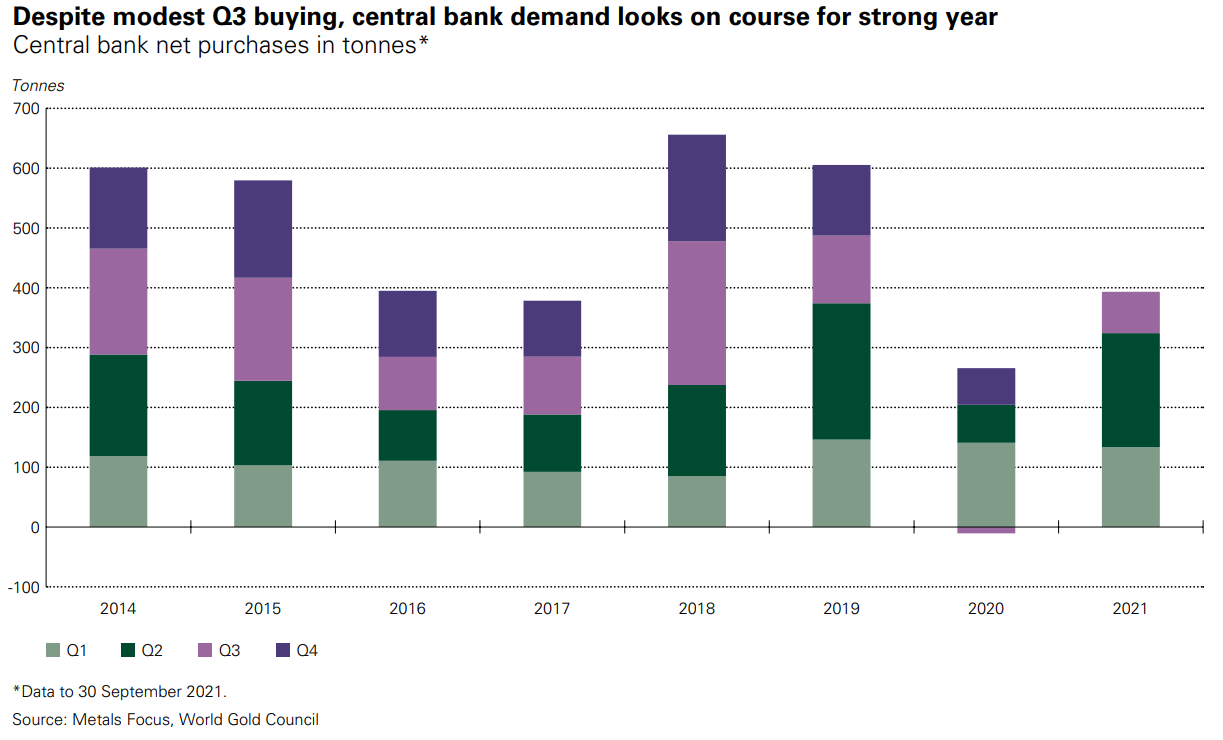
Central banks continue to replenish gold stocks (Source: World Gold Council)
The production of gold mines was hampered last year by the corona pandemic and lockdown measures. Those problems are now over and we can see that in production. Due to the relatively high gold price, it is attractive for gold mines to further increase production. For example, total global gold mine production in the third quarter reached a record 960 tonnes. Compared to the same period last year, this is an increase of 4%. This increase is partly attributable to gold mines in Indonesia and Mongolia, which were able to further increase their production.
Despite an increase in gold production from mines, less of the yellow precious metal came onto the market in the third quarter than in the same period last year. This is due to the sharp decline in the supply of scrap gold. In the past quarter, 298 tonnes of scrap gold were handed in worldwide, compared to 381.8 tonnes in the same period last year. That's a drop of more than 20%. Due to the stable and slightly declining gold price, people handed in less scrap gold than last year.
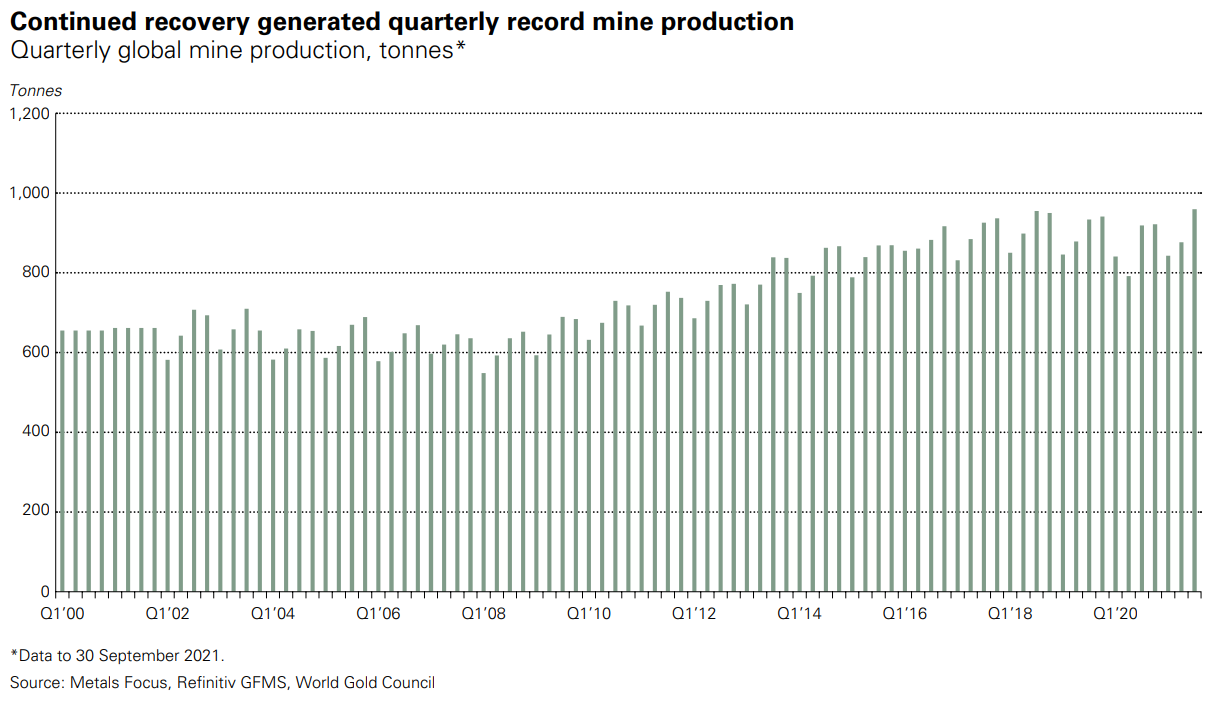
Gold mine production to record (Source: World Gold Council)
This contribution was made from Geotrendlines


