English
EN


In recent months, we have seen major shifts in the global gold market. Due to the strong dollar, demand for investment products such as gold ETFs is falling in the United States and Europe, while interest in the precious metal in Asia has risen sharply. Where does this pivot come from and what does it mean for the gold market?
In China, total gold imports already rose to the highest level in four years in August, driven by pent-up demand after the coronavirus pandemic. Due to the strong dollar, the Gold price under pressure, which is an additional reason for the price-conscious consumer in China to buy gold. Domestic demand again exceeded supply in September, as the gold price in Shanghai was more than $43 per troy ounce higher than the gold rate in London. Since 2016, that premium has not been this large, as the graph below shows.
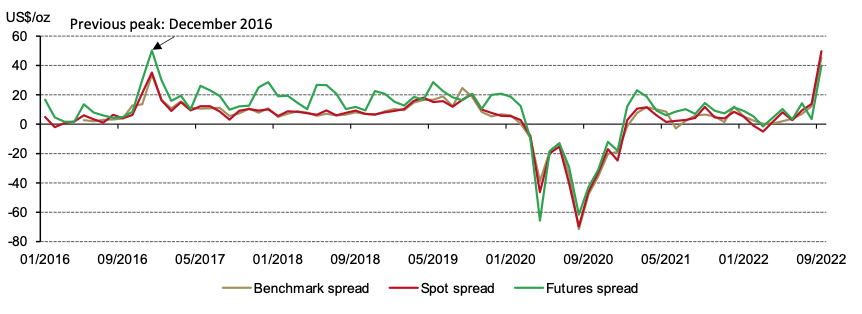
Premium on gold in China rises due to strong demand (Source: World Gold Council)
The reason for this high premium in China is that banks are only allowed to import a limited amount of gold. The central bank sets the quotas and banks have to stick to them. If the demand for gold on the Chinese market suddenly increases, this translates into higher premiums in the event of scarcity. "Demand usually picks up when the price drops", market analyst Philip Klapwijk of Precious Metals Insights told Bloomberg. This premium may fall again in the near future, if the central bank increases import quotas.
Not only is the demand for precious metals increasing in China, the market is also recovering in India. The fourth quarter is traditionally a strong quarter for the Indian gold market, as many festivals are held during this period. In addition, people often give each other gold as gifts. The World Gold Council expected more demand for gold and silver from India in the coming months. Traders in Thailand are also currently paying a premium compared to the gold price in London.
China and India are by far the largest markets for physical gold. Traditionally, this market often moves in the opposite direction to the Western gold market. When the price of gold rises, many Western investors take positions in gold contracts and investment products such as gold ETFs. This happened just after the corona crisis, when the price of gold rose and gold piled up in the vaults of London, Switzerland and New York.
Now that the price in dollars is falling a bit, we see an opposite movement. Many investors are selling positions, freeing up more gold for other countries. The precious metal, on the other hand, is shifting towards markets such as China and India. According to Bloomberg, statistics from the CME Group and the London Bullion Market Association (LBMA) show that more than 527 tonnes of gold have been removed from gold vaults in New York and London since the end of April this year.
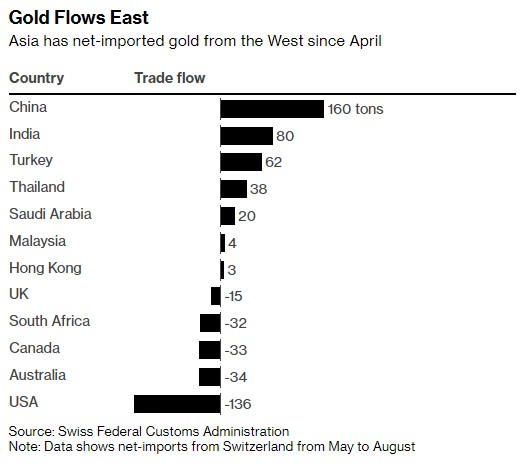
Gold flows from west to east (Source: Bloomberg)
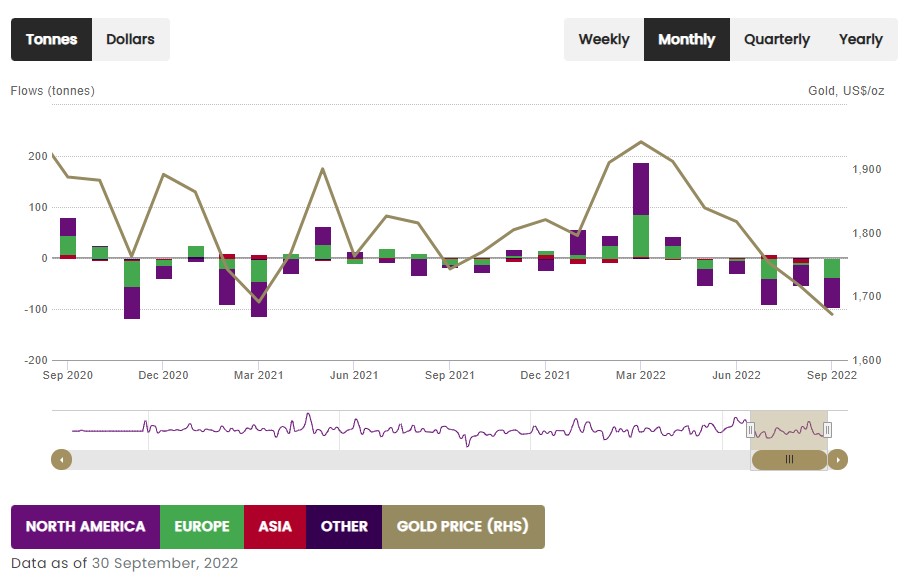
In recent months, Western investors have been selling positions in gold ETFs (Source: World Gold Council)
The above figures may suggest that there is less interest in gold in Western countries, but that is not entirely true. It is important to continue to distinguish between physical Gold Coins and Gold bars and derivative investment products traded on exchanges, such as ETFs and futures. The latter category is particularly popular with investors who want to take advantage of a price increase and with mutual funds that only want to invest in gold at certain times. Private individuals mainly buy coins and bars, with the aim of storing them for the long term as an alternative form of savings.
In recent years, we have seen an increasing group of savers and investors who want to buy physical bullion in the form of coins and bars. The demand for these investment products has only increased in recent months. As a whole, this market segment is smaller than the market for 'paper' gold investments, but that certainly does not make it any less important. Due to the high demand for coins and bars, the premiums and delivery times are increasing. Many people want to own precious metals privately because they are worried about how inflation, the value of money, or the geopolitical uncertainty in the world.
 Have a look at us YouTube channel
On behalf of Holland Gold, Paul Buitink and Joris Beemsterboer interview various economists and experts in the field of macroeconomics. The aim of the podcast is to provide the viewer with a better picture and guidance in an increasingly rapidly changing macroeconomic and monetary landscape. Click here to subscribe.