English
EN


The Finance Minister barely seeks information about the Dutch gold reserve and has little insight into how checks are carried out to verify that the gold is actually there. The reserve comprises 612 tonnes of gold worth more than €72 billion, managed by De Nederlandsche Bank (DNB), with more than two-thirds held abroad. There are also no agreements in place on how the gold could be used in a crisis. These are among the findings of the report Focus on the Gold Reserve, published today by the Netherlands Court of Audit. “The minister knows almost nothing and DNB knows little, according to the report,” says Paul Buitink of Holland Gold. Buitink has previously called, including in interviews with BNR and EenVandaag, for more of the country’s gold to be brought back to the Netherlands.
DNB itself checks whether the gold is present and securely stored. The external auditor, appointed by the minister in his capacity as shareholder, accompanies inspections of the vault in Zeist, but does not visit the vaults in New York, London or Ottawa (p. 17). For gold held at those locations, an 'external confirmation' is considered sufficient. As far as DNB is aware, this confirmation is issued by the foreign central banks themselves (p. 4). In other words, the custodian itself confirms that the gold is there; no independent auditor conducts a physical inspection. DNB did not share its own inspection reports with the Court of Audit, and the ministry never requested them (p. 16). When asked whether the gold reserve was actually there, the ministry was able to provide little information (p. 14).
There is no indication whatsoever that any gold is missing. But without independent physical inspections, there is also no independent assurance for most of the reserve. In Germany and Austria, national audit institutions are allowed to scrutinise their central banks’ management of gold reserves, but Dutch law does not allow this (pp. 14-15).
DNB itself describes the gold as a 'rainy-day reserve' for emergencies such as a financial crisis, severe political instability or war (p. 10). In 2010, the central bank referred to it as 'our national reserve for a rainy day' (p. 9). Yet DNB and the minister have made no agreements or drawn up scenarios for how the gold could be used in a crisis (p. 10). According to DNB, the gold belongs to DNB and will remain its property even in extreme circumstances (p. 10).
That is striking, given that the gold is intended precisely for periods of severe crisis. Finance Minister Heinen argues in his response that agreements covering crisis situations would restrict DNB’s independence.
“It is almost inconceivable that there is no strategic thinking about the Dutch gold reserve,” says Buitink. “DNB’s independence is crucial, but it should not be used as an argument for having no strategy at all. Especially at a time of heightened geopolitical tensions.”
Gold is regarded as retaining its value during periods of economic uncertainty, unlike equities or bonds (p. 7). It therefore serves as an anchor of confidence and an ultimate reserve. The investigation follows earlier work by the Court of Audit. In 2022, its Focus on Strategic Stocks report examined the emergency stocks maintained by central government, ranging from oil and medicines to cash. Members of parliament have also repeatedly questioned in recent years whether it is prudent to keep such a large share of the country’s gold abroad (pp. 18-19).
Following the fall of the Berlin Wall, DNB secretly sold 400 tonnes of gold in 1992 and a further 300 tonnes in 1996, at a time when central banks were reducing their holdings because gold generated little return (p. 8). After a major sale by the Bank of England caused market concern in 1999, fifteen European central banks agreed under the Central Bank Gold Agreement to sell gold only gradually. The Dutch reserve has remained stable at 612.45 tonnes since 2008 (p. 8).
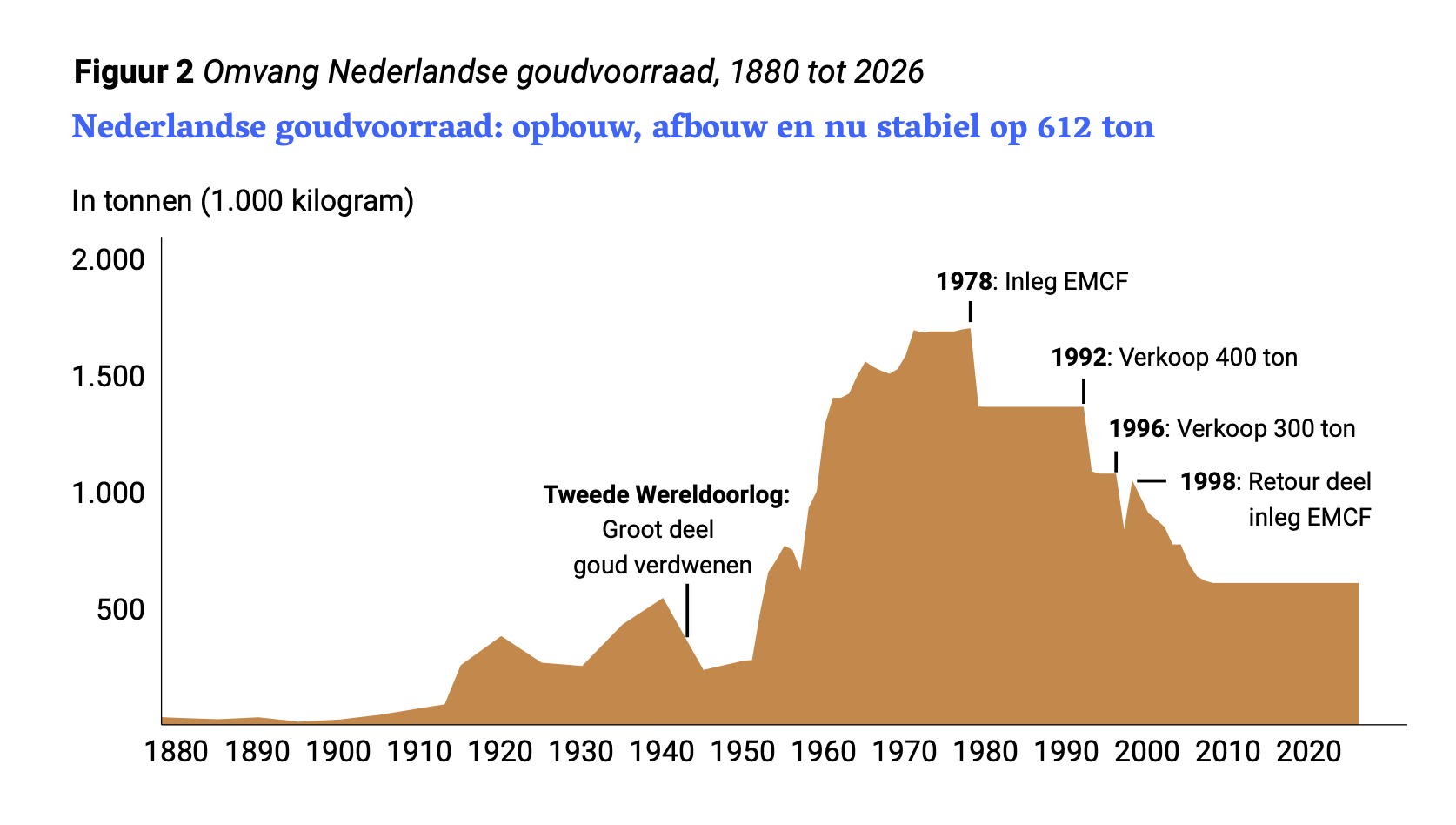 Size of the Dutch gold reserve, 1880-2026 (Source: Netherlands Court of Audit, p. 9)
The minister himself wrote to parliament that 'the management of the gold reserve is among the vital interests of the state' (p. 4). In an extreme emergency, the reserve is intended to help maintain confidence in the Netherlands. Yet the minister receives very little information about it (p. 4). Gold did not feature in the records of meetings between the minister and the DNB president until the end of 2025 (p. 17). Nor do the ministry’s archives contain any records relating to the secret transfer of gold from New York to the Netherlands in 2014. It is not known whether the minister was informed beforehand (p. 19).
DNB’s independence is enshrined in law, and the minister has no say over how much gold the Netherlands holds, how it is managed or where it is stored (p. 11). “Rightly so,” says Buitink. “You do not want politicians using the gold to plug every hole in the budget. But the Court of Audit also says that independence does not mean there cannot be a dialogue.” The Court of Audit cites the European Monetary Institute: 'The prohibition on external influence should not be interpreted so broadly as to exclude a dialogue between national central banks on the one hand and governments and other state bodies, such as parliament, on the other' (p. 12). Or, as the Court of Audit summarises it: 'Seeking information is not the same as influencing decision-making' (p. 17).
Between March and August 2026, DNB moved around 86 tonnes of gold from the US and Canada to London. In essence, this was an exchange. DNB sold almost 59 tonnes in New York and bought gold in London that meets international trading standards. More than 27 tonnes was physically moved to Zeist, while the same amount was transferred from Zeist to London. As a result, not a single additional gram of gold ended up in the Netherlands, while the value of the gold held in Zeist remained €22 billion (p. 21).
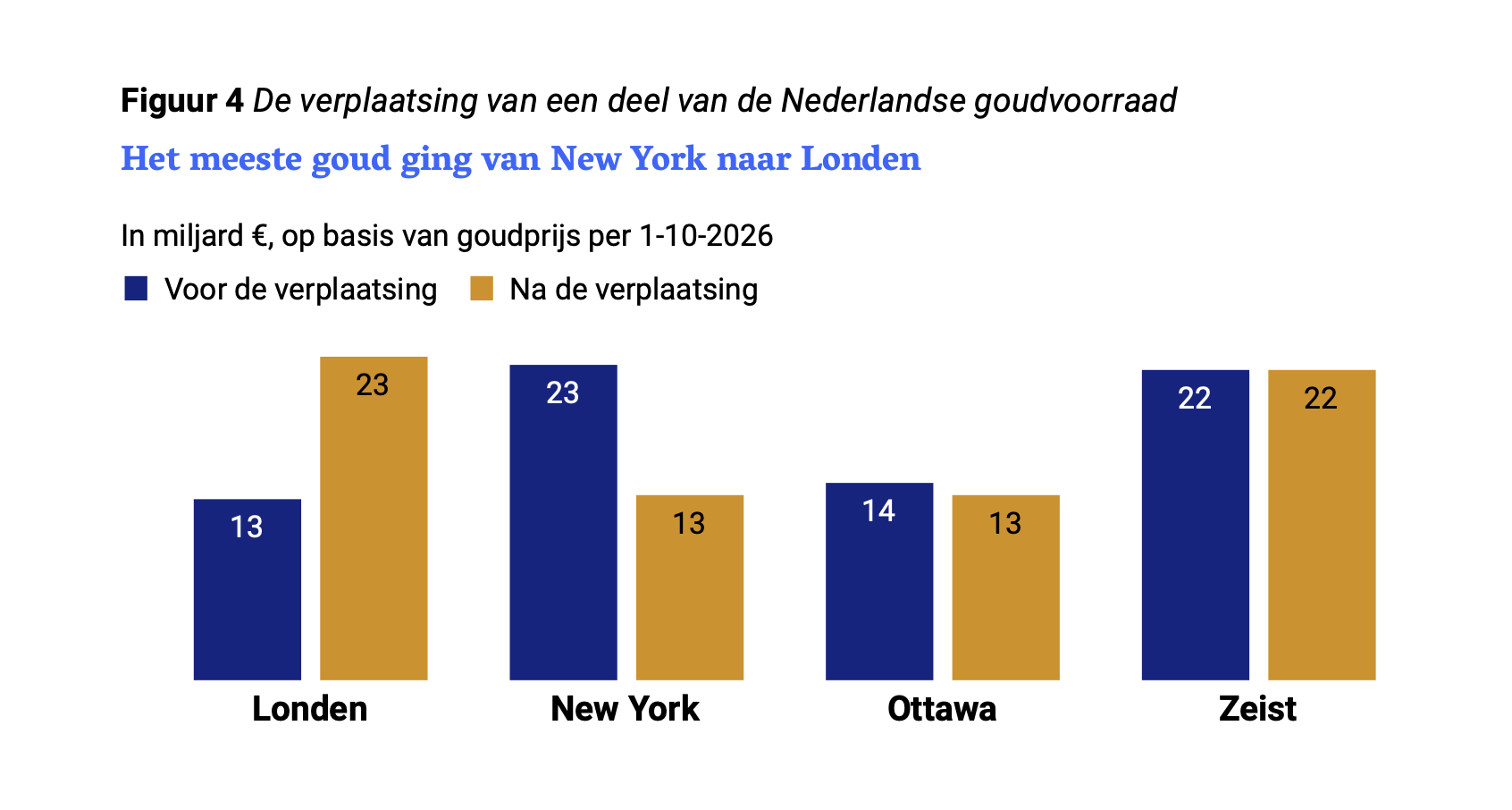 Distribution of the gold reserve before and after the relocation (Source: Netherlands Court of Audit, p. 21)
The operation was considered so sensitive that the Court of Audit’s investigation was suspended. DNB informed the minister on 8 December 2025 (p. 19); at his request, the Court of Audit paused its investigation ten days later 'because of the major interests at stake for our country and the safety of those involved' (p. 20). The precise reason has not been made public.
“It is striking that DNB president Olaf Sleijpen said at the end of March that there were no plans to move the gold out of the US, even though DNB had already told the minister in early December that it intended to do so and the relocation had already begun in March. A kind of white lie,” says Buitink. “And the delay to the report was also very likely related to Trump and tensions between the EU and the US.”
According to Follow the Money, Trump’s unpredictability did indeed play a role, although DNB officially cites other reasons.
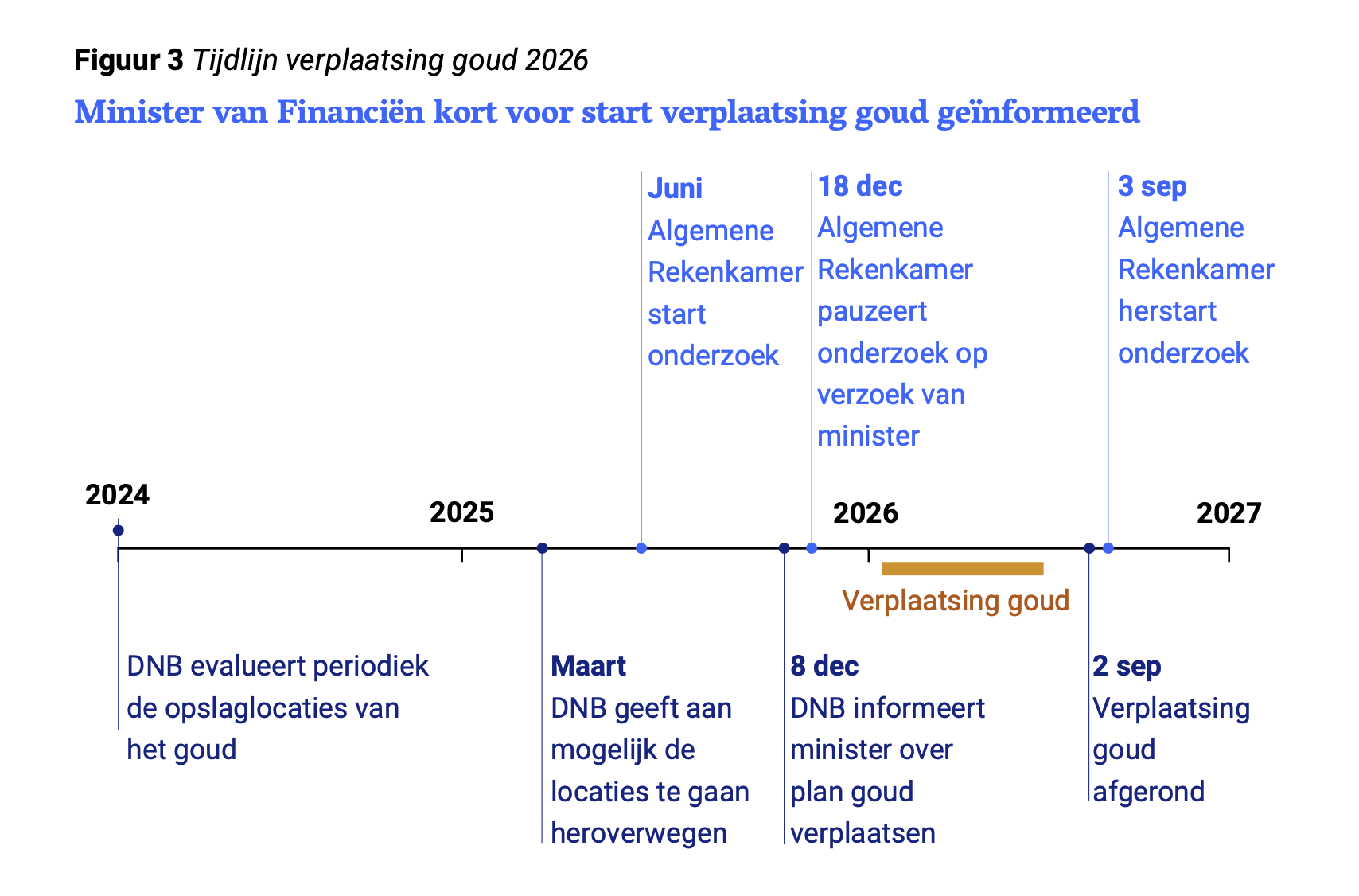 Timeline of the gold relocation and the Court of Audit investigation (Source: Netherlands Court of Audit, p. 20)
The Netherlands is not alone. Germany, France, India, Poland and other countries have also relocated their gold in recent years (p. 21).
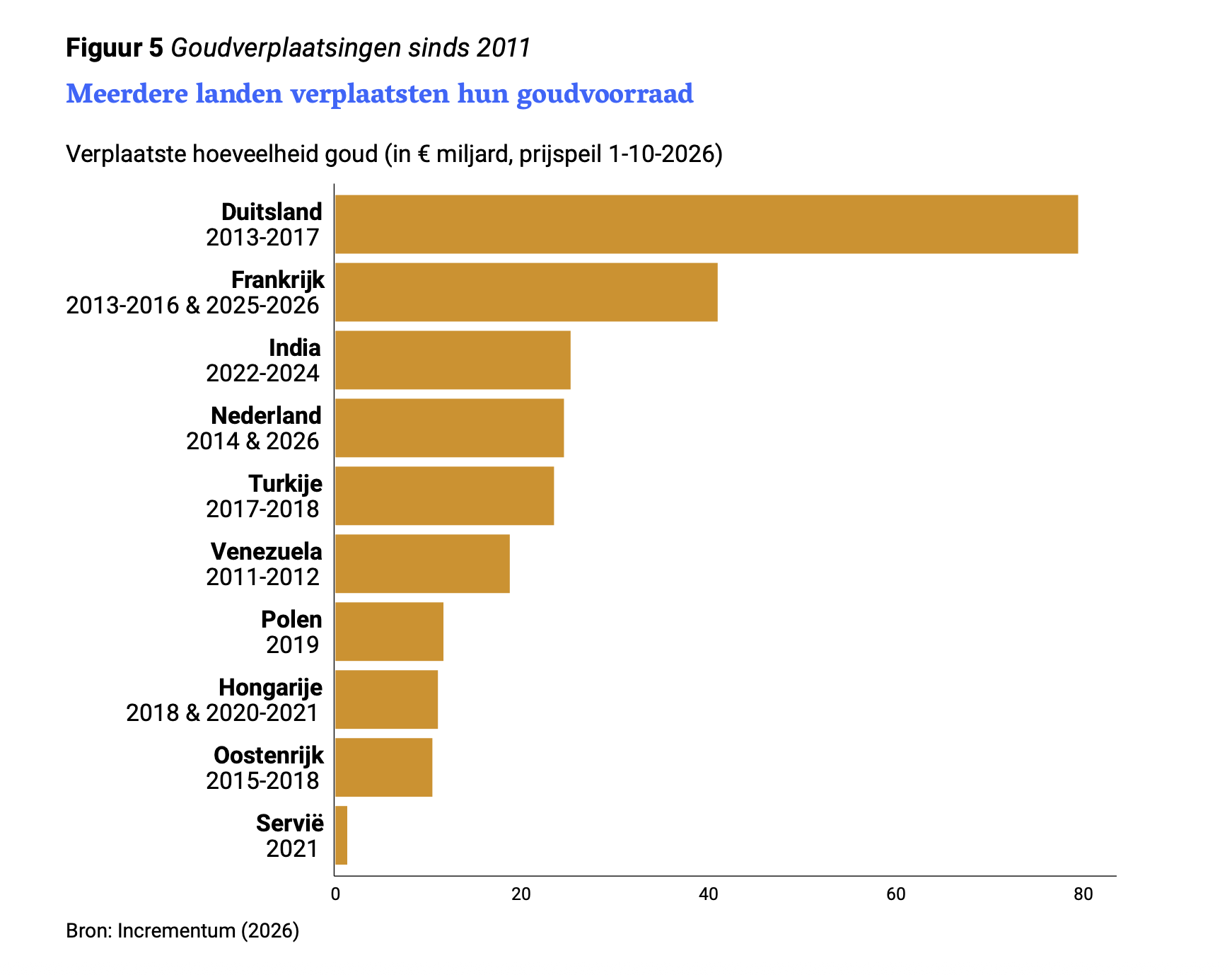 Gold relocations by country since 2011 (Source: Netherlands Court of Audit, p. 21)
Buitink has long argued for more of the Dutch gold reserve to be held on Dutch soil. Speaking to EenVandaag, he pointed to strained relations with the US and to Germany and Poland, which keep more of their gold closer to home. “Look, for example, at the Polish central bank, which is among the world’s largest gold buyers, or the German central bank, which has previously brought gold back from abroad. They clearly give much more thought to gold,” Buitink said. Following the move to London, he told BNR's The Friday Move: “I hope DNB has now simply taken the first step and ultimately sees it through.” The report reinforces that point: more than two-thirds of the reserve is still held abroad, without independent physical oversight and without a crisis plan.
The House of Representatives’ Finance Committee received a closed technical briefing from the Court of Audit today. We will be watching closely to see whether parliament now presses for greater transparency and oversight.