9.3
8.889 reviews

English
EN


Gold and Bitcoin are tools to increase your financial freedom and a way to escape the current money system. In addition, they are means to protect your assets against inflation. That's what Boris van de Ven says in an interview with Holland Gold. According to him, the money system is broken because it no longer offers opportunities to save. Solid money should be a means of calculation, a medium of exchange and a store of value, but the euro no longer fulfils the latter function.
According to him, the big crime that is now taking place in our current money system is that you can no longer save. Inflation is now 7.6%, which means you have to get quite a lot of returns to keep up with that. We have to work harder and harder to save against inflation. And if you are saving for a house, you have to deal with an inflation rate of up to 20%. The beauty of precious metals and Bitcoin, according to van de Ven, is that they represent real possession. "You're holding something that has value and can beat inflation over time."
Click here or on the image below for the video:
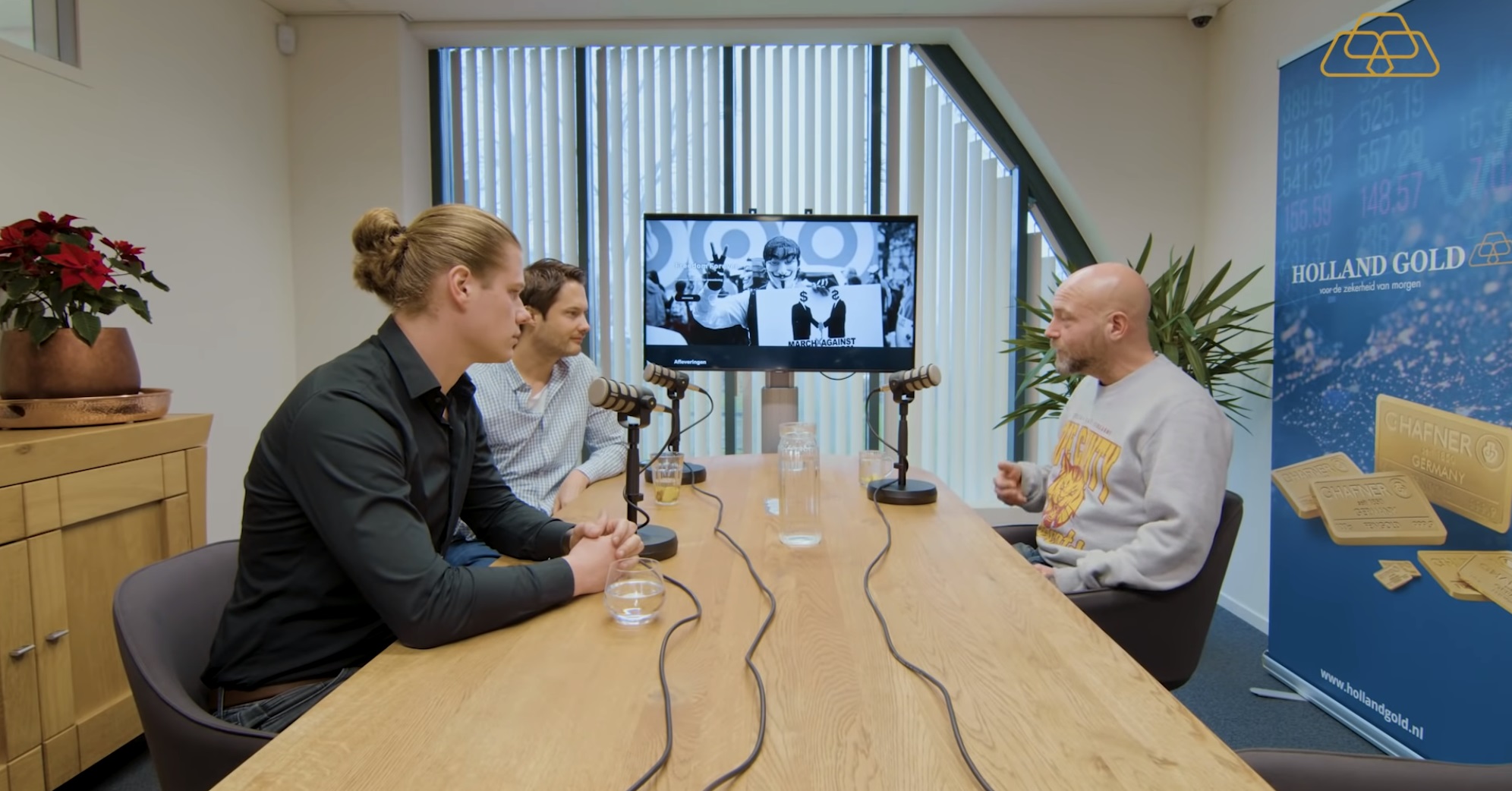
Boris van de Ven: 'Bitcoin is a monetary weapon'
According to van de Ven, we are at the end of a long cycle, just as we were at the end of a cycle eighty years ago. At that time, there was hyperinflation in Germany, which was the result of reparations. However, the hyperinflation was only a short period, which followed an era of abundant credit and massive speculation in stocks and real estate. This caused enormous polarization in society, just as we see today.
Social discontent was very high at the time, while the stable middle class was shrinking. "These are social changes that happen at the end of these kinds of cycles. We are now at the end of such a cycle. The corona crisis is a sign of this, but the implosion of our money system is also part of it.", according to van de Ven.
According to van de Ven, technological innovations bring new forms of freedom. Think, for example, of new weapons, the development of railways and shipping. All these technologies offered new possibilities that allowed people to increase their freedom. For example, during the golden age, we were able to sail ships to distant lands and trade.
In this way, technological innovation in the digital age can once again bring about major changes. For example, thanks to the internet, it is much more difficult for governments to suppress free speech. And with Bitcoin, there is a tool that allows people to make payments beyond the reach of governments. "As a Bitcoin you can hide behind a wall of encrypted energy, the government can't reach it. And that's an excellent place to sit at a time when the government is becoming increasingly authoritarian."
As an example, van de Ven mentions saving for a house. "Saving in euros is no longer possible, because you can't keep up with inflation. But you can sit in Bitcoin and say, "What I'm doing here, that's not what the government is about. If the pressure becomes too great, I'll move to a country like El Salvador.' And that's the cool thing about this digital generation, you've been given new tools. You can't save anymore and buy a house with the resources that were there to do that, but there are new resources now."
Boris van de Ven finds it frustrating that many people are only in crypto to get rich quick, because virtual currencies are an excellent tool to regain your freedom. "Having this instrument at your disposal is infinitely valuable when you need it. It's better to have a weapon in your house and not need it than to need it and not have it at home. That's exactly the same thing. And that is also the case with Bitcoin. It is a weapon, a monetary weapon. Better you learn how to use it responsibly. And that's not selling your house, taking out an extra loan to put it all in Bitcoin."
The great thing about Bitcoin, according to van de Ven, is that it is so transparent. You just see how much there is and where it is. "Bitcoin is the best alternative to that peak centralization we're currently seeing. It's a tool to defend your assets against governments."
This contribution comes from Geotrendlines


