English
EN


The ECB should buy shares to stimulate the Eurozone economy. Larry Fink, director of asset manager BlackRock, said this in an interview with news agency Reuters. He also believes that European government leaders should encourage investing in shares, because there is not yet a stock culture in Europe like there is in the United States.
"European equities trade at a much lower price than equities in the United States because they don't have an equity culture. I strongly believe that Europe needs to find a way to get Europeans to focus on equities as a long-term investment."
Fink's comments come at a time when central banks are under a magnifying glass. Analysts & Investors expect At the end of this month, the US central bank will cut interest rates, while there are persistent rumours that the ECB will start another stimulus programme later this year.
The director of BlackRock doubts the usefulness of a possible interest rate cut by the ECB. According to him, more negative interest rates will not have a positive effect on the economy, especially in an economy where many savings are still parked in bank accounts. He expects that more negative interest rates will only have harmful effects on savers.
Indeed, in recent years, European equities have lagged far behind European equities. The most obvious reason is that there are many popular tech companies listed on the American stock exchange, which have risen sharply in value in recent years. In European equity markets, the manufacturing and financial sectors have a much heavier weighting, two sectors that have underperformed. U.S. equities are also benefiting from a flight towards the dollar.
By buying up shares, the ECB can give a boost to the stock market, but it is questionable to what extent this is in line with the central bank's mandate. Buying government bonds can already be interpreted as an indirect form of debt financing by governments, because it allows countries to borrow more cheaply.
By buying up shares, a central bank would indirectly support companies, because it indirectly finances companies. Buying up shares also drives up the value of listed companies. Finally, the purchase of shares by the central bank entails a certain arbitrariness. After all, smaller companies that are not listed on the stock exchange do not benefit from it.
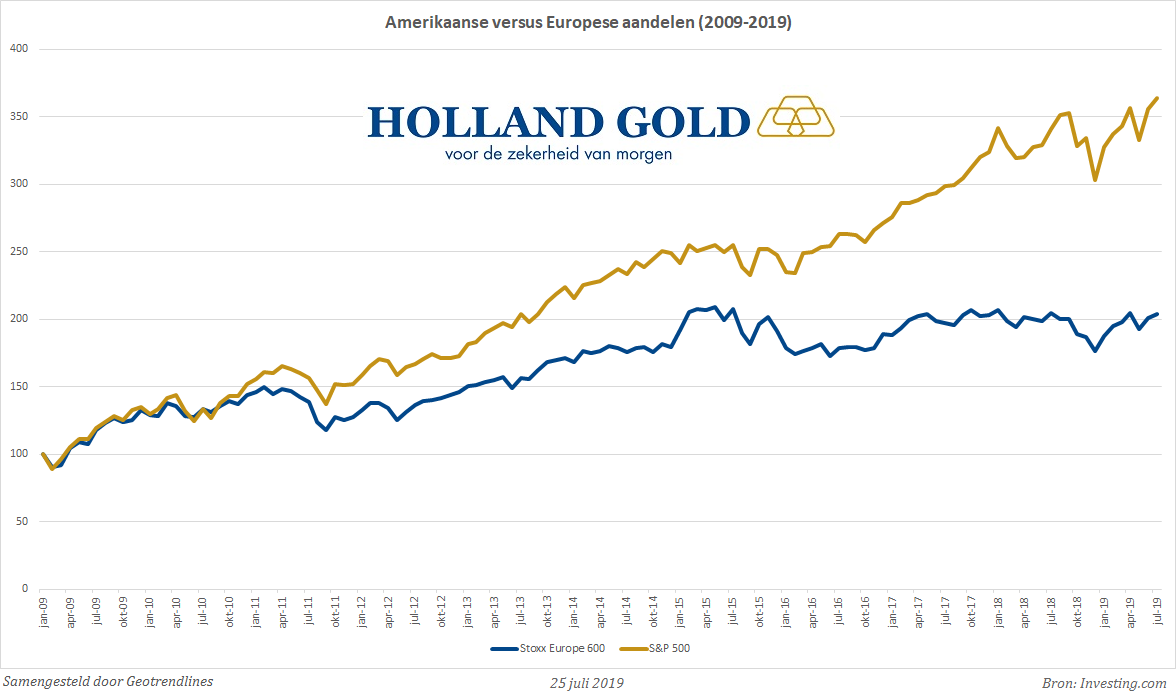
European equities lag U.S. equities
Central banks have made a drastic change of course in less than a year. At the end of last year, the US central bank was still planning to implement a number of interest rate hikes this year, but now the discussion is whether interest rates should be cut by 25 or 50 basis points. The ECB tapered off its bond-buying programme at the end of last year, but there are already rumours of a New incentive round.
In Japan, too, the central bank is ready to open the money tap further. The Bank of Japan is said to be willing to support the government's new fiscal stimulus program. finance. The Japanese central bank has also been buying stocks and government bonds for years. It cannot therefore be ruled out that the ECB will put more trump cards on the table in the coming years. Buying up shares is one of them.
It seems only a matter of time before European banks start passing on the negative deposit rate to savers. As a result, more savers will be forced to seek refuge in shares or tangible assets such as real estate, art and precious metals. It is therefore no coincidence that stocks as well as gold and silver have risen sharply in value in recent weeks, achieving new records.