English
EN


Despite today’s price decline and the recent volatility, some of the world’s largest asset managers are rebuilding their gold positions. Meanwhile, in Brussels, a European commissioner is calling for more taxpayers’ money to finance climate policy. VW is cutting 100,000 jobs as part of the biggest restructuring ever seen in the global automotive industry. Will the gold price continue to rise? Read on!
On Friday afternoon, the gold price fell by nearly 2 percent after new data showed that US employment had grown more strongly than expected. This increased the likelihood of an interest-rate hike by the Federal Reserve. Because gold itself pays no interest, interest-bearing investments become relatively more attractive when rates rise. Moreover, higher interest rates generally lead to a stronger dollar, which could put further pressure on the gold price.
Nevertheless, gold’s advance does not appear to be over yet. On Thursday, the Financial Times published an article entitled Gold’s bull run shows little sign of ending soon. In it, Bhanu Baweja, chief strategist at UBS Investment Bank, writes that the current gold rally began in 2018 and was initially driven by falling real interest rates and the accommodative monetary policy pursued during the coronavirus crisis. In February 2022, however, something fundamentally changed, according to Baweja. After Western countries froze Russia’s foreign-exchange reserves, reserve and asset managers around the world began to question which reserves would remain truly safe and accessible during a crisis. Their answer was gold.
Central banks and sovereign wealth funds in emerging economies subsequently increased their gold allocations from approximately 5 to 7 percent of their reserves in 2022 to 11 percent today. Since then, gold has also become much less sensitive to interest-rate increases, while continuing to benefit strongly from rate cuts. Baweja expects deteriorating public finances, declining confidence in government bonds and the search for greater diversification to provide further support for the gold price.
In last week’s Holland Gold Monthly Update, we discussed how Dutch pension fund ABP had significantly reduced its investments in US government bonds. This week brought another striking development. The Norwegian sovereign wealth fund, which at $2.3 trillion is the largest sovereign wealth fund in the world, has proposed reducing the share of government bonds in its bond portfolio. US government bonds in particular would be affected. According to Bloomberg, Norway’s holdings could fall by approximately $75 billion.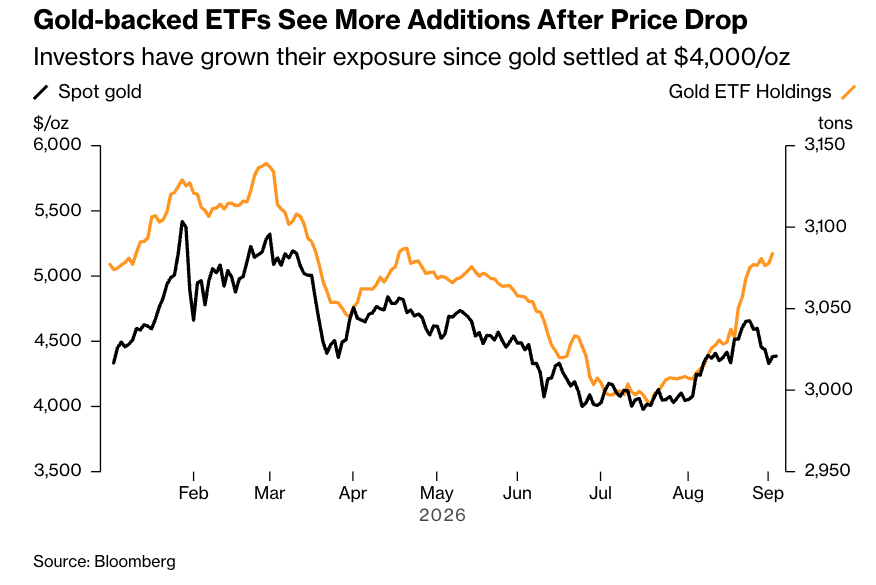
Demand for gold from ETFs is rising again (source: Bloomberg)
“Money is flowing out of the dollar and into hard assets, including gold and Bitcoin, because confidence in US fiscal discipline is declining,” says Anthony Saglimbene, chief market strategist at US asset manager Ameriprise Financial, in another article published on Friday by the US financial news website Bloomberg.
Some of the world’s largest asset managers are said to have rebuilt their gold positions following the price decline. They expect the structural drivers of the gold price to remain intact, even as the Federal Reserve adopts a tougher stance in its fight against inflation. “The drop to $4,000 represented an excellent buying opportunity for those who did not yet own gold,” says Michael Cuggino, chairman of the Permanent Portfolio Family of Funds.
“We regard gold as inexpensive, as a good hedge and as reasonably liquid,” says Lorenzo Portelli, head of cross-asset strategy at the Amundi Investment Institute. Europe’s largest asset manager bought gold in the expectation that the price would return to $5,000 per troy ounce by the end of the year.
Several asset managers do warn, however, that any further rise will be accompanied by considerable price volatility. Higher bond yields and the increasing likelihood of an interest-rate hike by the Federal Reserve could put pressure on the gold price in the short term.
Nevertheless, they still regard gold as an attractive hedge within a broader investment portfolio. “Gold has become a much more widely accepted investment,” says Arnout van Rijn, portfolio manager at Robeco. For him, the acceleration in central-bank gold purchases during the second quarter provided the impetus to buy gold again. According to the World Gold Council, central banks bought a net 289 tonnes of gold during that period, the highest level ever recorded in a second quarter.
Viewing tip: Paul Buitink on Radio 1 discussing DNB’s relocation of Dutch gold.
According to Spanish socialist European Commissioner Teresa Ribera, the European Union must begin considering ‘bold’ proposals to finance the high cost of its climate policy. The European Commissioner for a Clean, Just and Competitive Transition made the remarks to Politico.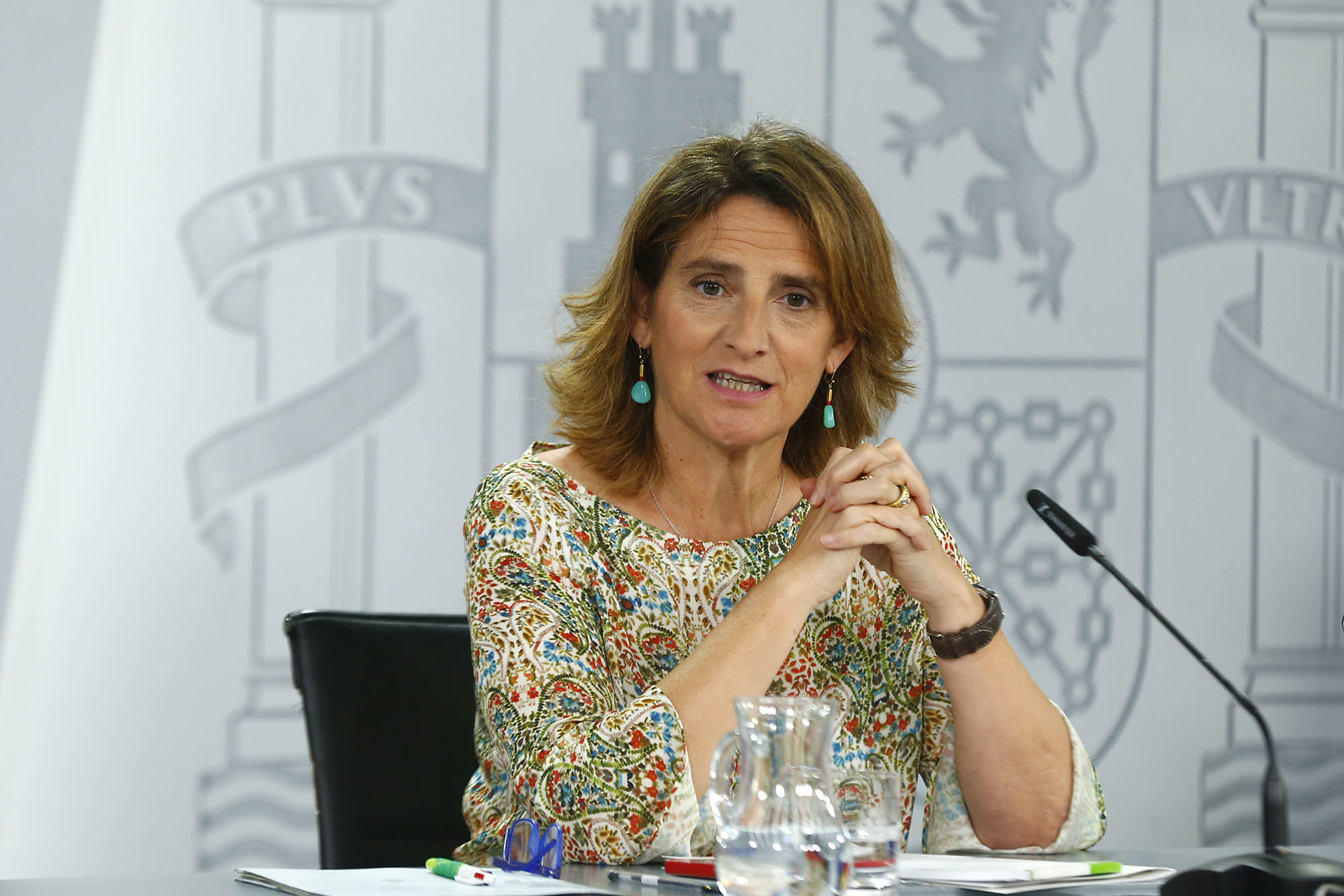
Teresa Ribera (source: La Moncloa/Flickr)
Ribera is considering a larger Brussels budget, more joint debt and an additional tax on energy companies’ profits. She wants to use these measures to finance hundreds of billions of euros in climate spending. She acknowledges that national and European budgets are insufficient to pay for her plans. Despite the already extremely high tax burden and debt levels in Western Europe, she does not want to scale back her ambitions, but instead wants to raise even more money: “National budgets and traditional European resources alone will not be sufficient.”
The European Commission will present a new package of climate measures this autumn. Ribera is therefore also calling for more financial resources: “Ambition without the means to make it a reality risks ending in wishful thinking without concrete results.” She also warned: “We cannot afford to lose any more time.”
This week, the long-running crisis at Volkswagen and in the German automotive industry, caused in part by high energy costs, entered a new chapter. Management and the trade unions agreed to cut another 50,000 jobs by the end of this decade. This brings the total number of job losses to 100,000, equivalent to one in seven employees. The company also appears to be planning to withdraw the Seat brand from the market.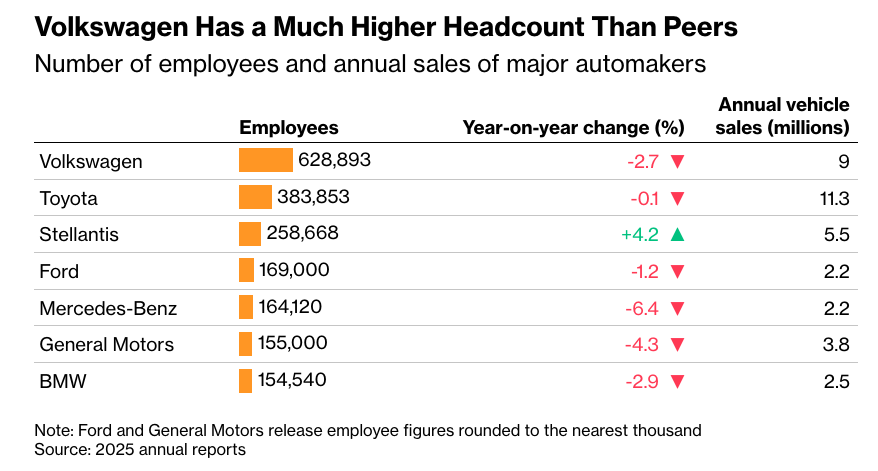
Number of Volkswagen employees (source: Bloomberg)
It is the biggest restructuring ever undertaken in the global automotive industry. According to management, the primary purpose of the measures is to reduce Volkswagen’s high production costs in Germany. The group has significantly more employees than rival automakers. “The work is only just beginning,” workers’ representatives warned. Under its Future Plan 2030, Volkswagen aims to approximately halve the number of models it offers by 2035 and reduce the complexity of its product range by around three-quarters.
Politico writes that the growing crisis at Volkswagen is providing political tailwinds for the right-wing Alternative für Deutschland (AfD). Important state elections will take place in Saxony-Anhalt on Sunday. Later this month, residents of Berlin and Mecklenburg-Western Pomerania will also go to the polls, two states where the AfD is likewise gaining ground. “The demise of traditional German carmakers is the result of failed economic and energy policies,” said Tino Chrupalla, co-chair of the AfD.
His fellow co-chair Alice Weidel also lashed out at the German government: “No chancellor has fuelled our country’s economic misery and deindustrialisation as much as Friedrich Merz.” A poll shows the AfD at 43 percent in Saxony-Anhalt. This puts the party far ahead of the Christian Democrats, who are polling at 22 percent, and brings an absolute majority in the state parliament within reach. To be continued!