9.3
8.489 reviews

English
EN


The energy crisis is escalating rapidly. Oil prices are reaching levels not seen since 2008, while the first fuel stations in Europe are running out of supply. What are the consequences, and does this mark the beginning of a new wave of inflation?
This week, the price of crude oil for immediate delivery rose to its highest level since 2008. The so-called Dated Brent, the price for physical deliveries from the North Sea, reached $141.36 per barrel on Thursday, surpassing the levels seen during the Russian invasion of Ukraine. In the previous weekly selection, you could read that Larry Fink, CEO of BlackRock, predicts a global recession if oil prices remain between $100 and $150 per barrel for a prolonged period.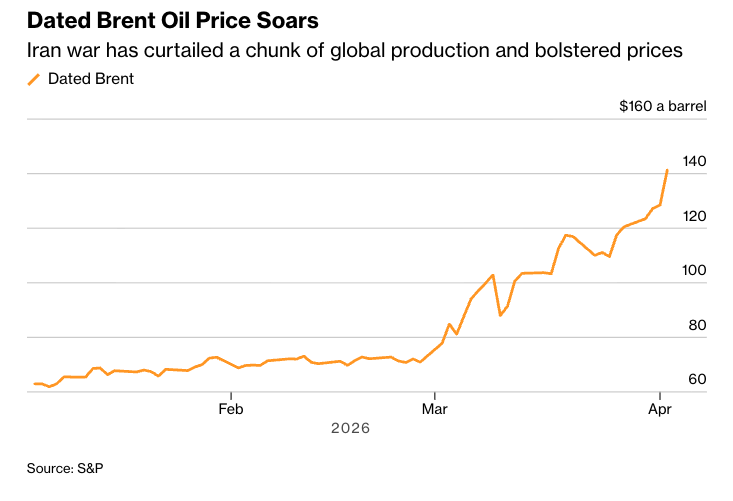
Oil price rises to highest level since 2008 (source: Bloomberg)
Bloomberg writes that the increase points to a growing gap between futures contracts and the physical market, where the increasing scarcity of inventories is being priced in more strongly. This scarcity is now also clearly visible at the pump: in the Netherlands, you already pay more than €2.77 for a liter of diesel. In France, hundreds of fuel stations are out of stock. It is estimated that around 12 percent of fuel stations are now facing shortages of petrol and/or diesel. The shortages arose after Total introduced a voluntary price cap of €1.99 per liter of petrol and €2.09 per liter of diesel.
The price of a barrel of diesel has now risen above $200, the highest level since 2022. Diesel is essential to the economy and indispensable for agriculture, transport, and shipping. Europe is heavily dependent on imports in this regard. Despite rising prices and the first shortages at fuel stations, available cargoes are not flowing en masse to Europe, but rather to other parts of the world, even as far as Australia. Competition for fuel is therefore increasing further. According to Bloomberg, Europe will simply have to offer more to attract sufficient diesel.
European air traffic will also be affected. The CEO of Ryanair says the airline will have to cancel “5 to 10% of flights in May, June and July” if the Strait of Hormuz remains closed. Which routes will be affected depends on the availability of jet fuel at the destination. According to Politico, British airports are the most vulnerable, followed by French airports. A first regional UK flight route has already been scrapped due to high fuel prices. The Netherlands and Belgium, as oil hubs of Europe, appear to be in a relatively favorable position.
Global food prices are under pressure due to the conflict in the Middle East. The Economist writes that the number of people facing acute hunger could reach record levels in 2026 if the conflict in Iran does not end soon.
According to the International Energy Agency (IEA), many governments are still primarily focused on cost compensation rather than reducing fuel demand. To soften the looming wave of inflation, they are choosing to limit price increases through a record release of strategic oil reserves and tax cuts. 38 countries have chosen to reduce the cost of fuel consumption, while 26 countries have taken measures to limit consumption itself.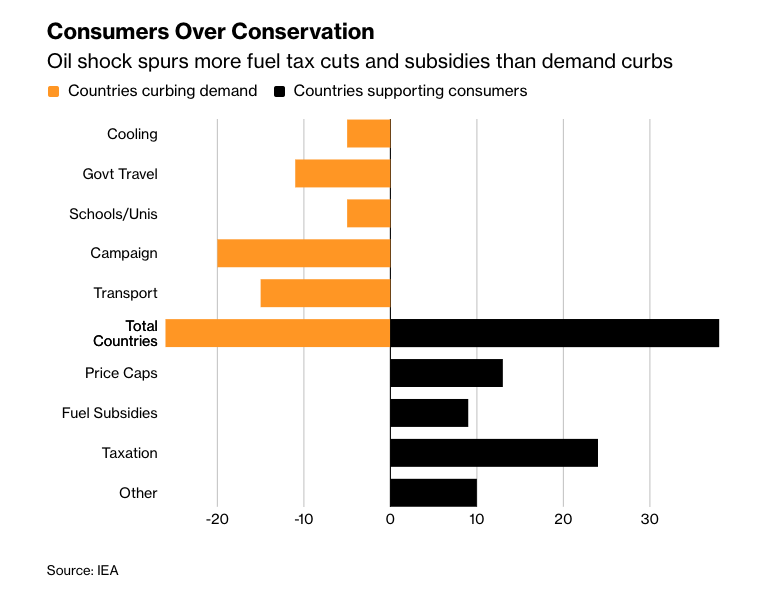
Consumption restrictions and compensation (source: Bloomberg)
According to EU Energy Commissioner Dan Jørgensen, Europe must prepare for a prolonged energy shock: “This will be a prolonged crisis… energy prices will remain high for a long time.” The EU is currently exploring “all options,” including fuel rationing and the release of additional oil from strategic reserves.
We previously wrote that Europe must prepare for a crisis and that energy prices could remain high even in the event of a ceasefire, as a large part of the energy infrastructure in the Gulf region has been damaged. Meanwhile, attacks continue. Iran once again attacked energy-related targets in the Gulf states on Friday. An oil refinery in Kuwait was hit, and in Abu Dhabi the largest gas processing facility was shut down after a fire broke out due to debris from an intercepted missile.
Governments are therefore expected to increase spending to compensate voters, while the economy is being hit by higher energy prices and rising uncertainty. Many European countries are already dealing with high debt ratios and budget deficits. In last Tuesday’s Monthly Update, we already pointed out that this, combined with the looming inflation wave, has pushed up government bond yields since the start of the conflict. Frank Knopers indicated in the podcast that this could once again lead to a European debt problem.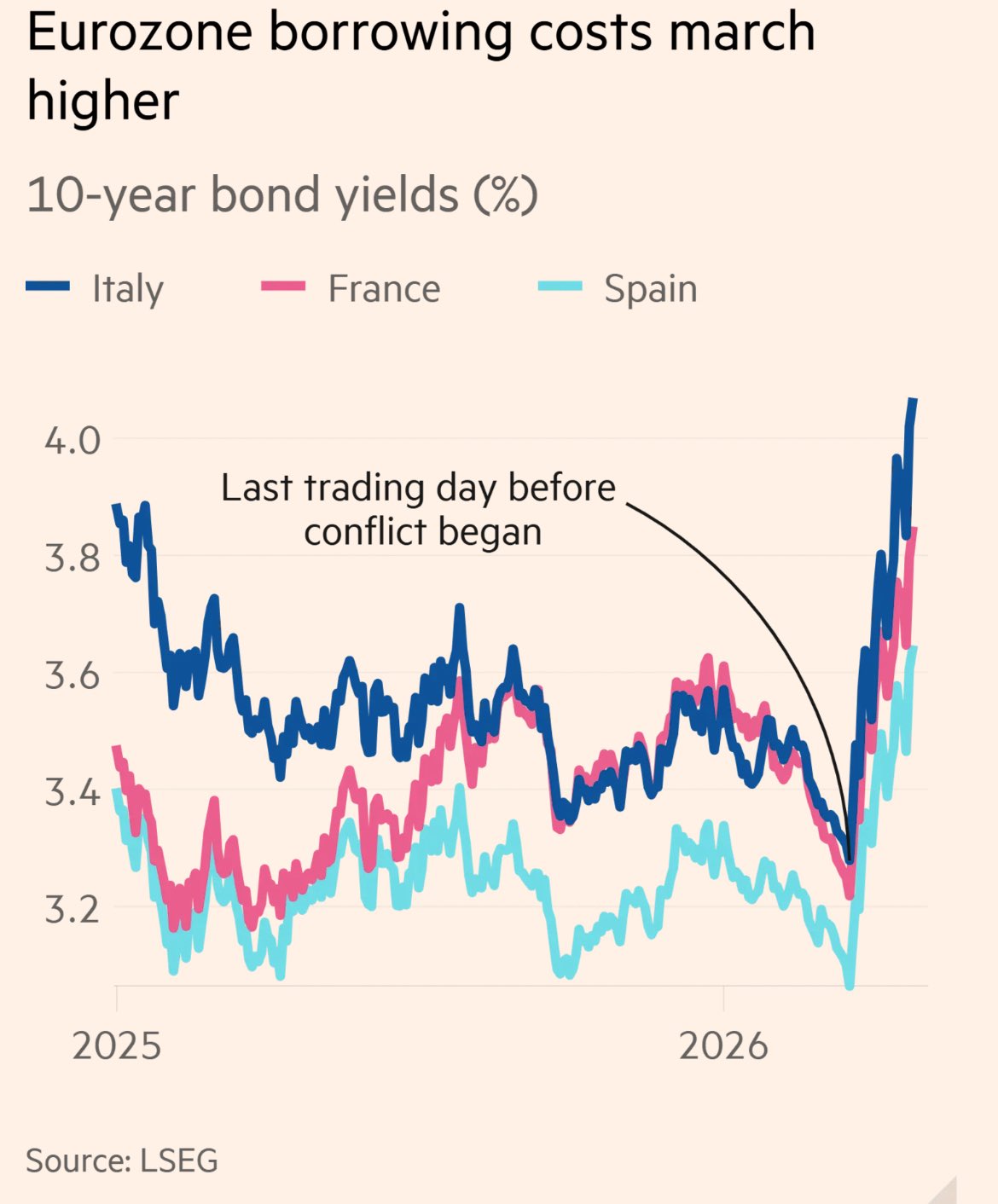
Rising government bond yields since the start of the conflict (source: FT)
BlackRock has increased its short positions in German government bonds and expects rising inflation to push borrowing costs above the highest level in 15 years. Tom Becker, manager of the Tactical Opportunities Fund, also expects higher interest rates. “Markets may be underestimating the fiscal response of European policymakers, who will spend more on energy security for the winter and investments in military readiness,” he said. “This means the supply of government bonds will increase in the coming quarters.”
In an additional Holland Gold Podcast, Thomas van Galen, Chief Strategist at Achmea Investment Management, said he expects inflation in the Netherlands to rise to 5 percent this year. In the inflation figure published this week by CBS, we already saw an increase from 2.4 to 2.7 percent.
To end the Easter weekend on a somewhat positive note, there is also a bright spot: a container ship owned by a French company has left the Strait of Hormuz. It appears to be the first known passage of a ship linked to Western Europe since the start of the war. In addition, three tankers with Omani ownership appear to have passed through the strait via a route along their own coastline, as an alternative to the northern route through Iranian waters.
Another bright spot comes from Saudi Arabia, where it is increasingly possible to export oil via Yanbu, a port on the Red Sea. The increase in exports via Yanbu now compensates for approximately 45% of the lost supply from the Persian Gulf this month.
In Germany, the position on nuclear energy is now being reconsidered. Chancellor Merz also called for the construction of new gas-fired power plants. In Italy, there is consideration of reactivating four coal-fired power plants that are currently on standby if problems with gas and oil supply worsen.
Economist Han de Jong advocates for more domestic production of fossil energy in Europe. According to him, security of supply and affordability have been subordinated to climate goals for too long. Further acceleration of the energy transition offers no short-term solution. He therefore calls for stronger investment in nuclear energy and fossil fuel production, and for less influence of climate activists on energy policy. “Keep activists as far away from the policy levers as possible,” said De Jong.
Also take a look at our YouTube channel
On behalf of Holland Gold, Paul Buitink and Yael Potjer interview various economists and experts in the field of macroeconomics. The aim of the podcast is to provide viewers with better insight and guidance in an increasingly fast-changing macroeconomic and monetary landscape. Click here to subscribe.


