English
EN


What a week. Gold briefly touched a 15-month low on Wednesday before rallying nearly 3% on Friday. Silver is up around 7% over the week, having plunged well below $40 on Wednesday. What drove these sharp price swings, and what do they tell us about the outlook for the months ahead?
Anyone following the gold price this week will have witnessed some dramatic swings. On Monday, Nvidia brought back its chief executive, Jensen Huang, prompting a rally in equity markets. Gold rose by 2.7% and silver by 4.7%. The rally was short-lived, however, as renewed doubts over the AI boom and reports of new US import tariffs pushed gold down 2.2% and silver down 5.2% on Tuesday. We covered the events of those first few days in our in-depth market update on Wednesday.
Wednesday marked the low point. Following strong US economic growth and inflation figures, gold fell to an intraday low of $3,426 per troy ounce, its lowest level since August 2025. Silver plunged to $38.09. Yet both metals managed to close higher that day as Wall Street recovered. US stock markets were closed for Thanksgiving on Thursday, making for a quiet trading session.
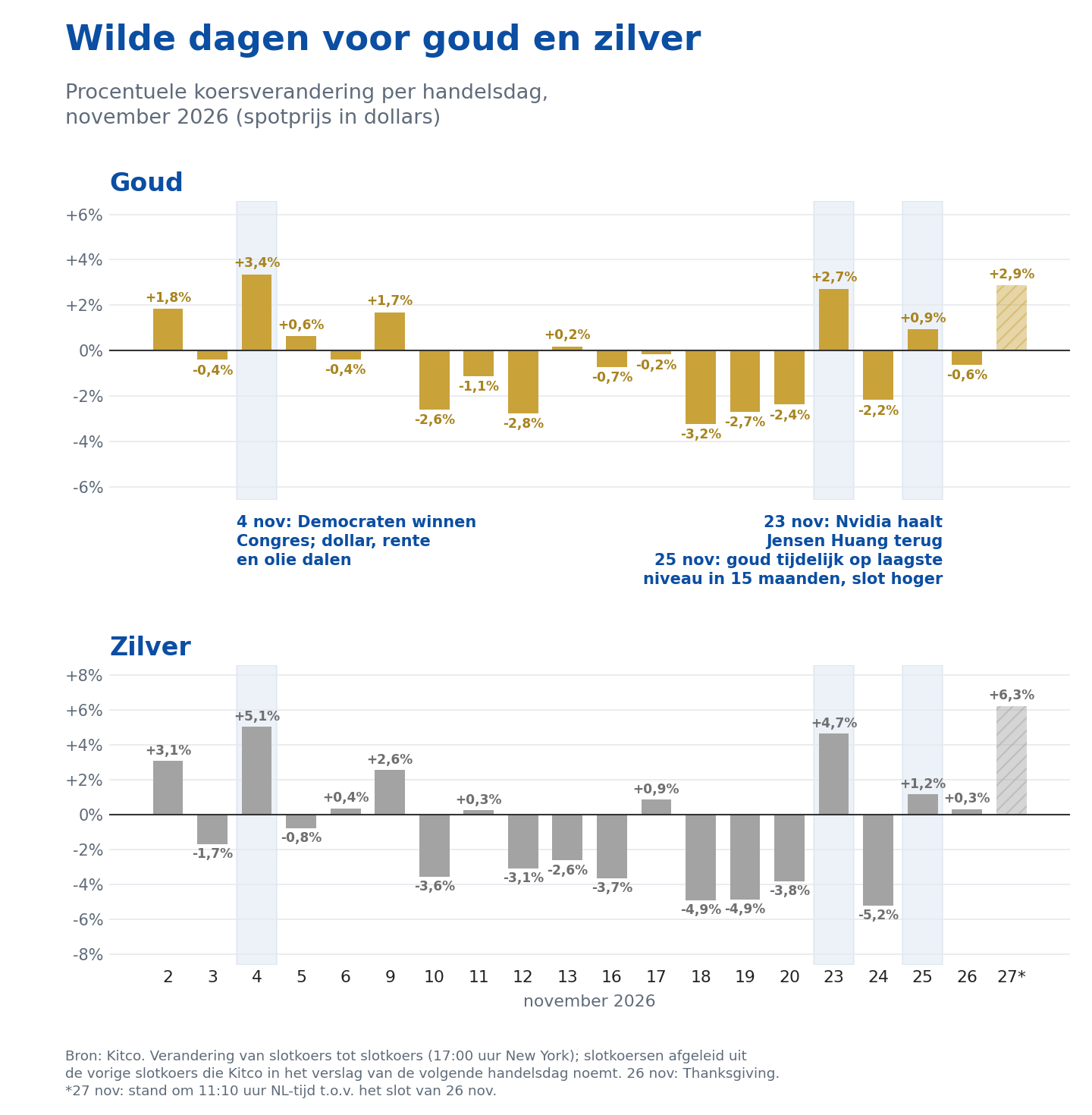 Daily price movements in gold and silver in November (source: Kitco)
Friday finally brought some relief. Technology stocks continued their recovery, while Chinese equities surged following a rare pledge of government support. Beijing reassured investors by promising to actively support the stock market, including through share purchases by state-backed funds. This gave gold and silver an additional boost. Chinese investors hold relatively large amounts of gold and silver, and when equity markets fall, they often draw on these reserves, creating selling pressure. As trading in China gets under way in the middle of the night in the Netherlands, any easing of that pressure is often reflected in the gold price early in the European morning. Gold rose nearly 3% on Friday morning to around $3,668 (just over €107,700 per kilogram), while silver climbed more than 6% to $44. Over the week as a whole, gold is up nearly 4% and silver around 7%.
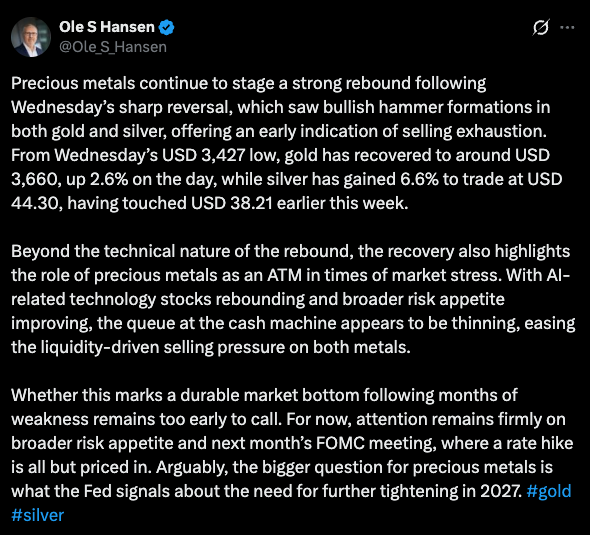 Gold is often used as an “ATM”, or cash machine, during periods of market stress, according to Ole Hansen (source: Ole Hansen on X).
What explains such dramatic swings? The answer lies less in gold itself than in the wider financial markets. As Koen Lauwers explained in Thursday’s market update, there was a widespread scramble for liquidity. Investors who have borrowed money to invest and are nursing losses on equities need to raise cash quickly. They therefore sell whatever is easiest to liquidate, and that is often gold. When equity markets recover, that selling pressure subsides and gold rebounds just as sharply. The recovery “highlights the role of precious metals as an ATM in times of market stress”, wrote Ole Sloth Hansen, Head of Commodity Strategy at Saxo Bank, in a post on X. With AI-related stocks recovering and risk appetite returning, “the queue at the cash machine appears to be thinning”, easing selling pressure on both metals.
Beneath all this volatility lies an interest rate outlook that has become more hawkish rather than less so this week. PCE inflation, the Fed’s preferred measure of inflation, stood at 3.8% in October. Core inflation, which excludes food and energy, rose to 3.3%. Meanwhile, the US economy expanded at an annualised rate of 4.3% in the third quarter, its fastest pace in three years.
The Fed’s Beige Book, which gathers insights from businesses across the twelve Federal Reserve districts, offered little reason to expect monetary easing either. Eight districts reported growth, while four reported no change. Wages rose slightly faster than in the previous reporting period, and businesses reported persistent cost pressures stemming from energy, transport, insurance and import tariffs.
This is reflected in the CME FedWatch Tool. Investors are now pricing in a 98.9% probability of an interest rate rise on 9 December, compared with 88.6% a week earlier. Markets are pricing in a 65.9% probability that interest rates will be 50 basis points above their current level by the end-of-January meeting, and a 41% probability that they will be 75 basis points higher by mid-March. Higher interest rates make gold, which pays no interest, less attractive in the short term. According to Saxo’s Hansen, a December rate rise is already all but priced in. “Arguably, the bigger question for precious metals is what the Fed signals about the need for further tightening in 2027.”
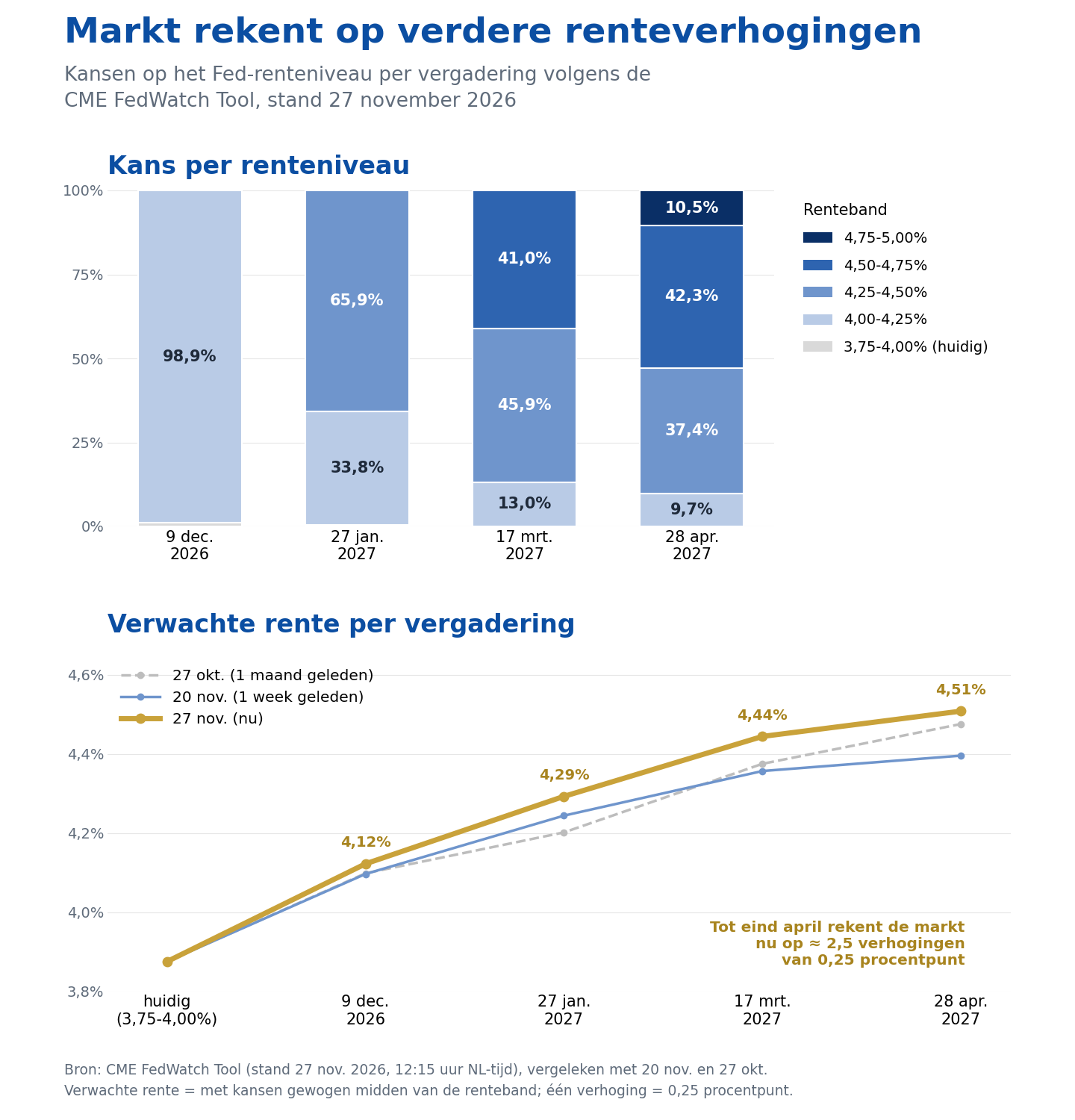 Market expectations for the US policy rate at each Fed meeting (source: CME FedWatch Tool)
Adding to these pressures are the newly proposed US import tariffs: 20% on Chinese goods, potentially doubling to 40% if trade talks break down, and 15% on EU goods, with a possible upper limit of 20%. China has described the investigation as unilateral and has not ruled out retaliatory measures. Meanwhile, oil prices climbed to just over $97 a barrel following fresh attacks in the Gulf, up from $90 on Wednesday. Both tariffs and higher oil prices could keep inflation elevated.
The picture in Europe is somewhat different. Inflation in France and Spain slowed much more sharply than expected, while the French economy contracted in the third quarter. Investors are consequently expecting fewer interest rate rises from the ECB.
Friday’s developments in the copper market were particularly striking. The red metal surged by as much as 6.5% on the London Metal Exchange, its biggest gain since January, after hitting an 11-month low. Copper had reached a record high of nearly $15,000 per tonne in September, but subsequently fell sharply amid doubts over the construction of AI data centres. According to traders, Friday’s rally was largely driven by short covering, as investors who had previously bet on falling prices were forced to close their short positions.
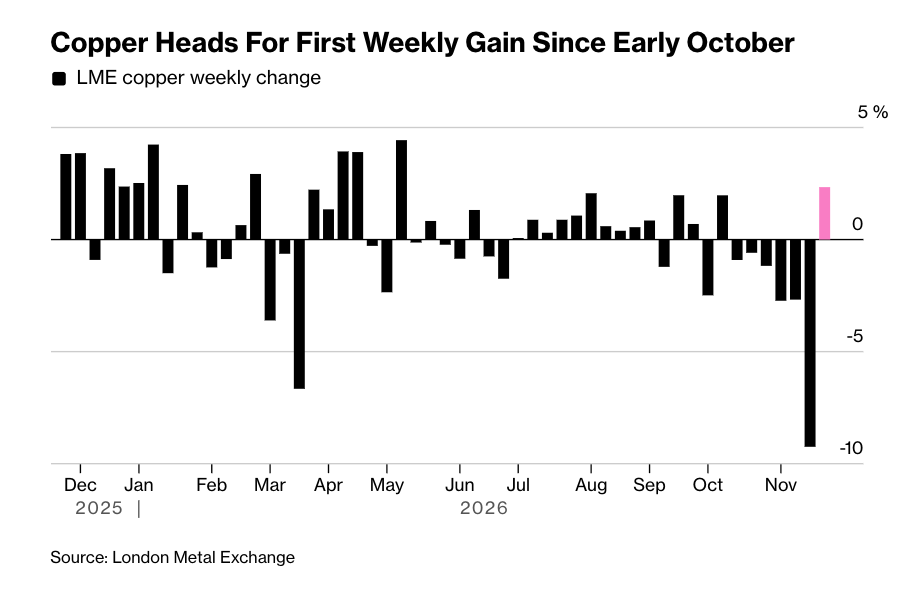 Weekly changes in copper prices on the London Metal Exchange (source: Bloomberg)
It is no coincidence that copper and silver are rebounding together. More than half of global silver demand comes from industry. When market sentiment improves and investors become more willing to take on risk, silver benefits on two fronts: both as a precious metal and as an industrial metal. This also helps explain why silver has experienced much larger price swings than gold this week.
Whether gold has found a bottom remains an open question. Hebe Chen, an analyst at Vantage, describes the $3,450 to $3,500 range as the ‘line in the sand’ for gold. TD Securities does not expect gold to move towards $5,000 until the second half of 2027, provided inflation falls below 3% and the Fed has room to cut interest rates. Other major banks share a similarly positive outlook. Goldman Sachs expects gold to reach $4,650 by the end of 2027, while UBS and Société Générale forecast $5,000 and JPMorgan Private Bank expects around $4,600.
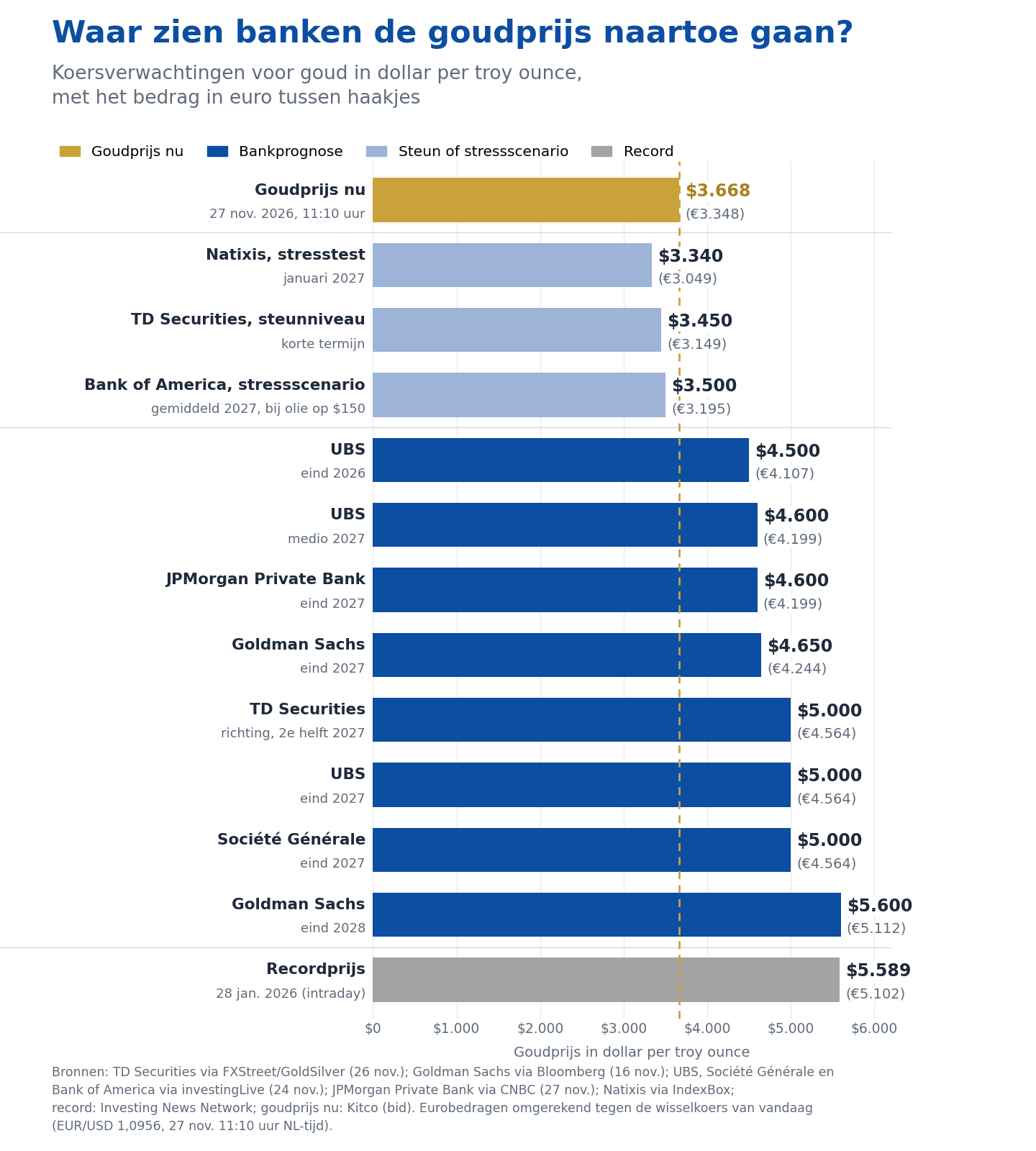 Gold price forecasts from major banks, with euro equivalents calculated using today’s exchange rate (sources: Bloomberg, investingLive, CNBC, GoldSilver)
While investors were largely focused on the Fed and Nvidia this week, the Dutch central bank (De Nederlandsche Bank, or DNB) issued a warning on Tuesday with implications much closer to home. In its twice-yearly Financial Stability Report, DNB warns that risks to the financial system are mounting. Cyberattacks are becoming more frequent, with AI making them faster and more powerful. Speaking to the Dutch newspaper AD, DNB President Olaf Sleijpen described the risk of a major and prolonged systems outage as “not a red alert, but a very dark shade of amber”. He once again urged Dutch households to keep enough cash at home to cover at least three days.
Equity markets themselves are also a source of concern for DNB. Share prices could fall sharply if returns on AI investment fail to live up to lofty expectations. Moreover, many financial institutions are reliant on a small group of technology companies. Dutch pension funds have around €120 billion invested in US technology stocks, accounting for nearly half of their listed equity holdings. This week’s saga surrounding Nvidia chief executive Jensen Huang demonstrated just how vulnerable markets are to this concentration.
The vulnerabilities highlighted by DNB are precisely why many people choose to hold physical gold. A gold bar or coin does not depend on a functioning payment system, a server or a handful of technology companies. It is not a digital balance but a tangible asset that belongs entirely to you, even if you choose to have it stored in a secure vault. Physical gold provides a long-term buffer in a financial system where, as the regulator itself points out, risks are increasingly materialising at the same time.