9.3
8.521 reviews

English
EN


Billionaire investor Warren Buffett has seen shares on a large scale in recent months Sold. Even during the recovery rally that followed, he did not return to the stock market. Instead of buying stocks, he further expanded the cash position of his investment firm Berkshire Hathaway, to $137 billion. He sold shares of financial institutions, energy companies and airlines, among others, sectors that have been hit hardest by the corona crisis.
Buffett surprised friend and foe alike by not getting in after the sharp stock correction in February and March. Globally, stock markets have recovered about half of the losses, while the US S&P 500 has already made up almost two-thirds of the losses. Yet billionaire Buffett does not dare to step in this time, even though he did so during the financial crisis of 2008. Then, in the depths of the crisis, he wrote for the New York Times Another op-ed titled "Buy American. I am.' At the time, he bought billions worth of shares in financial institutions and chemical companies, among others.
The fact that a seasoned value investor like Warren Buffett does not take advantage of the stock market correction is remarkable. Normally, these are the times when you, as an investor, can buy shares at a very attractive price. The fact that the billionaire is keeping his powder dry for a while suggests that he is counting on a deterioration in the stock market climate. Instead of buying shares, he calmly waits for a real buying opportunity.
Stock markets worldwide bottomed out around March 23, thanks in part to central bank intervention. The Fed and the ECB announced large-scale bond-buying programs, halting the decline. Stock prices then quickly went up again, Driven by retail investors. Over the past few weeks, they even stood in line to buy shares.
Stock prices fell sharply in February and March, but for good reason. Many companies have sharply lowered their profit expectations due to the corona crisis, which means that the price/earnings ratio is not that favorable at all. Certainly not after the powerful recovery rally we have seen since the end of March.
According to the latest figures from Factset the S&P 500's earnings per share have already fallen by 23% due to the coronavirus crisis. The forward P/E ratio of the US stock market is currently 21. This makes US equities more expensive than the average of both the past five and ten years. That picture is probably not much better for most European equity markets.
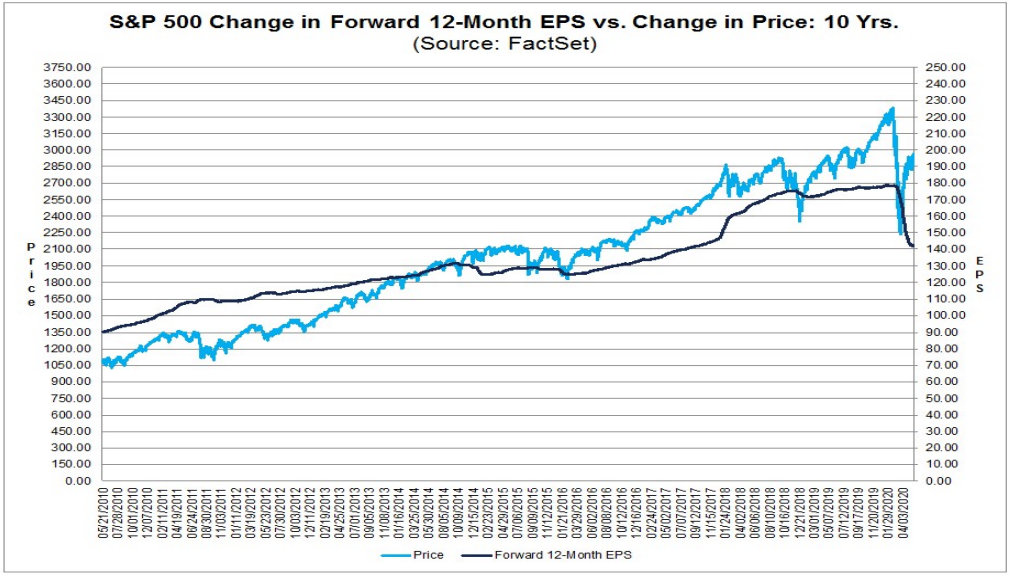
Expected corporate profits have fallen sharply, but stock prices are rising again (Source: Factset)
An investor like Warren Buffett also looks at these numbers and sees that stocks are not that attractively valued at the moment. If corporate earnings remain at current levels, the likelihood of a new correction is very high. Especially if the economic outlook does not improve, but rather deteriorates. We understand that Buffett is not eager to buy shares now.
This contribution was made from Geotrendlines


