9.3
8.524 reviews

English
EN


The Gold price has broken through the $2,000 per troy ounce barrier for the first time in history this week. That's a little over a week after the old all-time high of $1,920 was passed. Investors are fleeing to gold because of its safe-haven status. It is also one of the few investments that can compete with government bonds in terms of liquidity.
The price of the precious metal has been in a strong uptrend for more than a year as investors worry about the economic outlook. Last year, we already saw the first signs of stress in the financial system. In August, the yield curve inverted, a signal that is often an indication of a new crisis. A month later, the repo market became turbulent as interest rates skyrocketed due to a shortage of safe collateral.
Central banks had to intervene to calm the market. The Federal Reserve stopped reducing its balance sheet and pumped hundreds of billions of dollars into the Repo Market. Around the same time, the ECB announced its plans to buy debt again, at a pace of €20 billion per month. In the midst of this uncertainty, the price of gold was already starting to rise.
The situation seemed to be under control again at the end of last year, but was abruptly disrupted by the corona crisis at the beginning of this year. Measures to prevent the spread of the virus worsened the global economic outlook. Investors fled equities and into traditional safe havens such as government bonds and gold. At one point in March, share prices were more than 30% lower than at the beginning of this year.
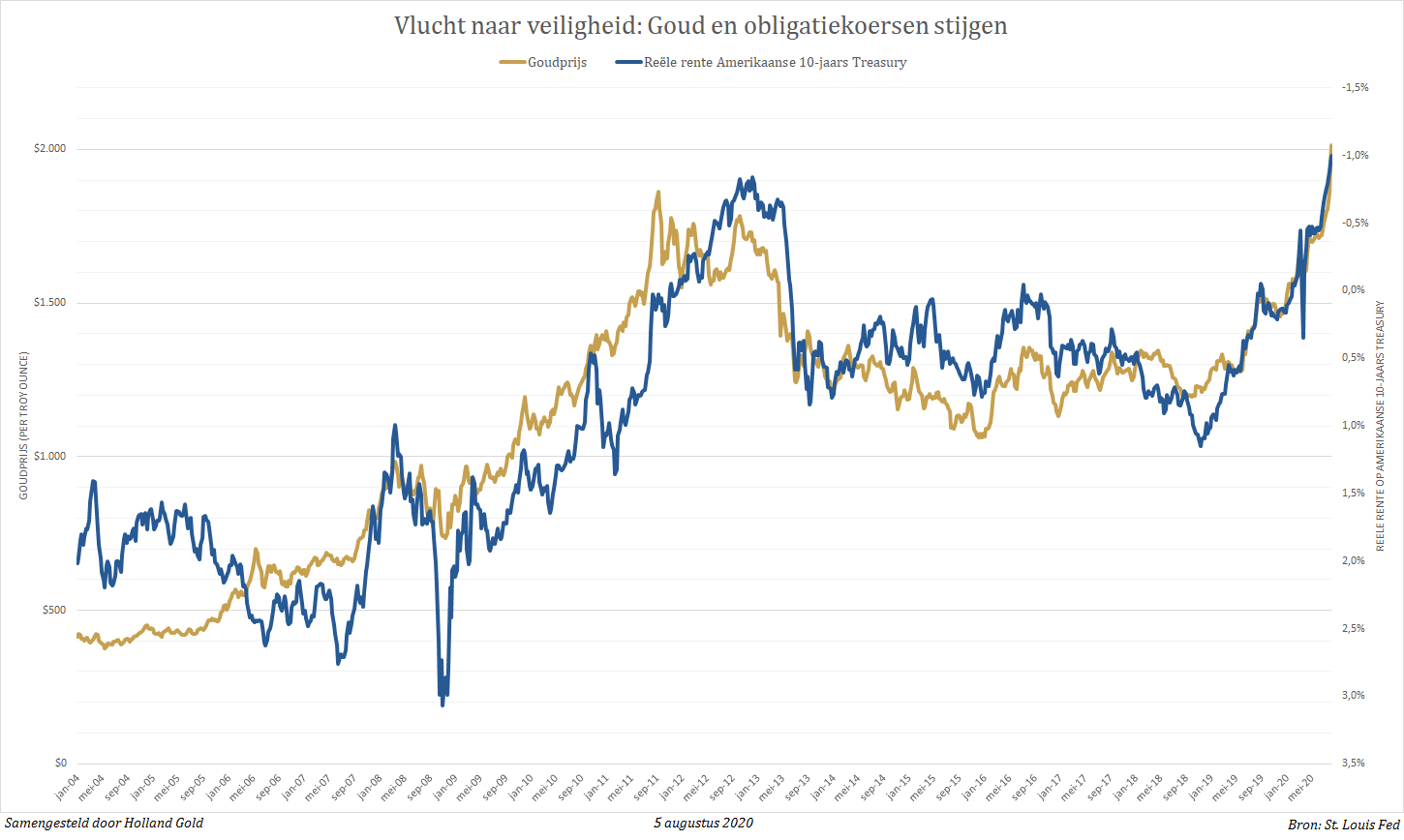
Investors are fleeing to liquidity from government bonds and gold (click for larger version)
From the low point of late March, the stock market managed to recover, but there is still no sign of a recovery in the global economy. This is also evident from the price development of safe havens such as government bonds and gold, which have only risen further since the depths of the crisis.
Since then, we have seen a strong correlation between the real interest rate on government bonds and the price of gold. For example, the yield on US 10-year Treasuries recently fell to a new low of 0.52%. According to calculations by Deutsche Bank, this is the lowest level in more than 200 years. Yields on U.S. 10-year inflation-adjusted bonds hit a low of -1% late last week. Records are also being broken in the bond market.
These extremely low interest rates make gold an attractive alternative to government bonds. This is reflected in the gold price, which has risen extra fast in recent weeks. For example, the gold price rose from $1,800 to $1,900 per troy ounce in just six trading days. The step to this milestone of $2,000 per troy ounce took only a few days longer.
Negative interest rates on government bonds signal a high level of distrust among investors. Despite all the promises made by central banks and the many billions in monetary easing, the economic outlook remains gloomy. The threat of a second wave of the coronavirus has gripped the market, while central banks can do little more. This combination of factors gives the gold price an extra stimulus that will not weaken for the time being.
This contribution comes from Geotrendlines


